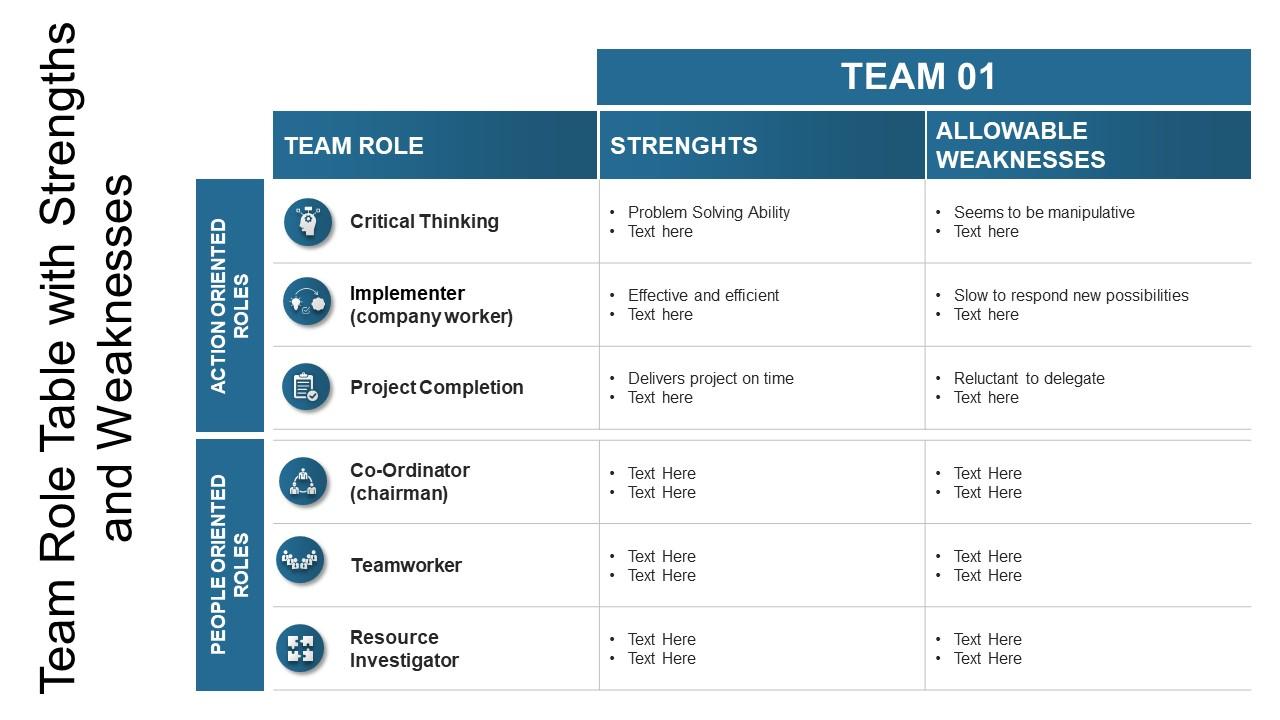
Tabla de roles de equipo con fortalezas y debilidades
Try Before you Buy Download Free Sample Product
Audience
Editable
of Time
Nuestra tabla de roles de equipo con fortalezas y debilidades es explícita y efectiva. Combinan claridad y expresión concisa.
Características de estas diapositivas de presentación de PowerPoint:
Presentando este conjunto de diapositivas con el nombre Tabla de roles del equipo con fortalezas y debilidades. Los temas que se tratan en estas diapositivas son Finalización de proyectos de pensamiento crítico, Implementador, Coordinador, Trabajador en equipo, Investigador de recursos. Esta es una presentación de PowerPoint completamente editable y está disponible para su descarga inmediata. Descárguelo ahora e impresione a su audiencia.
People who downloaded this PowerPoint presentation also viewed the following :
Tabla de roles de equipo con fortalezas y debilidades con las 2 diapositivas:
Dale a tu audiencia una experiencia satisfactoria. Encontrarán nuestra tabla de roles de equipo con fortalezas y debilidades elevándose.
FAQs for Team role table with
High-performing teams typically include leaders who provide direction and accountability, subject matter experts who deliver specialized knowledge, collaborators who facilitate communication and coordination, innovators who drive creative problem-solving, and executors who ensure reliable task completion. These complementary roles work synergistically by balancing strategic vision with operational excellence, fostering knowledge sharing across departments, and ultimately delivering faster project timelines, higher quality outcomes, and sustained competitive advantage through diverse skill integration.
Understanding team roles enhances communication by establishing clear expectations, defining responsibilities, reducing overlap, and creating accountability structures within collaborative environments. When team members recognize their specific contributions and those of colleagues, organizations experience improved workflow coordination, minimized conflicts, and enhanced project outcomes, with many finding that role clarity ultimately delivers faster decision-making and stronger team cohesion.
When assigning team roles, consider individual strengths, skills, experience levels, workload capacity, and personality compatibility with specific responsibilities. Strategic role allocation also requires evaluating communication styles, leadership potential, and complementary expertise across functions, with many high-performing teams finding that diverse skill combinations and clear accountability structures ultimately deliver enhanced collaboration and measurable performance outcomes.
Individual strengths and weaknesses significantly shape team dynamics by determining optimal role allocation, task distribution, and collaborative approaches within organizations. Teams that strategically leverage diverse skill sets, complement individual limitations through partnership structures, and align responsibilities with natural competencies deliver enhanced performance, streamlined workflows, and ultimately achieve superior project outcomes across various business environments.
Role clarity significantly enhances team efficiency by reducing task duplication, minimizing conflicts, and streamlining decision-making processes across all organizational levels. Through well-defined responsibilities, teams deliver faster project completion, improved resource allocation, and enhanced accountability, with many organizations finding that clear role definitions ultimately reduce operational costs while boosting overall productivity and employee satisfaction.
Team leaders effectively identify unique skills through regular one-on-one assessments, skills mapping exercises, project observation, and open feedback sessions that reveal individual strengths and preferences. By strategically aligning these discovered talents with specific project roles, delegating tasks that match natural abilities, and creating cross-functional opportunities, leaders enhance team performance while fostering individual growth and engagement.
Cultural differences affect team roles through varying communication styles, decision-making approaches, hierarchy expectations, conflict resolution methods, and collaboration preferences. These differences can create both challenges and opportunities, with many international organizations finding that diverse cultural perspectives enhance problem-solving capabilities, drive innovation, and ultimately deliver competitive advantages when managed strategically.
Teams can navigate role conflicts by establishing clear role definitions upfront, implementing regular communication channels, and creating structured conflict resolution processes. Through transparent dialogue and flexible role adjustments, organizations in sectors like software development and consulting find that addressing overlapping responsibilities early prevents project delays, while fostering collaborative problem-solving ultimately enhances team cohesion and project outcomes.
Emotional intelligence significantly influences team role effectiveness by enhancing communication, conflict resolution, and interpersonal dynamics within collaborative environments. Team members with strong emotional intelligence excel in leadership positions, client-facing roles, and cross-functional coordination, while enabling better role alignment, reducing workplace tensions, and ultimately delivering improved project outcomes and organizational performance.
Regular assessments of team roles drive continuous improvement by identifying skill gaps, optimizing resource allocation, and enhancing collaboration effectiveness through structured feedback loops. These evaluations enable organizations to reallocate responsibilities strategically, develop targeted training programs, and strengthen cross-functional partnerships, with many teams finding that quarterly role reviews ultimately deliver improved productivity, reduced bottlenecks, and enhanced competitive advantage.
Teams can minimize role redundancy through clear role definition, strategic skill mapping, regular responsibility audits, and cross-functional collaboration frameworks. By implementing structured communication protocols and leveraging project management tools, organizations streamline workflows, eliminate duplicate efforts, and enhance operational efficiency, with many finding that well-defined roles ultimately deliver faster project completion and improved resource allocation.
Remote teams can effectively define team roles through digital collaboration platforms, clear documentation systems, virtual role-mapping sessions, and regular check-ins via video conferencing. These approaches streamline accountability by establishing transparent responsibilities, enabling seamless task delegation, and maintaining consistent communication channels, with many organizations finding that structured digital frameworks ultimately deliver enhanced productivity and stronger team cohesion.
Signs of role ambiguity include unclear responsibilities, overlapping duties, conflicting priorities, lack of decision-making authority, and frequent miscommunication between team members. These issues can be addressed by establishing clear job descriptions, defining reporting structures, creating accountability frameworks, and conducting regular role clarification meetings, ultimately delivering improved productivity and reduced workplace confusion.
Teams can adapt their roles by establishing flexible role definitions, cross-training members in multiple competencies, implementing regular role assessments, and maintaining open communication channels about shifting priorities. Through agile frameworks and dynamic resource allocation, organizations streamline project delivery while enhancing team versatility, with many finding that role flexibility ultimately delivers faster adaptation times and improved project outcomes.
Teams can leverage role assessment frameworks like RACI matrices, Belbin Team Roles, and DISC assessments, alongside project management tools such as Asana, Monday.com, and Microsoft Project. These frameworks enable organizations to map individual strengths to project requirements, clarify accountability structures, and optimize resource allocation, with many finding that strategic role alignment significantly enhances project outcomes and team performance.
No Reviews