Cronograma Para Serviços de Desenvolvimento Web Ppt Powerpoint Presentation Gallery Arquivos

Rating:
90%
Timeframe for web development services ppt powerpoint presentation gallery files
Slide 1 of 2
Favourites Favourites

Try Before you Buy Download Free Sample Product

Audience Impress Your
Audience
Editable 100%
Editable
Time Save Hours
of Time
The Biggest Sale is ending soon in
0
0
:
0
0
:
0
0
Rating:
90%

Características destes slides de apresentação do PowerPoint:

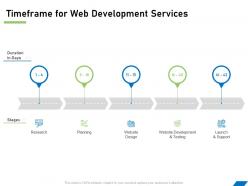
Apresentando este conjunto de slides com o nome Timeframe For Web Development Services Ppt Powerpoint Presentation Gallery Files. Este é um processo de cinco etapas. As etapas desse processo são Pesquisa, Planejamento, Design do Site, Desenvolvimento e Teste do Site, Lançamento e Suporte. Esta é uma apresentação PowerPoint completamente editável e está disponível para download imediato. Baixe agora e impressione seu público.

People who downloaded this PowerPoint presentation also viewed the following :

FAQs for Timeframe for web development services ppt powerpoint

Key stages include project planning and requirements gathering, design and wireframing, development and coding, testing and quality assurance, and deployment with ongoing maintenance. These phases streamline project delivery by establishing clear objectives, creating user-focused interfaces, and ensuring robust functionality, with many organizations finding that structured timelines reduce costs while accelerating launch schedules.

Project requirements significantly influence web development timelines by determining scope complexity, feature specifications, integration needs, and resource allocation demands. Complex e-commerce platforms with payment gateways, user authentication, and inventory management naturally require more development time than basic informational websites, with many businesses finding that clearly defined requirements upfront streamline development processes and ultimately deliver faster, more cost-effective outcomes.

Client feedback significantly influences web development timelines by triggering revisions, scope adjustments, and iterative refinements throughout the design, development, and testing phases. Timely, specific feedback accelerates project completion, while delayed or extensive revision requests can extend timelines, with many development teams finding that structured feedback loops and clear approval processes ultimately streamline delivery and enhance client satisfaction.

Agile methodologies significantly accelerate web development schedules by enabling iterative development cycles, continuous client feedback, and adaptive planning throughout the project lifecycle. Through sprint-based workflows, development teams deliver functional components faster, reduce revision cycles, and maintain flexibility for scope changes, with many organizations finding that agile approaches ultimately streamline timelines while enhancing final product quality.

Common web development delays include scope creep, unclear requirements, client feedback bottlenecks, technical integration challenges, and resource allocation issues. These obstacles often compound throughout projects, with many development teams finding that establishing clear communication protocols, defining detailed specifications upfront, and implementing agile methodologies significantly streamlines delivery timelines while enhancing client satisfaction.

Scope creep significantly impacts web development timelines by introducing unplanned features, design changes, and functionality requests that extend project duration and resource allocation. While these additions can enhance the final product, they often delay deliverables, increase costs, and strain team resources, with many development agencies finding that clear scope documentation and change management processes ultimately protect both timeline integrity and client relationships.

**INPUT**: What tools and technologies can help streamline the web development timeline? **OUTPUT**: Timeline optimization tools include project management platforms, automated testing frameworks, CI/CD pipelines, code repositories, and collaborative design systems. These technologies streamline development by automating deployments, enabling real-time collaboration, and minimizing manual processes, with many development teams finding that integrated workflows reduce project timelines by 30-40% while enhancing code quality. [Word count: 54 words]

E-commerce sites typically require 3-6 months due to complex payment systems, inventory management, and security requirements, while blogs can be completed in 2-4 weeks with simpler content management needs. Corporate websites usually fall between these extremes at 6-12 weeks, with timeline variations depending on custom functionality, integrations with existing business systems, and compliance requirements, ultimately delivering solutions tailored to each sector's specific operational demands.

Web development phases typically span 8-16 weeks total, with planning requiring 1-2 weeks, design taking 2-4 weeks, development consuming 4-8 weeks, and testing/launch needing 1-2 weeks. These timelines vary significantly based on project complexity, with e-commerce platforms and enterprise solutions often requiring extended development periods, while simple business websites can be streamlined considerably, ultimately delivering faster market entry and competitive positioning.

Effective communication is crucial for web development timeline adherence, as it ensures clear requirements gathering, prevents scope creep, facilitates rapid issue resolution, and maintains stakeholder alignment throughout the project lifecycle. Through regular updates, milestone reviews, and transparent feedback loops, development teams streamline decision-making processes, minimize costly revisions, and deliver projects on schedule, ultimately enhancing client satisfaction and operational efficiency.

Testing and quality assurance should comprise 20-30% of total development time, with unit testing ongoing throughout development, integration testing spanning 1-2 weeks, and user acceptance testing requiring another 1-2 weeks. This strategic timeline allocation enables development teams to identify issues early, reduce post-launch fixes, and deliver robust applications, with many organizations finding that comprehensive testing ultimately accelerates market deployment.

Post-launch services and maintenance typically begin immediately after deployment and continue indefinitely, representing an ongoing phase rather than a discrete timeline segment. These services encompass regular updates, security patches, performance optimization, and content management, with many organizations finding that proactive maintenance significantly reduces long-term costs while ensuring optimal user experiences and competitive digital presence.

Custom web development timeline estimation should consider project complexity, feature requirements, design specifications, third-party integrations, and team size. These factors significantly impact delivery schedules, with many development teams finding that thorough requirement gathering, realistic scope definition, and buffer time for testing ultimately streamline project execution and enhance client satisfaction.

Team size and expertise level significantly impact web development speed by determining resource allocation, task distribution efficiency, and problem-solving capabilities. Larger teams with specialized expertise can parallelize development processes, streamline complex integrations, and minimize debugging time, while experienced developers deliver faster coding, better architecture decisions, and reduced revision cycles, ultimately accelerating project timelines and enhancing delivery quality.

Clients can help ensure project schedules by providing timely feedback, delivering content and assets promptly, maintaining clear communication channels, and making decisions quickly when approvals are needed. By establishing dedicated project contacts, preparing materials in advance, and responding to developer queries within agreed timeframes, organizations streamline workflows and minimize delays, ultimately accelerating launch timelines while maintaining quality standards.

Ratings and Reviews

90% of 100
Review Form
Write a review
Most Relevant Reviews
  1. 100%

    by Liam Perez

    Unique and attractive product design.
  2. 80%

    by Darin Chen

    Nice and innovative design.

2 Item(s)

per page: