Timeline of architecture project with activities overlap
Try Before you Buy Download Free Sample Product
Audience
Editable
of Time
Our Timeline Of Architecture Project With Activities Overlap are topically designed to provide an attractive backdrop to any subject. Use them to look like a presentation pro.
People who downloaded this PowerPoint presentation also viewed the following :
Content of this Powerpoint Presentation
Description:
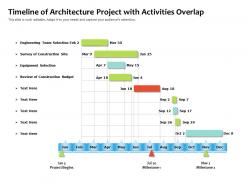
The image depicts a Gantt chart presentation slide titled "Timeline of Architecture Project with Activities Overlap." It serves as a visual representation of a project's schedule, indicating the start and end dates of individual tasks. Key elements of the slide include:
Title:Â
"Timeline of Architecture Project with Activities Overlap"
Editable Note:Â
Indicates the slide is fully editable, allowing customization according to project needs.
Task Lines:Â
Represent different project tasks or stages, with checkboxes on the left. Two tasks are explicitly mentioned, while five placeholders labeled "Text Here" allow for additional activities.
Timeline Bars:Â
Each task is associated with a colored bar on the timeline, indicating its duration. Task durations may span multiple months, with specific dates provided (e.g., "Feb 2 - Mar 30" for Engineering Team Selection).
Timeline Duration:Â
Runs from January to December, with markers indicating the project's start on January 3rd and milestones on July 20th and November 2nd.
Use Cases:
This project management slide can be applied across various industries for structured timeline planning. Here are seven specific industries and their potential uses:
1. Construction:
Use: Plan and track key project phases and milestones.
Presenter: Project Manager.
Audience: Construction Team, Stakeholders.
2. Technology Development:
Use: Outline software release schedules and development cycles.
Presenter: Product Manager.
Audience: Development Team, Investors.
3. Event Planning:
Use: Schedule tasks for event organization and critical deadlines.
Presenter: Event Coordinator.
Audience: Event Staff, Vendors, Sponsors.
4. Manufacturing:
Use: Monitor product development and manufacturing processes.
Presenter: Operations Manager.
Audience: Production Team, Quality Assurance.
5. Pharmaceuticals:
Use: Manage clinical trial phases, regulatory submissions, and product launch timelines.
Presenter: Clinical Project Manager.
Audience: Research Team, Regulatory Affairs, Executives.
6. Marketing and Advertising:
Use: Track campaign development, media buys, and launch events.
Presenter: Marketing Director.
Audience: Marketing Team, Creative Agencies, Clients.
7. Education:
Use: Plan academic program implementations, facility renovations, or event calendars.
Presenter: Academic Administrator.
Audience: Faculty, Staff, Department Heads.
Timeline of architecture project with activities overlap with all 2 slides:
Use our Timeline Of Architecture Project With Activities Overlap to effectively help you save your valuable time. They are readymade to fit into any presentation structure.
FAQs for Timeline of architecture project
Architecture project timelines should include schematic design, design development, construction documentation, permitting and approvals, bidding and contractor selection, and construction phases. These phases enable architects to systematically progress from initial concepts to final delivery, with many firms finding that structured timelines enhance client communication, resource allocation, and project coordination, ultimately delivering predictable outcomes and competitive project management.
Gantt charts enhance architecture timeline visualization by displaying project phases, task dependencies, resource allocation, and critical milestones in a clear, chronological format. These visual tools enable architecture teams to streamline project coordination, identify potential bottlenecks, and communicate progress effectively to clients and stakeholders, ultimately delivering improved project transparency and enhanced deadline management across complex construction phases.
Delays in architecture project timeline stem from design revisions, permit approvals, material procurement issues, weather conditions, and coordination challenges between contractors. These factors often compound in complex projects, with many construction firms finding that inadequate initial planning, scope changes, and regulatory compliance requirements significantly impact schedules, ultimately affecting project budgets and client satisfaction across residential and commercial developments.
Client approvals significantly impact architectural project timelines by creating potential delays at each design phase, from initial concepts through construction documentation and permitting stages. While necessary for project success, approval bottlenecks can extend timelines by weeks or months, with many architectural firms finding that establishing clear approval processes and decision deadlines ultimately streamlines project delivery and enhances client satisfaction.
Site analysis plays a foundational role in project timeline development by identifying potential constraints, environmental factors, soil conditions, zoning requirements, and accessibility challenges early in the process. Through comprehensive site evaluation, architects can anticipate construction complexities, permitting delays, and infrastructure needs, ultimately enabling more accurate scheduling and resource allocation while minimizing costly timeline disruptions during later project phases.
Stakeholders should receive updates weekly during active phases and bi-weekly during planning or documentation phases, with critical milestones requiring immediate communication. This structured approach ensures transparency and alignment while preventing information overload, with many architecture firms finding that consistent communication reduces revisions, accelerates approvals, and ultimately delivers projects on schedule and within budget.
Project management software like Microsoft Project, Primavera P6, Asana, and Trello are most effective for creating architecture project timelines, along with specialized tools like ArchiCAD and Revit for design-integrated scheduling. These platforms streamline project coordination by enabling task dependencies, resource allocation, and real-time collaboration, with many architecture firms finding that integrated scheduling ultimately delivers faster project completion and enhanced client communication.
Risk management integrates into architecture project timelines through early identification phases, regular assessment checkpoints, contingency buffer allocations, and milestone-based reviews throughout design and construction stages. These strategic approaches enable firms to anticipate potential delays, budget overruns, and regulatory challenges, while maintaining project momentum, ultimately delivering more predictable outcomes and enhanced client satisfaction.
**INPUT**: What strategies can be employed to streamline the timeline without compromising quality? **OUTPUT**: Timeline optimization strategies include parallel task execution, pre-approved material selections, standardized design templates, advanced project management software, and early stakeholder engagement. These approaches streamline workflows by reducing revision cycles, minimizing decision delays, and enhancing coordination between architects, contractors, and clients, with many firms finding that strategic planning ultimately delivers faster project completion while maintaining design excellence. [Word count: 58 words]
Regulatory approvals significantly extend project timelines through permit processing, plan reviews, and compliance verification, often adding 3-6 months depending on project complexity and jurisdiction requirements. These approvals present both challenges and opportunities, with many architectural firms finding that early engagement with regulatory bodies, thorough documentation, and proactive compliance planning ultimately streamline approvals and minimize costly delays.
Milestone tracking provides critical checkpoints that monitor project progress, resource allocation, budget adherence, and quality standards throughout architectural development phases. It enables project managers to identify potential delays early, reallocate resources strategically, and maintain stakeholder communication, with many architecture firms finding that structured milestone systems reduce project overruns by 20-30% while enhancing client satisfaction.
Interdisciplinary collaboration can significantly accelerate project timelines by streamlining communication, reducing design conflicts, and enabling parallel workflows across architectural, engineering, and construction teams. When architects, engineers, contractors, and consultants work cohesively from project inception, organizations experience fewer costly revisions, faster approval processes, and seamless integration of building systems, ultimately delivering projects on schedule while maintaining quality standards.
Common pitfalls include underestimating design phases, inadequate stakeholder consultation periods, insufficient buffer time for revisions, overlooking permit approval delays, and failing to coordinate with engineering consultants. These oversights often derail project schedules by creating cascading delays, budget overruns, and client dissatisfaction, with many architectural firms finding that front-loaded planning ultimately delivers smoother execution and stronger client relationships.
Unforeseen challenges should be addressed through built-in buffer periods, typically 15-20% of total project duration, flexible milestone adjustments, and proactive risk assessment protocols. These contingency strategies enable architects and project managers to accommodate design revisions, permit delays, and material shortages while maintaining client expectations, ultimately delivering successful projects within realistic timeframes.
Best practices for timeline adjustments include establishing change control processes, building buffer time into schedules, maintaining clear communication protocols, and implementing phased review checkpoints. These approaches enable project teams to assess scope modifications systematically, reallocate resources efficiently, and communicate impacts transparently to stakeholders, ultimately delivering successful outcomes while minimizing delays and budget overruns.
No Reviews