Transformative learning ppt powerpoint presentation outline show cpb

Rating:
80%
Transformative learning ppt powerpoint presentation outline show cpb
Slide 1 of 2
Favourites Favourites

Try Before you Buy Download Free Sample Product

Audience Impress Your
Audience
Editable 100%
Editable
Time Save Hours
of Time
The Biggest Sale is ending soon in
0
0
:
0
0
:
0
0
Rating:
80%
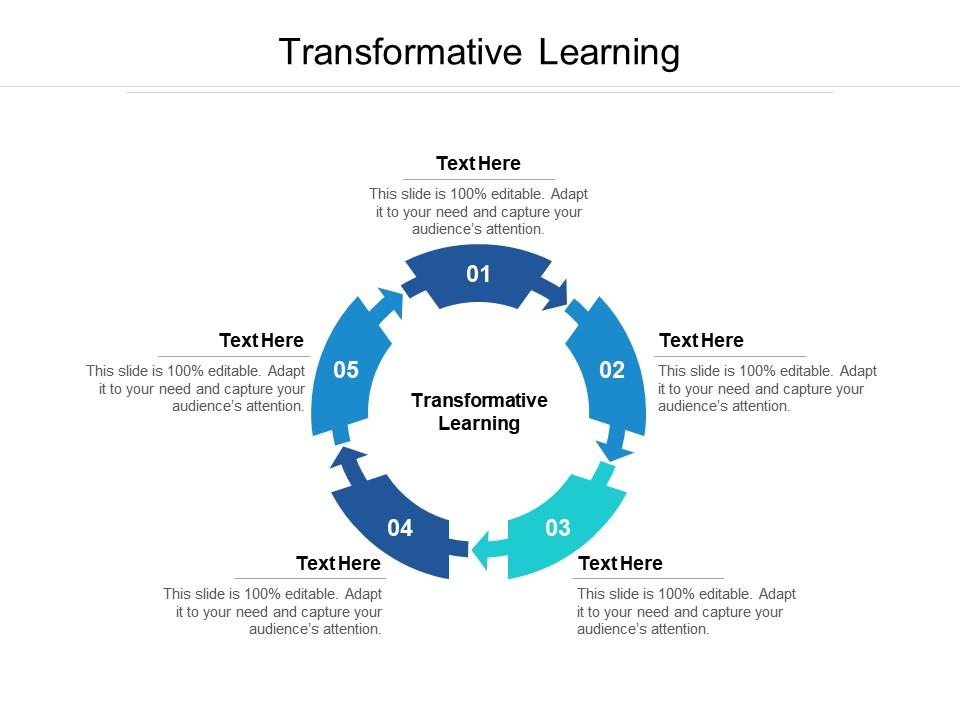
Presenting our Transformative Learning Ppt Powerpoint Presentation Outline Show Cpb PowerPoint template design. This PowerPoint slide showcases five stages. It is useful to share insightful information on Transformative Learning This PPT slide can be easily accessed in standard screen and widescreen aspect ratios. It is also available in various formats like PDF, PNG, and JPG. Not only this, the PowerPoint slideshow is completely editable and you can effortlessly modify the font size, font type, and shapes according to your wish. Our PPT layout is compatible with Google Slides as well, so download and edit it as per your knowledge.

People who downloaded this PowerPoint presentation also viewed the following :

FAQs for Transformative learning ppt powerpoint presentation

Transformative learning principles include critical reflection on assumptions, engaging diverse perspectives, questioning existing beliefs, collaborative dialogue, and applying new insights to real-world contexts. Unlike traditional models focused on knowledge transfer, transformative learning empowers individuals to fundamentally shift their worldview, with many organizations finding that employees develop enhanced problem-solving capabilities, adaptability, and innovation skills.

Educators can facilitate transformative learning by incorporating diverse perspectives, encouraging critical reflection, creating safe dialogue spaces, using real-world problem-solving scenarios, and connecting learning to students' personal experiences. These approaches enable students from varied backgrounds to challenge assumptions, develop empathy, and construct new understanding through collaborative inquiry, ultimately fostering deeper engagement and more meaningful educational outcomes.

Transformative learning fundamentally reshapes adult education by encouraging critical reflection, challenging assumptions, and fostering perspective transformation, while conventional methods focus primarily on knowledge transmission and skill acquisition. This approach enables adult learners to question existing beliefs, integrate personal experiences with new concepts, and develop autonomous thinking capabilities, ultimately delivering more engaged learners and sustainable behavioral changes compared to traditional instructional approaches.

Reflection serves as the critical catalyst in transformative learning by enabling individuals to examine their assumptions, question existing beliefs, and integrate new perspectives with previous experiences. Through reflective practices, learners systematically evaluate their thought processes, identify knowledge gaps, and reconstruct understanding, with many educational institutions finding that structured reflection accelerates deeper learning outcomes and sustainable behavioral change.

Technology enhances transformative learning through immersive simulations, AI-powered personalized pathways, virtual reality experiences, collaborative digital platforms, and real-time feedback systems. These tools enable deeper self-reflection, experiential practice, and perspective-shifting scenarios, with educational institutions and corporate training programs finding that technology-enhanced approaches accelerate meaningful behavioral change and critical thinking development.

Educators face challenges including resistance to change, limited resources, inadequate training, rigid curricula, and varying student readiness when implementing transformative learning strategies. These obstacles can be overcome through comprehensive professional development, phased implementation approaches, and administrative support, with many educational institutions finding that collaborative planning, technology integration, and flexible assessment methods ultimately deliver enhanced student engagement and improved learning outcomes.

Transformative learning influences personal and professional development by challenging existing assumptions, encouraging critical reflection, and fostering new perspectives that reshape how individuals approach problems and opportunities. Through this process, learners develop enhanced adaptability, stronger leadership capabilities, and improved decision-making skills, with many professionals finding that transformative experiences accelerate career advancement and enable more meaningful workplace contributions.

Effective assessment methods for transformative learning include reflective portfolios, critical incident analyses, learning journals, peer evaluations, and self-assessment rubrics. These approaches enable educators to measure perspective shifts, critical thinking development, and behavioral changes by tracking students' evolving worldviews, enhanced problem-solving abilities, and practical application of new insights, ultimately delivering deeper engagement and more meaningful educational outcomes.

Culture significantly shapes transformative learning by influencing individual worldviews, communication styles, social expectations, and the acceptable pace of personal change within communities. Different cultural contexts create varying levels of openness to questioning established beliefs, with collectivist societies often emphasizing group harmony while individualistic cultures encourage personal transformation, ultimately affecting how organizations and educational institutions design learning experiences that resonate across diverse populations.

Transformative learning revolutionizes lifelong education by fostering critical self-reflection, challenging existing assumptions, and developing autonomous learning capabilities that extend far beyond formal educational settings. This approach enables professionals to continuously adapt their perspectives, skills, and knowledge frameworks throughout their careers, with many organizations finding that employees who engage in transformative learning demonstrate enhanced problem-solving abilities and strategic thinking.

Organizations can adopt transformative learning by encouraging critical reflection on assumptions, fostering collaborative dialogue, promoting experiential learning opportunities, and creating psychological safety for questioning established practices. Through structured mentoring programs, cross-functional projects, and regular feedback sessions, companies like healthcare systems and financial institutions enhance employee adaptability, innovation, and problem-solving capabilities, ultimately delivering improved performance and competitive advantage.

Critical thinking and dialogue serve as catalysts for transformative learning by challenging existing assumptions, encouraging perspective-taking, and fostering deep reflection on beliefs and values. These processes enable learners to question established frameworks, engage with diverse viewpoints, and construct new understanding through collaborative discourse, ultimately delivering enhanced problem-solving capabilities and adaptive thinking skills that many educational institutions find essential for developing resilient, innovative leaders.

Transformative learning integrates into online environments through interactive discussions, reflective journaling, case-based scenarios, peer collaboration platforms, and multimedia storytelling tools. These digital approaches enable learners to challenge assumptions, explore diverse perspectives, and construct new understanding through virtual communities, ultimately delivering deeper engagement and critical thinking skills that many educational institutions find essential for meaningful online experiences.

Strategies to encourage a growth mindset in transformative learning include reframing challenges as opportunities, emphasizing process over outcomes, providing constructive feedback, celebrating effort and progress, and modeling continuous learning behaviors. These approaches enhance learner resilience, adaptability, and engagement by fostering curiosity, reducing fear of failure, and promoting self-reflection, with many educational institutions finding that this strategic combination ultimately delivers improved learning outcomes and stronger problem-solving capabilities.

Social interaction influences transformative learning by facilitating critical discourse, challenging assumptions through diverse perspectives, and creating supportive environments for examining beliefs. Through peer discussions, collaborative reflection, and shared experiences, learners engage in perspective-taking, receive constructive feedback, and develop new frameworks together, with many educational institutions finding that group-based learning accelerates personal transformation and deeper understanding.

Ratings and Reviews

80% of 100
Write a review
Most Relevant Reviews
  1. 80%

    by Roberts Roberts

    Very unique and reliable designs.

1 Item

per page: