Arten von Schulungen zu künstlicher Intelligenz Ppt
Try Before you Buy Download Free Sample Product
Audience
Editable
of Time
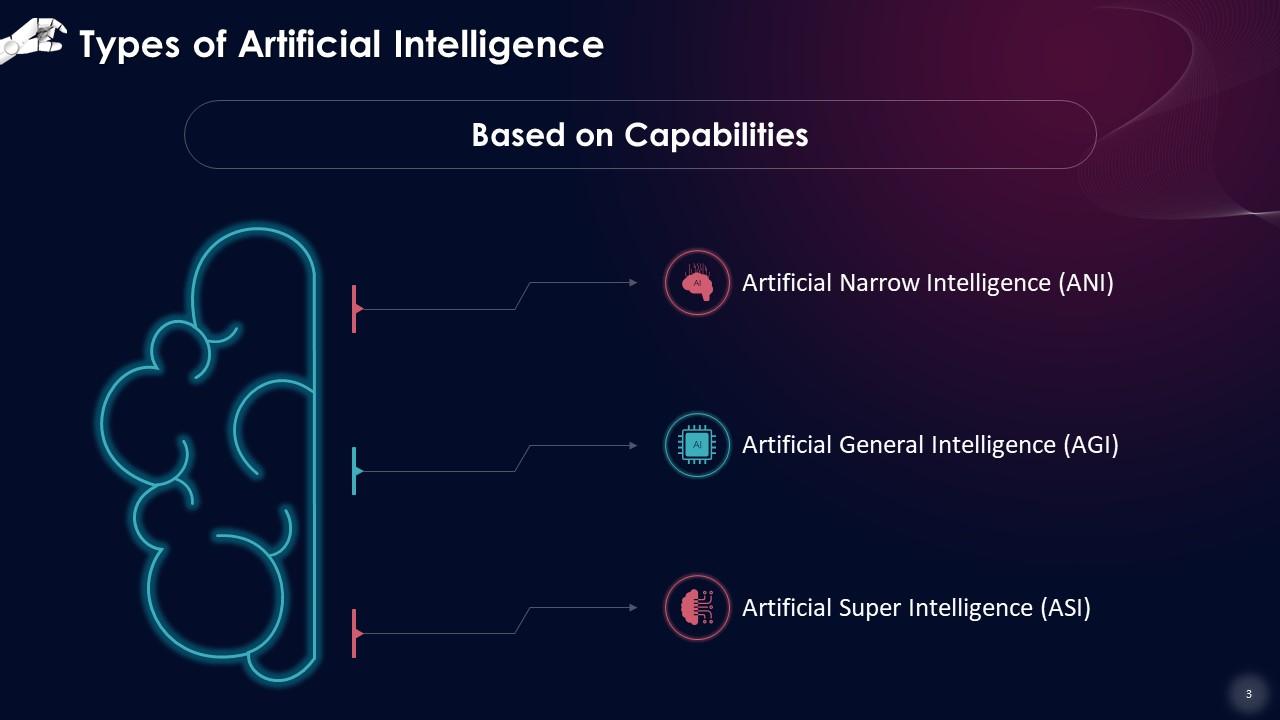
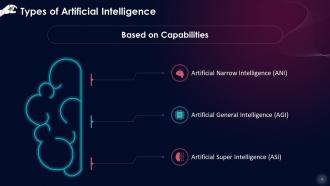
In diesem Foliensatz werden zwei Kategorien von KI basierend auf Funktionalität und Fähigkeiten besprochen. Zu den funktionalen Arten der KI gehören die begrenzte Theorie, die reaktive Maschine, die Theorie des Geistes und die selbstbewusste KI. Die zweite auf Fähigkeiten basierende Kategorie umfasst künstliche Narrow Intelligence (ANI), künstliche allgemeine Intelligenz (AGI) und künstliche Superintelligenz (ASI).
Merkmale dieser PowerPoint-Präsentationsfolien :
People who downloaded this PowerPoint presentation also viewed the following :
Inhalt dieser Powerpoint-Präsentation
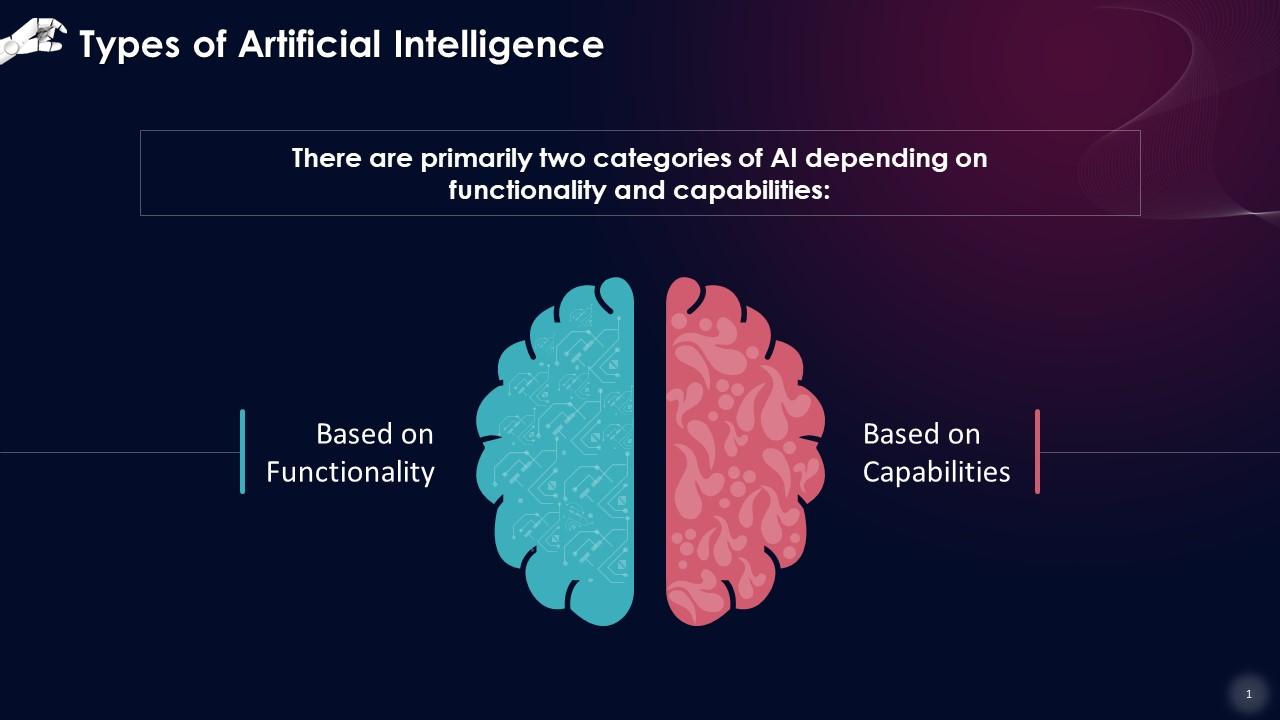
Folie 1
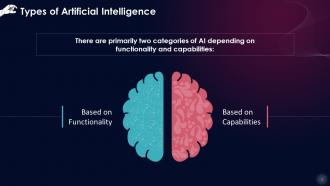
Diese Folie listet die Arten der künstlichen Intelligenz auf. Je nach Funktionalität und Fähigkeiten gibt es hauptsächlich zwei Kategorien von KI.
Folie 2
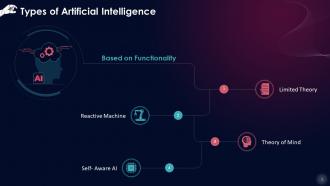
Diese Folie veranschaulicht, dass die funktionale Kategorisierung KI anhand ihrer Ähnlichkeit mit dem menschlichen Geist und ihrer Fähigkeit, wie Menschen zu denken und zu fühlen, klassifiziert. Die Funktionstypen der KI sind:
Hinweise für Kursleiter:
- Eingeschränkte Theorie: Diese Art von KI verfügt über Gedächtnisfähigkeiten, die es ihr ermöglichen, frühere Informationen/Erfahrungen zu nutzen, um bessere zukünftige Urteile zu fällen. Die meisten Anwendungen, die uns heute begegnen, passen in diese Kategorie. Diese KI-Anwendungen können trainiert werden, indem eine beträchtliche Menge an Trainingsdaten in einem Referenzmodell in ihrem Speicher gespeichert wird
- Reaktive Maschinen: Dies sind die grundlegendste und älteste Form der künstlichen Intelligenz. Diese simulieren die Fähigkeit eines Menschen, auf viele Arten von Eingaben zu reagieren. Da es dieser Art von KI an Gedächtnisleistung mangelt, kann sie nicht auf zuvor erworbene Informationen/Erfahrungen zugreifen, um bessere Ergebnisse zu erzielen
- Theorie des Geistes: Da diese Art von KI in unserem täglichen Leben kaum oder gar nicht präsent ist, befindet sie sich hauptsächlich im „Work in Progress“-Stadium und ist auf Forschungslabore beschränkt. Sobald diese Arten von KI erstellt sind, verfügen sie über ein umfassendes Verständnis des menschlichen Gehirns, einschließlich seiner Wünsche, Vorlieben, Emotionen, mentalen Prozesse usw. Die KI wird ihre Reaktion basierend auf ihrem Verständnis des menschlichen Gehirns und seiner Launen ändern
- Selbstbewusste KI: Es ist die letzte Stufe in der Entwicklung der KI. Seine Existenz ist spekulativ und kann nur in Science-Fiction-Filmen entdeckt werden. Diese Art von KI kann menschliche Emotionen und Gefühle verstehen und hervorrufen. Diese Arten von KI sind noch Jahrzehnte, wenn nicht Jahrhunderte davon entfernt, Realität zu werden. Dies ist die Art von KI, die Skeptiker wie Elon Musk beunruhigt. Sobald eine KI sich ihrer selbst bewusst wird, kann sie in den Selbsterhaltungsmodus wechseln; Es könnte die Menschheit als mögliche Bedrohung betrachten und direkt oder indirekt Anstrengungen unternehmen, um unsere Rasse auszulöschen
Folie 3
Diese Folie zeigt, dass die zweite Kategorisierungsmethode in der IT-Branche häufiger vorkommt und auf den Fähigkeiten der KI gegenüber der menschlichen Intelligenz basiert.
Hinweise für Kursleiter:
- ANI ist die höchste Stufe der KI, die wir bisher erreicht haben
- AGI steht für Artificial General Intelligence, manchmal auch als KI auf menschlicher Ebene bekannt
- ASI ist eine künstliche Superintelligenz, die in allen Disziplinen schärfer ist als der gesamte Intellekt der klügsten Menschen der Welt
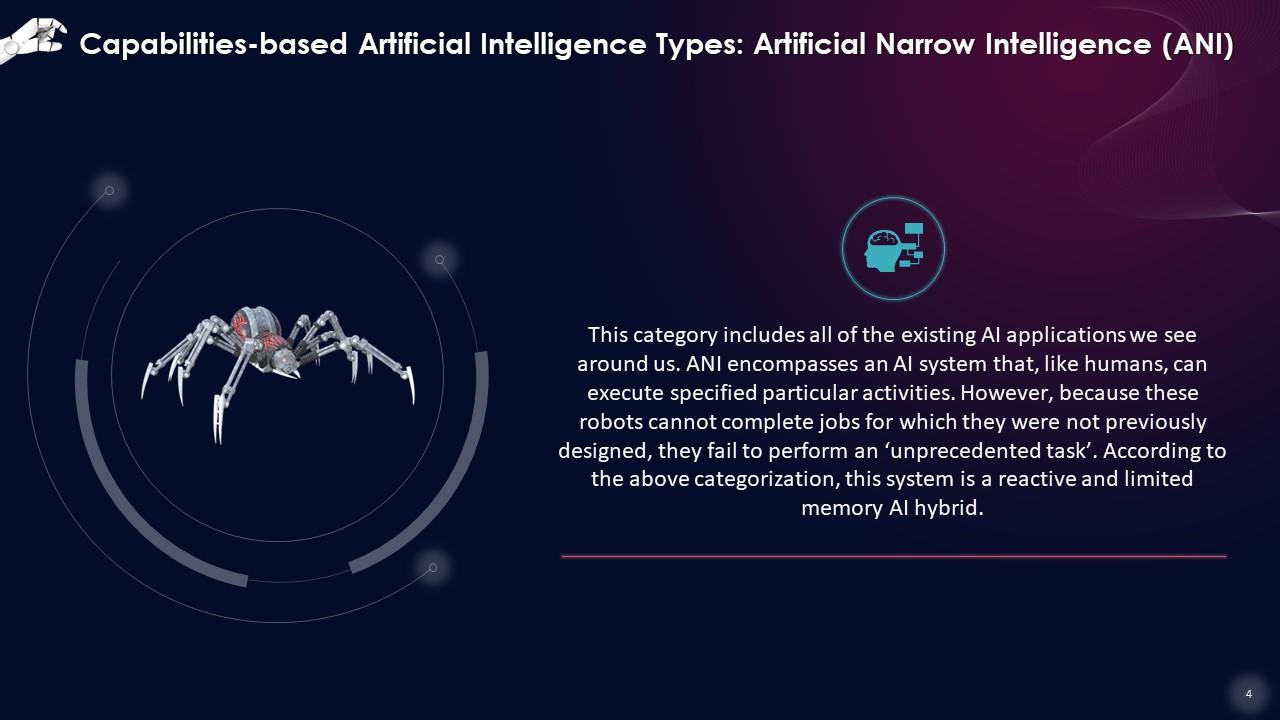
Folie 4
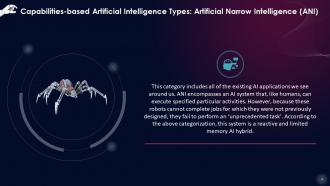
Diese Folie zeigt, dass künstliche Intelligenz ein KI-System umfasst, das wie Menschen bestimmte bestimmte Aktivitäten ausführen kann. Da diese Roboter jedoch keine Aufgaben erledigen können, für die sie nicht zuvor entwickelt wurden, können sie eine „beispiellose“ Aufgabe nicht erfüllen.
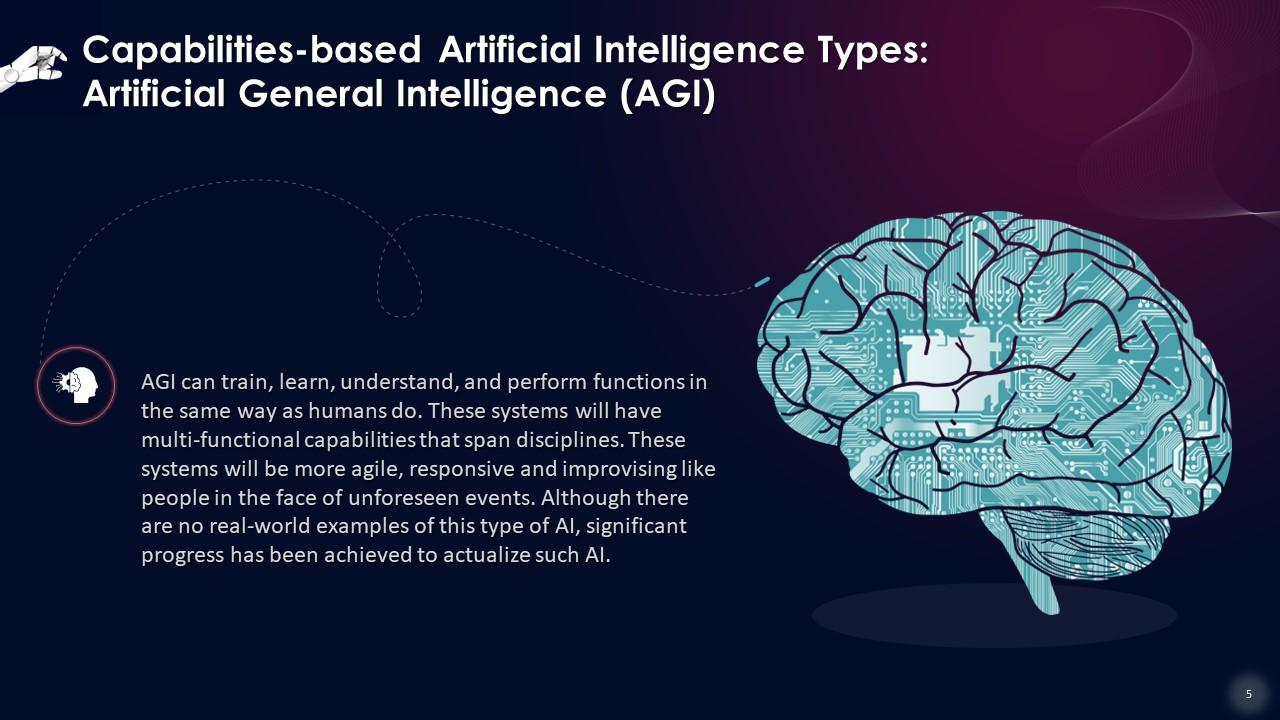
Folie 5
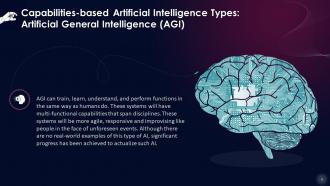
Diese Folie zeigt, dass künstliche allgemeine Intelligenz wie Menschen trainieren, lernen, verstehen und Funktionen ausführen kann. Diese Systeme werden über multifunktionale Fähigkeiten verfügen, die sich über alle Disziplinen erstrecken, und diese Systeme werden agiler sein und wie Menschen auf unvorhergesehene Ereignisse reagieren und improvisieren.
Folie 6
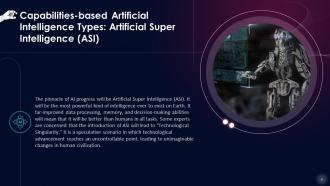
Diese Folie zeigt, dass künstliche Superintelligenz (KI) die leistungsstärkste Art von Intelligenz sein wird, die es jemals auf der Erde gab. Die deutlich verbesserte Datenverarbeitung, das Gedächtnis und die Entscheidungsfähigkeit werden bedeuten, dass es bei allen Aufgaben besser als der Mensch sein wird. Einige Experten befürchten, dass die Einführung von ASI zu technologischer Singularität führen wird.
Hinweise für Kursleiter:
Technologische Singularität: Es handelt sich um ein spekulatives Szenario, in dem der technologische Fortschritt einen unkontrollierbaren Punkt erreicht, der zu unvorstellbaren Veränderungen in der menschlichen Zivilisation führt.
Arten von Schulungs-Ppts für künstliche Intelligenz mit allen 22 Folien:
Nutzen Sie unser Schulungs-PPT „Arten der künstlichen Intelligenz“, um effektiv wertvolle Zeit zu sparen. Sie sind gebrauchsfertig und passen in jede Präsentationsstruktur.
FAQs for Types Of Artificial
So supervised learning is like having a teacher - you show the AI labeled examples, like "this is a cat, this is a dog" until it gets it. Pretty straightforward. Unsupervised learning? Way cooler but harder. You just dump raw data on it and see what patterns it finds on its own. No labels, no hand-holding. I'd definitely start with supervised if you're new to this stuff. It's so much easier to debug when things go wrong (and they will). Plus you can actually tell if it's working or just making stuff up. Unsupervised feels like magic when it works though.

So reinforcement learning is like trial and error but way more intense - your AI just does stuff and learns from getting rewarded or punished. Different from supervised learning where you spoon-feed it examples. The agent figures things out by actually doing it, kinda like how you'd learn a video game by playing it a million times (which sounds awful but works). Takes forever compared to other methods and gets messy, but honestly it's your best bet when you can't create normal training data. Perfect for decision-making problems or when you need something to control systems.
So transfer learning is when you grab a model that's already been trained on tons of data and just tweak it for what you need. Way better than building from zero. The model already knows general patterns, so you're just teaching it your specific stuff with way less data. Saves crazy amounts of time too. Oh and BERT or ResNet are good starting points - though honestly ResNet's been around forever at this point. But yeah, it's like getting a head start instead of doing everything yourself. Total lifesaver for most projects.
So basically you train one model on multiple related tasks at the same time instead of building separate ones. The cool thing is it actually performs better than individual models because it learns more general patterns - kinda like how playing different sports makes you more athletic overall, if that makes sense. You'll avoid overfitting too since the model can't just memorize one specific task. Honestly, it's way more efficient resource-wise. Start with tasks that use similar data types. Works really well when the reasoning skills overlap between tasks.
Your model is only as good as the data you feed it. Bad data? You'll get garbage predictions back - it's that simple. I learned this the hard way on a project last year where we had tons of missing values and biased samples. The whole thing fell apart during testing. Clean, well-balanced datasets make your model way more accurate and reliable. Honestly, I'd rather have less data that's high quality than mountains of messy stuff. Spend time upfront scrubbing your data and checking for weird patterns. Trust me, it beats debugging a broken model later when you're under deadline pressure.
Ugh, so many issues to watch out for. Bias is huge - your training data basically teaches the model society's prejudices, so you get hiring algorithms that discriminate against women or facial recognition that can't identify Black people properly. Privacy's another mess since you're often using data people never agreed to share. Then there's the black box thing where nobody understands why it made a decision. Honestly feels overwhelming sometimes. Your best bet is testing everything for fairness across different demographics, keeping detailed records, and auditing your datasets constantly. It's tedious but necessary.
So GANs are pretty cool - you've got two neural networks basically fighting each other. One makes fake data, the other tries to spot what's real vs fake. Think of it like a forger going up against a detective who keeps getting sharper. The generator gets way better at creating realistic stuff because it's constantly being challenged by this tough discriminator that won't let anything slide. That's why GAN-generated images and audio can look so legit now. You should mess around with PyTorch if you want to see how this whole adversarial thing actually works in practice.
Honestly, it depends what you're building, but I'd start with the basics. Accuracy, precision, recall, F1-score - these will give you different angles on how well things are working. Loss during training is huge too because that's how you catch overfitting (which happens way more than you think). Oh, and don't just trust your test numbers! Real-world performance can be totally different. For specialized stuff like translation you'll need custom metrics like BLEU scores, but most people overcomplicate this at first. Start simple, then add complexity as you actually need it.
So quantum computing could totally change AI training - the math is insane but basically these systems can test multiple solutions at once instead of going one by one. Neural networks could train way faster on certain problems. But honestly? We're nowhere near ready yet. Current quantum computers are too glitchy and unreliable for real AI work. I'd watch the hybrid stuff though - quantum handles the tricky optimization bits while regular computers do everything else. That seems more realistic than the full sci-fi version everyone talks about.
Dude, synthetic data is a lifesaver when you don't have enough real training data. You can create tons of diverse examples without worrying about privacy issues or spending crazy money on data collection. The labeling happens automatically too, which saves so much time and cash. Edge cases are where it really shines - stuff that barely happens in real life but could totally wreck your model. I learned this the hard way on my last project, actually. Just make sure your synthetic data matches real-world patterns or you'll train on complete nonsense. Mix it with real data to start.
So continuous learning lets AI systems update with fresh data instead of getting stuck with whatever they learned initially. Your models can adapt to new patterns and user behaviors without rebuilding everything - which honestly saves so much time. It's like how you get better at stuff through practice, except automated. Performance stays solid longer too, which is huge because nobody wants their AI going stale after six months. Oh, and it handles market shifts way better than static models. Pretty much keeps your systems from becoming outdated paperweights.
Honestly, it's brutal. Your biggest headache will be computational limits - you're trying to learn and respond instantly with barely any processing power. Data quality becomes a nightmare too since there's no time to properly validate what you're feeding the model. Latency kills everything because users want immediate responses, but the learning process slows things down. Oh, and if your model starts acting up? Good luck rolling that back quickly. I'd definitely start small with simple models first. Build solid monitoring from day one - trust me on this one, you'll need it way more than you think.
So basically, you get actual humans to review your AI's work and correct it as it learns - like having someone check your homework. The model picks up on real human judgment instead of just crunching data patterns. Works really well for tricky stuff where context matters or when things get subjective. Your AI ends up making way fewer bizarre mistakes and actually gets nuance better. Plus it learns faster since humans catch errors early. I'd honestly just start with having people review your most important outputs first - no need to go crazy with it right away.
PyTorch is where it's at for research stuff - way easier to debug when things inevitably break. TensorFlow still runs most production setups though, their serving tools are solid. Cloud-wise, you've got SageMaker, Vertex AI, Azure ML - they all handle the scaling headaches for you. Honestly picking one and actually sticking with it matters more than which one you choose (I learned this the hard way). Start with PyTorch if you're learning. TensorFlow feels like navigating a maze sometimes, especially when you're just trying to figure out the basics.
Honestly, you need both types of people in the room or your training's gonna miss key stuff. Domain experts catch the weird edge cases and context that doesn't show up in your data - like, they actually know what matters in the real world. Meanwhile, your AI people handle the technical setup and can spot problems before they blow up your whole process. I've seen this work best when the domain folks help pick features and validate results while the tech team does their optimization thing. Seriously though, just get them talking during your next design phase - you'll catch so many issues early it's not even funny.
-
The quality of the templates is as fine as it could get. It was a purchase well made!
-
The design is very attractive, informative, and eye-catching, with bold colors that stand out against all the basic presentation templates.