Types Of Government Interaction In E Governance Services
Try Before you Buy Download Free Sample Product
Audience
Editable
of Time
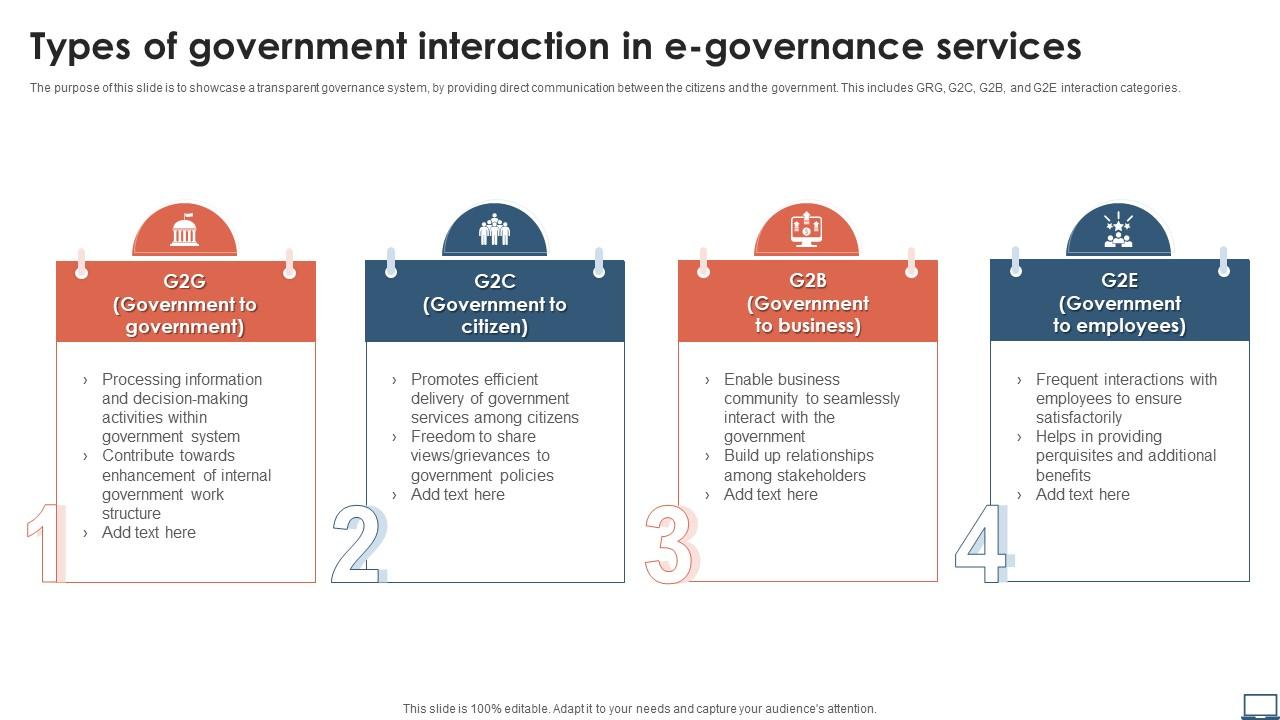
The purpose of this slide is to showcase a transparent governance system, by providing direct communication between the citizens and the government. This includes GRG, G2C, G2B, and G2E interaction categories.
People who downloaded this PowerPoint presentation also viewed the following :
Types Of Government Interaction In E Governance Services with all 6 slides:
Use our Types Of Government Interaction In E Governance Services to effectively help you save your valuable time. They are readymade to fit into any presentation structure.
FAQs for Types Of Government Interaction In
So there's basically four types of e-gov stuff. G2C is what you'll use most - filing taxes online, renewing licenses, applying for permits. Pretty convenient actually. G2B covers business registrations and compliance junk. Then there's G2G where different agencies finally talk to each other digitally (about time, right?). G2E is just for government employees' internal stuff. You're mostly gonna deal with G2C services. Honestly, find your local government portal and bookmark it - saves so much hassle instead of waiting in those awful DMV lines.
G2C services are honestly pretty cool - citizens can renew licenses, pay taxes, and get permits online without dealing with government office hours. No more waiting in those awful lines! The 24/7 access is perfect for busy people, and you can actually track your application status instead of wondering if it got lost somewhere. Plus there's usually feedback systems where you can complain directly to officials (which feels weirdly satisfying). Transparency builds trust too since you can see where tax money goes. Just make sure whatever platform you're using works well on mobile - nobody wants to fill out forms on a broken website.
So basically G2G lets agencies swap data directly instead of making you fill out the same forms everywhere. Pretty genius, right? Your permit gets approved faster because departments can just grab info from shared databases. No more ping-ponging between offices while you wait around forever. Tax stuff moves quicker too since everyone's actually talking to each other now. The trick is getting solid data-sharing agreements set up first - that's honestly where most of the magic happens. Way better than the old siloed mess we used to deal with.
Dude, these B2G platforms are seriously worth checking out. Instead of dealing with paper forms and office visits, you can submit all your permits and licenses digitally. Track everything in real-time too. The automated renewal reminders are clutch - I used to forget that stuff constantly. Most systems catch errors before you submit, which saves you from those annoying rejection emails later. Your city probably has an online portal already (most do now). Honestly beats the hell out of mailing documents and crossing your fingers they don't disappear into some bureaucratic void.
Honestly, start with what you've got and figure out where the biggest gaps are. You'll need secure web portals and solid digital identity systems - that's non-negotiable. Cloud infrastructure handles all the data traffic, and make sure everything works great on mobile since that's how most people actually use this stuff. APIs are huge for getting different government systems to play nice together (why is this always such a nightmare?). Don't skip cybersecurity, payment gateways, and digital signatures either. Oh, and authentication tools obviously. The mobile thing is probably your biggest priority though.
Social media totally changed how governments talk to people - we went from boring one-way announcements to actual back-and-forth conversations. Now agencies can share stuff in real-time, answer questions instantly, and get feedback on policies. Twitter's great for crisis updates, Facebook works for explaining complicated policies, and Instagram makes government work look... well, almost cool? Citizens expect quick responses now though. Oh, and transparency is huge. If you're setting up any digital communication strategy, you'll need staff who can engage authentically across platforms - not just post and ghost. People can smell fake a mile away.
Look, multi-factor authentication and end-to-end encryption aren't negotiable anymore - that's your starting point. Run security audits and pen testing regularly so you catch problems before hackers do. Most systems screw up with access controls by giving people way too many permissions, so lock that down tight. Oh, and obviously encrypt everything - data transmission, backups, the whole nine yards. Citizens are handing over their most personal stuff here. I'd start by assessing what you've got now and tackle the worst vulnerabilities first.
So basically they make e-governance work for everyone by offering tons of different ways to access stuff. Mobile apps are huge since way more people have phones than laptops. They've got offline spots too, plus everything's in multiple languages with super simple interfaces - no tech genius required. Voice commands are pretty cool actually, though I'm not sure how well those work in practice. Community centers usually have staff who can help walk people through things if they get stuck. Oh and honestly? Just throwing services online isn't enough - you need like five different backup options for people to actually use them.
Ugh, honestly the biggest pain is going to be the digital divide stuff - like half the people can't even figure out basic tech. Staff retraining costs are brutal too. You've got to worry about cybersecurity and data privacy on top of everything else. Oh, and rebuilding workflows while keeping everything running? Total nightmare. Some folks will fight every change you try to make. My advice: start small with pilot programs in areas that won't blow up if something goes wrong. Work out the bugs there first before you touch anything critical. Infrastructure overhauls are inevitable but don't do it all at once.
Dude, mobile apps are a game changer for government stuff. Having services literally in your phone means you can do things 24/7 instead of trekking to some office during "business hours" (which never work for anyone's actual schedule). The interfaces are way cleaner than those clunky government websites too. They work offline for basic things, handle different languages, and actually send you reminders so you don't miss deadlines. Honestly, if agencies aren't doing mobile-first by now, they're just alienating people who expect everything to work on their phones.
So basically e-governance puts all the government stuff online - budget docs, meeting notes, decisions, everything. You can actually see where your tax money goes now, which is honestly pretty wild. It creates this digital paper trail that makes it way harder for officials to hide sketchy things. Plus there's usually feedback systems where you can complain directly (though whether they listen is another story lol). The cool part is governments tend to behave better when they know people are watching and can call them out easily.
Look at three main things: how many people actually use your digital services vs calling/visiting in person, plus time and money saved. Satisfaction surveys matter tons - honestly doesn't matter how sleek your portal looks if users find it confusing. Track completion rates for online stuff and how fast you deliver services too. The sweet spot is better service quality while cutting down paperwork headaches for staff. Oh, and definitely get baseline numbers for everything you do now so you can compare results every few months. That's where you'll see if it's actually working.
Honestly, just put feedback options everywhere - rating systems after people finish transactions, suggestion boxes on service pages, the whole deal. Make it ridiculously simple when citizens are already using your stuff anyway. Here's what really matters though: follow up with people automatically so they don't feel ignored (seriously, nothing's worse than shouting into the void). Show them how their complaints actually changed things. I'd probably start with whatever service gets the most traffic and perfect that system first. Once you've got that dialed in, roll it out to everything else. Way easier than trying to do it all at once.
Start with the basics - simple navigation and ditch the government-speak for normal language. Mobile-first is huge since people do everything on phones now. Progress bars are a lifesaver for those annoying multi-step forms (nobody wants to wonder if they're halfway done or just getting started). Clear paths for the stuff people actually do - permits, payments, whatever. Oh, and test with real people constantly. You'll be shocked what confuses users that seems obvious to you. Honestly, most gov sites still feel like they're stuck in 2005, so the bar isn't exactly high.
So those UN e-governance standards are pretty useful as a starting point, but honestly you can't just slap them onto any country and expect magic. Estonia's digital stuff is amazing, but try that same approach in rural Kenya? Good luck with that. The frameworks give you solid ideas about digital identity and how systems should talk to each other, which is helpful. But here's the thing - you've gotta pick what actually makes sense for your situation. Check your infrastructure first, see what your people can handle tech-wise, then maybe borrow pieces that fit. Building it step by step works way better than going all-in from day one.
-
Wonderful templates design to use in business meetings.
-
Easily Understandable slides.