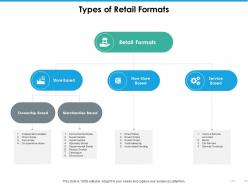
Types of retail formats ppt portfolio design inspiration
Try Before you Buy Download Free Sample Product
Audience
Editable
of Time
Create an impact across continents with our Types Of Retail Formats Ppt Portfolio Design Inspiration. You will acquire global acceptance.
People who downloaded this PowerPoint presentation also viewed the following :
Types of retail formats ppt portfolio design inspiration with all 5 slides:
Our Types Of Retail Formats Ppt Portfolio Design Inspiration are a cause for celebration. Their brilliance will fascinate you.
FAQs for Types of retail formats ppt
Primary retail formats include department stores, specialty stores, supermarkets, convenience stores, discount retailers, and e-commerce platforms, each distinguished by product assortment, store size, and customer service models. These formats deliver competitive advantage through different approaches, with department stores emphasizing comprehensive selection and service, specialty retailers focusing on expertise and niche markets, and discount formats streamlining operations for cost efficiency.
E-commerce has significantly transformed traditional retail by accelerating omnichannel strategies, reducing physical store footprints, and shifting focus toward experiential shopping environments. Many retailers now integrate online and offline operations seamlessly, with department stores becoming showrooms, grocery chains offering curbside pickup, and specialty retailers emphasizing personalized in-store experiences, ultimately delivering enhanced customer convenience and operational efficiency.
Technology enhances customer experiences across retail formats through personalized recommendations, seamless payment systems, inventory management, mobile apps, and omnichannel integration. These digital solutions streamline shopping journeys by reducing wait times, enabling click-and-collect services, and providing real-time product availability, with many retailers finding that strategic technology adoption ultimately delivers higher customer satisfaction and competitive advantage.
Brick-and-mortar stores compete effectively by leveraging experiential shopping, personalized customer service, immediate product access, and seamless omnichannel integration that online retailers cannot replicate. Through interactive displays, expert consultations, and instant gratification purchases, physical retailers create unique value propositions, with many finding that combining digital tools with tangible experiences ultimately delivers competitive advantage in an increasingly hybrid retail landscape.
Pop-up shops offer advantages including reduced overhead costs, market testing opportunities, enhanced brand awareness, flexible location strategies, and inventory liquidation capabilities. However, they present challenges through limited customer relationship building and inconsistent revenue streams, while requiring significant setup investments, though many retailers find that strategic pop-up deployments ultimately deliver valuable market insights and cost-effective brand exposure.
Consumer preferences drive retail format evolution by demanding greater convenience, personalized experiences, and seamless omnichannel integration across touchpoints. As shopping behaviors shift toward mobile-first interactions and experiential retail, formats like pop-up stores, click-and-collect services, and hybrid showrooms emerge, with many retailers finding that adaptive format strategies ultimately deliver enhanced customer loyalty and competitive differentiation.
Location significantly impacts retail format success through foot traffic patterns, demographic alignment, accessibility, competition density, and operational costs. Strategic placement in high-visibility areas with target customer concentration, like malls for specialty stores or street-level spaces for convenience formats, ultimately delivers enhanced customer reach and sustainable revenue growth.
Retailers can adapt their formats through eco-friendly store designs, sustainable product lines, circular economy initiatives like repair and resale services, and transparent supply chain practices. These approaches streamline operations while reducing environmental impact, with many retail chains finding that sustainability-focused formats enhance customer loyalty, attract environmentally conscious consumers, and ultimately deliver competitive advantage in an increasingly sustainability-driven marketplace.
Successful omnichannel retail strategies depend on integrated inventory management, consistent brand messaging across touchpoints, seamless customer data synchronization, unified payment systems, and cross-channel fulfillment capabilities. These elements work together by enabling customers to shop fluidly between online, mobile, and physical stores, with retailers like Target and Sephora finding that this integration significantly enhances customer satisfaction while driving revenue growth.
Global retail formats adapt to distinct consumer behaviors through localized shopping preferences, cultural payment methods, and regional convenience expectations. While European consumers favor smaller specialty stores and sustainable brands, Asian markets increasingly embrace mobile-first experiences and social commerce platforms, with American retailers finding success through omnichannel integration and personalized service delivery.
Emerging retail formats include experiential showrooms, dark stores for rapid fulfillment, micro-fulfillment centers, social commerce spaces, and hybrid digital-physical environments. These innovative approaches streamline customer journeys by combining personalized experiences, omnichannel integration, and convenient pickup options, with many retailers finding that flexible, community-focused formats deliver enhanced customer engagement and operational efficiency.
Discount retailers prioritize high-volume, self-service formats with minimal staffing, streamlined store layouts, and efficient inventory turnover to maintain low prices. Luxury retailers emphasize personalized customer experiences through dedicated sales associates, premium store environments, and curated product selections, with many finding that this strategic combination of exclusivity and service builds brand loyalty and justifies higher price points.
Experiential retail transforms traditional shopping by creating immersive, interactive environments that engage customers beyond simple transactions, featuring hands-on demonstrations, personalized services, and community events. This approach enables retailers to differentiate themselves in an increasingly competitive landscape, with brands like Apple, Nike, and Sephora finding that experiential elements drive customer loyalty, increase dwell time, and ultimately deliver higher conversion rates and stronger emotional connections.
Retailers use data analytics to optimize format and layout by analyzing customer traffic patterns, purchase behaviors, and product performance metrics. Through heat mapping technology and sales data analysis, stores can strategically position high-margin items, improve customer flow, and reduce bottlenecks, with many retailers finding that data-driven layouts increase sales conversion rates and enhance overall shopping experiences.
Small retailers face budget constraints, limited negotiating power with suppliers, restricted location options, and fewer resources for market research when choosing retail formats. While larger chains leverage economies of scale and extensive data analytics, independent retailers often find success by focusing on niche markets, personalized customer service, and community connections, ultimately delivering unique experiences that compete effectively against standardized chain operations.
No Reviews