


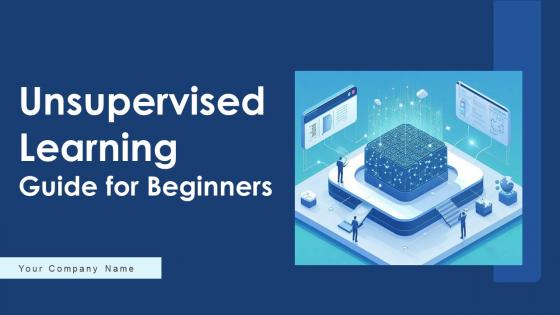
Unsupervised Learning Guide For Beginners AI CD




Try Before you Buy Download Free Sample Product
 Impress Your
 Audience
 100%
100% Editable
 Save Hours
 of Time


Check out our professionally designed Unsupervised Learning Guide for Beginners PPT, tailored to introduce foundational concepts and applications. This supervised and unsupervised learning presentation serves as a gateway to understanding the core principles of unsupervised Learning, a crucial facet of the vast landscape of machine learning. Moreover, the AI-supervised and Unsupervised Learning Template uncovers the essentials behind unsupervised Learning and untangles the intricacies of clustering, dimensionality reduction, and other pivotal techniques. Further, the unsupervised clustering PowerPoint presentation immerses you in real-world examples and practical applications that vividly illustrate the adaptability of unsupervised learning algorithms. Lastly, the unsupervised clustering presentation establishes a robust groundwork in unsupervised Learning. Arm yourself with the knowledge to reveal hidden patterns, glean insights, and extract valuable information from unlabeled data. Embark on your journey into unsupervised Learning, unlocking the potential of this dynamic machine-learning paradigm with our comprehensive guide catered to beginners. Get access to this powerful template now.
People who downloaded this PowerPoint presentation also viewed the following :
Content of this Powerpoint Presentation
Slide 1: This slide introduces Unsupervised Learning Guide for Beginners. State Your Company Name.
Slide 2: This is an Agenda slide. State your agendas here.
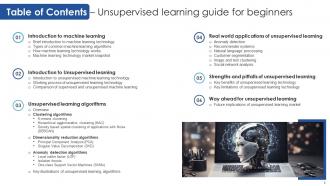
Slide 3: The slide displays Table of Contents for presentation.
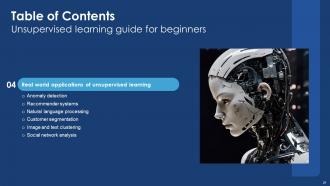
Slide 4: The slide continues Table of Contents.
Slide 5: This slide showcases basic introduction to machine learning technology, useful for new aspirants and veteran programmers.
Slide 6: This slide provides general overview of machine based learning types which can help AI developers build new ML models.
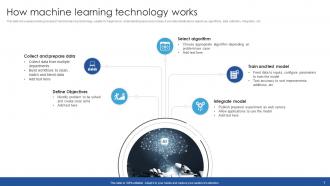
Slide 7: This slide showcases working process of machine learning technology, usable for beginners in understanding back-end process.
Slide 8: This slide demonstrates global market snapshot of machine learning which can help businesses and investors make certain decisions.
Slide 9: The slide renders Title of Contents for presentation.
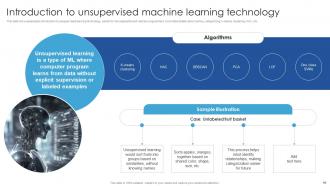
Slide 10: This slide shows basic introduction to unsupervised learning technology, useful for new aspirants and veteran programmers.
Slide 11: This slide highlights how unsupervised learning technology works, useful for new aspirants and veteran programmers.
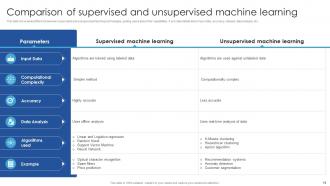
Slide 12: This slide showcases difference between supervised and unsupervised learning technologies, guiding users about their capabilities.
Slide 13: The slide describes Title of Contents further.
Slide 14: This slide depicts major types of unsupervised learning technology algorithms, useful for new aspirants and veteran programmers.
Slide 15: This slide showcases basic understanding to unsupervised learning algorithm i.e. K-means clustering.
Slide 16: This slide highlights basic understanding to unsupervised learning algorithm i.e. Hierarchical agglomerative clustering (HAC).
Slide 17: This slide provides basic understanding to unsupervised learning algorithm i.e. Density based spatial clustering of applications with Noise (DBSCAN).
Slide 18: The slide renders Title of Contents further.
Slide 19: This slide demonstrates basic understanding to unsupervised learning algorithm i.e. Principal Component Analysis (PCA).
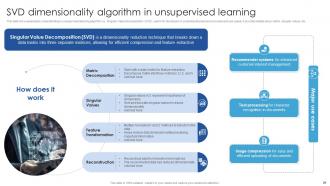
Slide 20: This slide showcases basic understanding to unsupervised learning algorithm i.e. Singular Value Decomposition (SVD).
Slide 21: The slide displays another Title of Contents.
Slide 22: This slide provides basic understanding to unsupervised learning algorithm i.e. Local outlier factor (LOF).
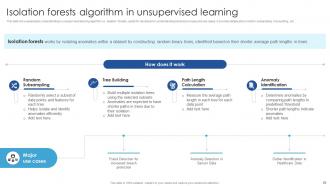
Slide 23: This slide showcases basic understanding to unsupervised learning algorithm i.e. isolation forests.
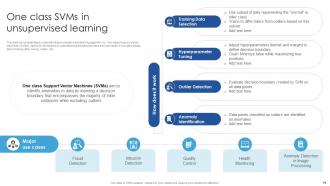
Slide 24: This slide gives basic understanding to unsupervised learning algorithm i.e. One-class Support Vector Machines (SVMs).
Slide 25: The slide renders Title of Contents further.
Slide 26: This slide highlights some examples where unsupervised learning algorithms are in action, useful for business and developers.
Slide 27: The slide displays Title of Contents further.
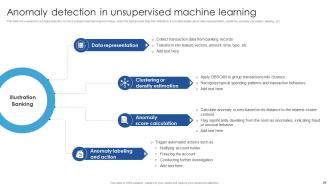
Slide 28: This slide showcases how anomaly detection works in unsupervised learning technology, useful for bankers and financial institutions.
Slide 29: This slide displays how recommendation engine works in unsupervised learning technology, useful for over the top (OTT) apps developers.
Slide 30: This slide highlights how natural language processing works in unsupervised learning technology, useful for developers.
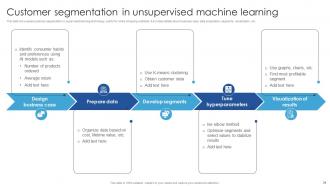
Slide 31: This slide showcases customer segmentation in supervised learning technology, useful for online shopping websites.
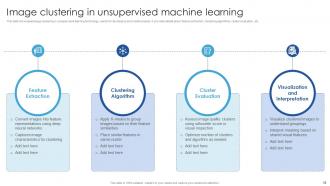
Slide 32: This slide demonstrates image clustering in unsupervised learning technology, useful for developers and creative teams.
Slide 33: This slide showcases social network analysis through unsupervised learning technology, useful for new aspirants and veteran programmers.
Slide 34: The slide depicts Title of Contents further.
Slide 35: This slide showcases key advantages of unsupervised learning technology, useful for new aspirants and veteran programmers.
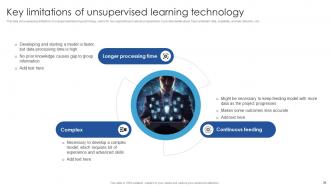
Slide 36: This slide describes key limitations of unsupervised learning technology, useful for new aspirants and veteran programmers.
Slide 37: The slide depicts Title of Contents for presentation.
Slide 38: This slide showcases market snapshot of unsupervised learning technology, useful for veteran programmers and business investors.
Slide 39: This slide shows all the icons included in the presentation.
Slide 40: This slide is titled as Additional Slides for moving forward.
Slide 41: This is About Us slide to show company specifications etc.
Slide 42: This is Our Target slide. State your targets here.
Slide 43: This slide depicts Venn diagram with text boxes.
Slide 44: This slide contains Puzzle with related icons and text.
Slide 45: This slide shows Post It Notes. Post your important notes here.
Slide 46: This is a Thank You slide with address, contact numbers and email address.
Unsupervised Learning Guide For Beginners AI CD with all 54 slides:
Use our Unsupervised Learning Guide For Beginners AI CD to effectively help you save your valuable time. They are readymade to fit into any presentation structure.

























FAQs for Unsupervised Learning Guide For
Unsupervised learning analyzes unlabeled data to discover hidden patterns, clusters, and structures, while supervised learning uses labeled datasets to predict specific outcomes through classification or regression. Supervised learning enables precise predictions for applications like fraud detection and loan approvals, whereas unsupervised learning reveals customer segments and market insights, with organizations increasingly combining both approaches for comprehensive data intelligence.
Clustering algorithms enable marketing teams to segment customers by analyzing purchasing patterns, demographic data, behavioral metrics, and engagement histories without predefined categories. Through k-means and hierarchical clustering, retailers identify distinct customer groups for targeted campaigns, personalized recommendations, and optimized pricing strategies, while financial services leverage these insights for customized product offerings, ultimately delivering higher conversion rates and enhanced customer experiences.
Dimensionality reduction simplifies complex datasets by eliminating redundant features, reducing computational costs, and revealing hidden patterns that enable more effective clustering, anomaly detection, and data visualization. Through techniques like PCA and t-SNE, organizations streamline analysis of high-dimensional data, with financial institutions and healthcare providers finding significantly faster processing times and clearer insights for strategic decision-making.
Unsupervised learning excels at anomaly detection by identifying patterns that deviate from normal data distributions through clustering, autoencoders, isolation forests, and statistical methods. These techniques enable organizations across finance, cybersecurity, and manufacturing to detect fraud, network intrusions, and equipment failures without labeled datasets, ultimately delivering faster threat response and reduced operational risks.
Unsupervised learning applications in natural language processing include topic modeling, sentiment analysis, document clustering, language translation, and text summarization. These techniques enhance content organization, automate customer feedback analysis, and streamline information processing across industries like media, customer service, and research, ultimately delivering faster insights and improved user experiences.
K-means clustering works by partitioning data into k clusters through iteratively assigning points to nearest centroids, recalculating centroid positions, and repeating until convergence. While this algorithm streamlines pattern recognition and customer segmentation for retail and marketing teams, it requires pre-defining cluster numbers and struggles with non-spherical data shapes, ultimately delivering scalable insights when applied to appropriate datasets.
Unsupervised learning evaluation metrics include silhouette score, inertia, Calinski-Harabasz index, Davies-Bouldin index, and adjusted rand index for clustering tasks. These metrics streamline model assessment by measuring cluster cohesion, separation quality, and internal consistency, with many organizations in retail and finance finding that strategic combinations ultimately deliver enhanced customer segmentation and operational efficiency.
Unsupervised learning algorithms handle noise through various approaches, with clustering methods like DBSCAN filtering outliers, dimensionality reduction techniques like PCA minimizing noise impact, and robust algorithms using statistical measures to identify anomalies. These noise-handling capabilities enable organizations in healthcare, finance, and manufacturing to extract meaningful patterns from imperfect datasets, ultimately delivering cleaner insights and more reliable automated decision-making processes.
Feature scaling is crucial in unsupervised learning because it ensures all variables contribute equally to distance calculations and clustering algorithms. Without proper scaling, variables with larger ranges can dominate the analysis, leading to biased clusters and inaccurate patterns, with many data scientists finding that normalization significantly enhances algorithm performance and interpretability.
Unsupervised learning analyzes customer behavior through clustering algorithms, anomaly detection, market basket analysis, and dimensionality reduction techniques that identify hidden patterns in purchase histories, website interactions, and demographic data. These methods enable businesses to discover customer segments, detect unusual spending patterns, and optimize product recommendations, with retailers and e-commerce platforms finding significantly improved targeting and personalization strategies.
Popular unsupervised learning tools include Python's Scikit-learn, TensorFlow, PyTorch, Keras, and R's cluster package. These platforms streamline implementation by offering pre-built algorithms, automated data preprocessing, and visualization capabilities, with many organizations finding that these tools accelerate model development, reduce technical complexity, and ultimately deliver faster insights across diverse business applications.
Hierarchical clustering creates tree-like structures showing relationships at multiple levels without requiring predetermined cluster numbers, while partitioning methods like k-means divide data into fixed, non-overlapping groups with specified cluster counts. Healthcare systems use hierarchical clustering for patient similarity analysis across treatment stages, whereas retail companies apply partitioning for customer segmentation, with hierarchical methods ultimately delivering deeper insights into data relationships and partitioning enabling faster, scalable categorization for business applications.
Interpreting unsupervised learning results presents challenges including lack of ground truth validation, subjective pattern evaluation, high-dimensional data visualization difficulties, and ambiguous cluster boundaries. These complexities require domain expertise and multiple validation approaches, with many organizations finding that combining statistical metrics with business context delivers more actionable insights and strategic value.
Unsupervised learning enhances recommendation systems through clustering algorithms that group similar users or products, dimensionality reduction techniques that identify hidden patterns in preferences, and association rule mining that discovers item relationships. These approaches enable platforms like Netflix and Amazon to deliver personalized recommendations by analyzing behavioral patterns, ultimately improving customer engagement and driving sales through more targeted content suggestions.
Ethical considerations include data privacy protection, algorithmic bias mitigation, transparency in decision-making processes, consent for data usage, and fairness in automated insights generation. Organizations must ensure responsible implementation by conducting bias audits, maintaining data anonymization standards, and establishing clear governance frameworks, ultimately delivering equitable outcomes while building stakeholder trust in increasingly data-driven business environments.
-
The templates you provide are great! They have saved me tons of time and made my presentations come alive. Thank you for this awesome product. Keep up the good work!
-
Thanks for all your great templates they have saved me lots of time and accelerate my presentations. Great product, keep them up!