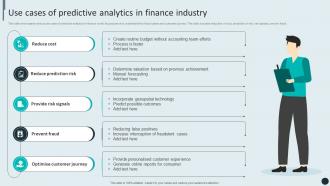
Use Cases Of Predictive Analytics In Finance Industry
Try Before you Buy Download Free Sample Product
Audience
Editable
of Time
This slide showcases various use case of predictive analytics in finance world. Its purpose is to understand the fraud cases and customer journey. This slide includes reduction of cost, prediction of risk, risk signals, prevent fraud.
People who downloaded this PowerPoint presentation also viewed the following :
Use Cases Of Predictive Analytics In Finance Industry with all 9 slides:
Use our Use Cases Of Predictive Analytics In Finance Industry to effectively help you save your valuable time. They are readymade to fit into any presentation structure.
FAQs for Use Cases Of Predictive Analytics
Predictive analytics revolutionizes financial risk management by enabling real-time threat detection, automated credit scoring, and portfolio optimization through advanced algorithms and machine learning. Banks and investment firms leverage these technologies to identify potential defaults, detect fraudulent transactions, and minimize market exposure, ultimately delivering faster decision-making and significantly reduced operational losses.
Key financial metrics enhanced through predictive analytics include credit risk assessment, fraud detection rates, loan default prediction, customer lifetime value, and cash flow forecasting. These capabilities enable financial institutions to minimize losses, accelerate loan approvals, and optimize investment strategies, with many banks finding that predictive models deliver significantly faster decision-making and improved operational efficiency.
Machine learning algorithms improve financial forecasting accuracy by analyzing vast datasets, identifying complex patterns, and adapting to market changes in real-time. These technologies enable banks and investment firms to process historical trends, economic indicators, and behavioral data simultaneously, delivering more precise predictions and reducing forecasting errors by up to 30%.
Predictive analytics detects financial fraud by analyzing transaction patterns, identifying anomalies in spending behavior, monitoring real-time payments for suspicious activity, and cross-referencing customer data against known fraud indicators. These technologies enhance security by flagging potentially fraudulent transactions before completion, reducing false positives through machine learning algorithms, and enabling financial institutions to prevent losses while maintaining seamless customer experiences.
Big data enhances predictive analytics for financial institutions by providing vast, diverse datasets from transactions, market feeds, social media, and customer interactions for more accurate modeling. Through advanced processing of structured and unstructured data, banks and investment firms can improve risk assessment, detect fraud patterns, and personalize services, ultimately delivering faster decision-making and competitive advantages in increasingly dynamic markets.
Predictive analytics enhances portfolio management by analyzing market trends, risk patterns, and asset correlations to forecast optimal allocation strategies, identify emerging opportunities, and minimize potential losses. Through machine learning algorithms and real-time data processing, investment firms streamline decision-making, reduce exposure to volatile sectors, and ultimately deliver superior returns while maintaining diversified risk profiles.
Ethical considerations include algorithmic bias in credit scoring, data privacy protection, transparency in automated decisions, fairness across demographic groups, and accountability for AI-driven outcomes. While predictive analytics enhances risk assessment and operational efficiency, financial institutions must balance competitive advantages with responsible implementation, ensuring equitable access to services and maintaining customer trust through transparent, auditable processes.
Financial analysts leverage predictive analytics for customer segmentation by analyzing transaction patterns, credit histories, spending behaviors, and demographic data to identify distinct customer groups. Through machine learning algorithms, banks and financial institutions can predict customer lifetime value, risk profiles, and product preferences, enabling targeted marketing strategies, personalized service offerings, and optimized resource allocation that ultimately enhance customer retention and profitability.
Financial organizations face challenges including data quality issues, regulatory compliance requirements, integration with legacy systems, skill gaps in analytics expertise, and high implementation costs. While these obstacles can be significant, many banks and investment firms find that strategic planning, phased rollouts, and targeted training programs enable successful deployment, ultimately delivering enhanced risk management, fraud detection capabilities, and competitive advantage in an increasingly data-driven marketplace.
Predictive analytics tools aid regulatory compliance by automating risk monitoring, identifying potential violations before they occur, and streamlining reporting processes across complex financial operations. Banks and investment firms leverage these systems to track transaction patterns, assess credit risks, and ensure adherence to evolving regulations, ultimately reducing compliance costs while enhancing regulatory transparency and operational efficiency.
Real-time data significantly enhances predictive analytics effectiveness by enabling immediate pattern recognition, reducing forecasting lag time, and improving model accuracy through continuous updates. Financial institutions leverage this capability for instant fraud detection, dynamic risk assessment, and automated trading decisions, with many banks finding that real-time insights deliver faster loan approvals and enhanced customer experiences while maintaining competitive advantage.
Fintech companies leverage predictive analytics through machine learning algorithms, real-time data processing, customer behavior modeling, and risk assessment automation to deliver personalized financial products and streamline operations. These technologies enable faster loan approvals, enhanced fraud detection, and targeted investment recommendations, with many digital banks and payment processors finding that predictive insights significantly reduce operational costs while improving customer acquisition and retention rates.
Finance professionals should monitor real-time analytics integration, AI-driven risk assessment automation, behavioral pattern recognition, regulatory compliance modeling, and cross-platform data harmonization trends. These advancing capabilities enable banks and financial institutions to predict market volatility, automate loan decisions, and detect fraud patterns more accurately, while investment firms leverage predictive insights for portfolio optimization, ultimately delivering faster decision-making and enhanced competitive positioning.
Predictive analytics enhances lending decisions by analyzing credit histories, income patterns, spending behaviors, and market trends to assess borrower risk more accurately. Banks and financial institutions leverage these insights to streamline loan approvals, reduce default rates, and optimize interest pricing, ultimately delivering faster services and improved portfolio performance.
Stock market prediction limitations include market volatility, external economic shocks, behavioral anomalies, data quality issues, and model overfitting to historical patterns. While predictive analytics enhances investment decision-making through risk assessment and trend identification, many financial institutions find that combining these tools with human expertise and diversified strategies delivers more reliable outcomes in increasingly unpredictable markets.
-
They guys always go the extra mile to meet the expectations of their customers. Almost a year has been associated with them.Â
-
Qualitative and comprehensive slides.