

Vendor management for enhancing procurement efficiency status powerpoint presentation slides





Try Before you Buy Download Free Sample Product
 Impress Your
Audience
 100%
Editable
 Save Hours
of Time


Our Vendor Management For Enhancing Procurement Efficiency Status Powerpoint Presentation Slides are topically designed to provide an attractive backdrop to any subject. Use them to look like a presentation pro.
People who downloaded this PowerPoint presentation also viewed the following :
Content of this Powerpoint Presentation
Slide 1: Here is the introductory slide of the PPT presentation titled: Vendor Management for Enhancing Procurement Efficiency Status. Add your company name here.
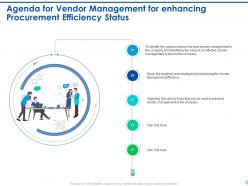
Slide 2: Use this slide to share the agenda of your PowerPoint presentation.
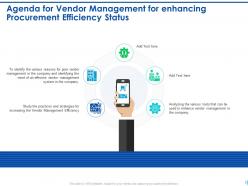
Slide 3: Use this other slide variant to share the agenda of this PowerPoint presentation.
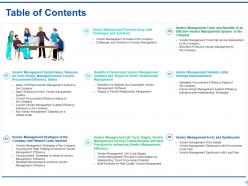
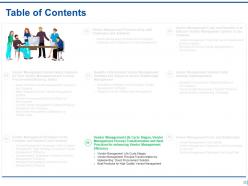
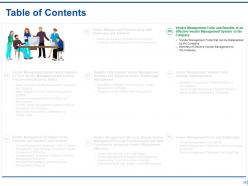
Slide 4: In this slide introduce the table of contents for your PPT presentation. Introduce the headings like the need for vendor management, benefits, strategies, challenges, etc..
Slide 5: Introduce the first element of the table of contents: the need for VMS, reasons for poor management, and the efficiency status of current procurement.
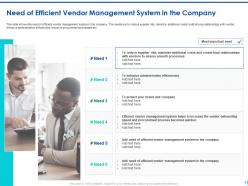
Slide 6: This slide shows the need for an efficient vendor management system in the company. Specify the requirements like reducing supplier risk, minimizing additional costs, building strong relationships with vendors, etc..
Slide 7: This slide shows significant reasons for the company's poor vendor management system, such as financial issues, misunderstanding the organization's requirements, poor relationship skills, etc.
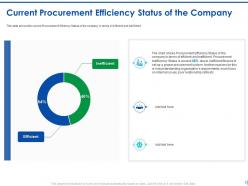
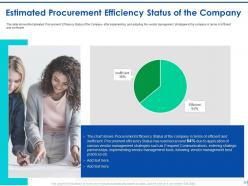
Slide 8: This slide shows the current Procurement Efficiency Status of the company in terms of efficiency and inefficiency using a chart.
Slide 9: This slide shows the company's current VMS efficiency indicators like timely order fulfillment, communicating time lags, delivery lead time, etc. They are compared for three years
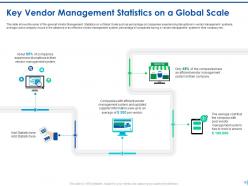
Slide 10: This slide shows some of the general vendor management statistics on a global scale, such as the percentage of companies experiencing disruptions in VMS, average cost a company incurs in the absence of an effective VMS in their company, etc.
Slide 11: Introduce the second heading of this PPT presentation in this slide. i.e., the vendor management strategies of the company and the related costs involved.
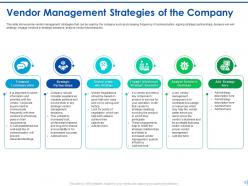
Slide 12: This slide shows some vendor management strategies that the company can use, such as increasing the frequency of communication, signing strategic partnerships, devising a win-win strategy, etc. These must be shared with the vendor.
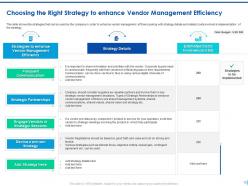
Slide 13: This slide shows the strategies that the company can use to enhance vendor management efficiency along with strategy details and related costs involved in implementing the strategy.
Slide 14: This slide shows the strategies that the company can use to enhance vendor management efficiency, such as conferences, workshops, emails, mobiles, and telephones, etc.
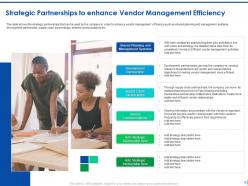
Slide 15: This slide shows the company's strategic partnerships to enhance vendor management efficiency, such as shared planning and management systems, development partnerships, supply chain partnerships, etc.
Slide 16: Introduce the third heading of this PPT presentation: the vendor management process and challenges and solutions.
Slide 17: This slide shows the process that is followed by the company to create a positive and effective engagement with the vendors, such as identifying business goals, setting up a vendor management team, creating a vendor-related database, etc.
Slide 18: This slide shows the company's challenges and the related solutions while dealing with vendors, such as complex vendor ecosystem, contract management challenges, reputational risk, etc.
Slide 19: Here in this slide introduce the fourth heading for your presentation, i.e. the benefits of automated vendor management software and the stages of vendor relationship management.
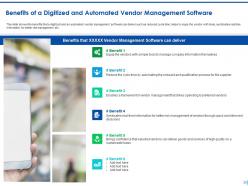
Slide 20: This slide shows the benefits that a digitized and automated vendor management software can deliver, such as reduced cycle time, helps to equip the vendor with tools, syndicates real-time information for better risk management, etc.
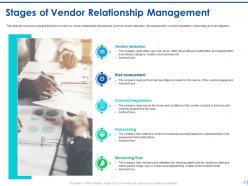
Slide 21: This slide shows various stages involved in vendor relationship management, such as vendor selection, risk assessment, contract negotiation, onboarding, and risk mitigation.
Slide 22: Introduce the fifth heading of your presentation, i.e., the life cycle stages, process transformation, and the best practices for enhancing the vendor management efficiency in this PPT slide.
Slide 23: This slide shows vendor management life cycle stages such as vendor qualification, vendor onboarding, ordering and delivery, vendor payment, and vendor offboarding.
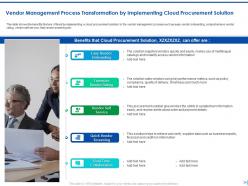
Slide 24: This slide shows the benefits of implementing a cloud procurement solution to the vendor management process, such as easy vendor onboarding, comprehensive vendor rating, vendor self-service, etc.
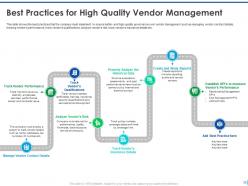
Slide 25: This slide shows the best practices that the company must implement to ensure better- and high-quality governance over vendor management, such as managing vendor contract details, tracking vendor's performance, tracking vendor's qualifications, etc.
Slide 26: This slide introduces the sixth title of the Table of Contents for your presentation, i.e.the tools and benefits of an effective Vendor management system to the company.
Slide 27: This slide shows the various vendor management tools that the company can use to improve and stabilize its vendor management system and its purpose and implementation costs.
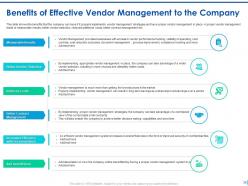
Slide 28: This slide shows the company's benefits if it correctly implements the vendor management strategies and has proper vendor management. That, in turn, leads to measurable results, better vendor selection, reduced additional costs, etc.
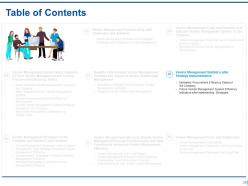
Slide 29: Introduce the seventh heading of your PPT presentation in this slide, i.e. the vendor management statistics after strategy implementation.
Slide 30: This slide shows the Estimated Procurement Efficiency Status of the Company after implementing and adopting the vendor management strategies in the company in terms of efficiency and inefficiency via a chart.
Slide 31: This slide shows the future estimated VMS efficiency indicators of the company compared for three years. Some indicators are timely order fulfillment, communication of time lags, delivery lead time, etc.
Slide 32: Introduce the eighth heading of the PPT presentation, i.e., the vendor management form and dashboards in this slide.
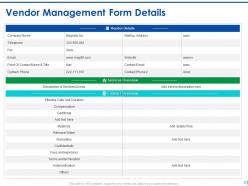
Slide 33: This is a slide to specify the vendor management form details.
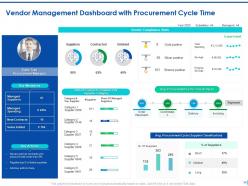
Slide 34: This is a slide to share the vendor management dashboard and the procurement cycle time.
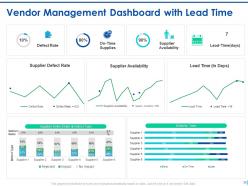
Slide 35: This is a vendor management dashboard with a lead time slide to represent details on a chart.
Slide 36: This is the icons slide for the vendor management for enhancing procurement efficiency status PowerPoint presentation.
Slide 37: This slide marks the beginning of additional slides to follow that comprise charts and other company details.
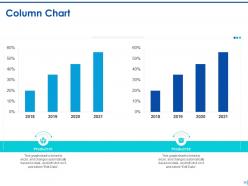
Slide 38: This slide contains a column chart to compare the performance of two products side by side.
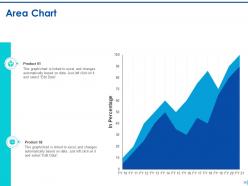
Slide 39: This slide contains an area chart to compare the performance of two products simultaneously.
Slide 40: This slide provides the Mission for the entire company. This includes the vision, the mission, and the goal.
Slide 41: Share your PPT presentation's professional, talented, and creative aspects in this slide.
Slide 42: This is the "my team" slide to share the critical members of your team with their name, designation, and photo.
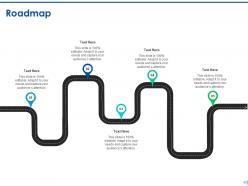
Slide 43: Trace your company's roadmap in light of this presentation in this slide.
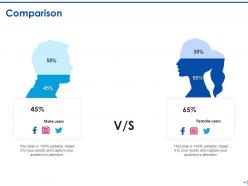
Slide 44: This is the comparison slide to distinguish the number of male and female users in your assessment.
Slide 45: Use this slide to share the timeline of your company's growth and milestones in this slide.
Slide 46: This is a Thank You slide where details such as the address, contact number, email address are added.
Vendor management for enhancing procurement efficiency status powerpoint presentation slides with all 46 slides:
Use our Vendor Management For Enhancing Procurement Efficiency Status Powerpoint Presentation Slides to effectively help you save your valuable time. They are readymade to fit into any presentation structure.
















FAQs for Vendor management for enhancing procurement efficiency status
Check their financials first - last thing you need is them folding halfway through your contract. Technical capabilities are huge too, plus whether they can grow with you. Don't just chase the lowest price (trust me on this one), look at their actual service quality. Security and compliance stuff matters depending on your industry. Their support team better be responsive - nothing worse than being ignored when things break. Oh, and definitely call their references. Maybe make a simple scorecard to compare everyone? That way you're not just going with whoever had the best sales pitch.
Honestly, good vendor management is a total money saver. When you've got solid relationships, negotiating better rates becomes way easier. I always get multiple quotes - makes vendors compete for your business. Consolidating suppliers usually scores you volume discounts too. Here's what really gets people though: those sneaky auto-renewals that suddenly spike your costs. I've watched so many teams get burned by that! Stay on top of your contracts and catch billing mistakes early. Oh, and switching vendors later is expensive as hell, so pick good ones upfront. The sweet spot is when vendors actually want to give you their best deals because they like working with you.
Dude, communication is everything with vendors - seriously makes or breaks the whole thing. Regular check-ins are key, plus being upfront about what you expect from the start. Don't just call when stuff's on fire (guilty as charged lol). Actually give them heads up when your business shifts, tell them how they're doing, work through problems together. Those vendors who feel like actual partners? They'll totally save your butt when crunch time hits. Monthly calls work great, or maybe quarterly if you're both super busy.
Dude, vendor management platforms are a game changer - you can dump all your contracts in one place and actually track performance without losing your mind. Automated alerts handle renewals and compliance stuff so you're not scrambling last minute. The reporting features alone will get back like 5+ hours per week, no joke. Digital onboarding makes new vendor setup way faster too. APIs connect everything automatically which is honestly pretty sweet. I'd say pick your worst headache first - maybe it's contract chaos or payment delays? - then grab whatever tool fixes that specific mess. You can always expand from there.
Here's what works: track quality stuff like defect rates, delivery performance (are they hitting deadlines?), cost variance, and how fast they respond when things go wrong. Most companies go overboard with metrics though - I've seen spreadsheets that are just ridiculous. Stick to what actually matters for your day-to-day operations. Don't forget the relationship side either. Numbers only tell you so much, so do regular check-ins to see how things really feel. Monthly scorecards help you catch problems early instead of scrambling later. Way better than those awkward quarterly reviews where everyone's pretending everything's fine.
Oh man, this stuff matters way more than people think. Different cultures handle communication totally differently - some want you super direct, others think that's incredibly rude. Time zones are annoying but whatever, the real issue is like... decision-making processes. Some vendors need to build a whole relationship first before they'll even talk business, while others just want to see the contract immediately. Religious holidays throw everything off, plus their email style might seem weird to you. Honestly? Find someone on your team who gets cultural differences and let them handle the relationship building part.
Ugh, the worst parts are definitely poor communication and scope creep. Missing deadlines too. It's like herding cats honestly! What's saved my sanity: nail down super clear expectations from day one with solid contracts. Weekly check-ins are a must. Track everything - delivery times, quality, how fast they respond to emails. I learned this the hard way but always have backup vendors ready. Don't wait when problems come up, jump on them immediately. Oh and start building relationships with good vendors now, not when you're panicking and need someone ASAP.
Look, don't make the mistake I've seen so many people make - picking vendors just on price. Big mistake. From the start, bake risk assessment into how you evaluate them. Check their financial health, run credit reports, look at their insurance. How's their cybersecurity? What about compliance stuff? Their business continuity plans actually matter too (learned that one the hard way). When you call references, ask specifically how they handled emergencies or crises. Weight all this risk stuff equally with cost and what they can actually do for you. Trust me on this one.
Look for relationship builders first - that's literally what vendor management is. Strong negotiators who won't get buried in contract details (and there will be SO many). You want strategic thinkers who can also jump into problem-solving mode when vendors mess up. Communication skills matter tons since they're basically translating between your teams and outside partners. Oh, and check your current team first! Someone might already have these skills but just hasn't had the chance to show them yet. Sometimes the best candidates are right there.
Honestly, those regular check-ins are a game changer. Instead of waiting for things to explode, you catch problems early and fix them before they turn into disasters. Vendors love knowing how they're doing too - working blind sucks for everyone. I've found monthly or quarterly calls work best where you both talk through what's crushing it and what needs work. It builds way more trust than just ghosting them between contracts. Small hiccups won't snowball into major headaches, and vendors start feeling like actual partners instead of just... I don't know, random service people you hired once.
Dude, vendor stuff is all about covering your ass legally. Get everything in writing - what they're delivering, when, and how to bail if things go south. If they're touching customer data or anything regulated in your industry, double-check they're compliant. Insurance and indemnification clauses are huge because when vendors screw up, they love pointing fingers at you instead. Oh and honestly? Don't try to DIY the contract language on big deals. Loop in your legal team early - way easier than cleaning up a mess later when something inevitably goes sideways.
Honestly, you've gotta bake compliance right into your vendor process from the start. Figure out what standards actually matter for your business first. Then make sure any potential vendors can hit those marks before you even think about contracts - I've watched companies mess this up and it's painful to see. Regular audits are your friend here. Have them send compliance docs on whatever schedule works for your industry. Oh, and create some kind of scorecard to track how they're doing over time. Trust me, treating compliance as optional is a recipe for disaster. Make it non-negotiable from day one.
Honestly, get a solid onboarding checklist together first - compliance stuff, security docs, all that boring but necessary paperwork. Assign someone from your team to be their go-to person. Trust me, having one point of contact saves everyone headaches later. A proper kickoff meeting makes a huge difference too. You'll want to nail down communication rules and performance metrics right away so nobody's confused about expectations. Oh, and don't forget regular check-ins for the first three months - catches problems before they blow up into bigger issues.
Honestly, vendor management software is pretty clutch for procurement stuff. It puts all your vendor info, contracts, and performance data in one spot instead of having it scattered everywhere. No more digging through endless email threads (thank god). The automation handles boring tasks like PO approvals and invoice matching automatically. You can actually see spending patterns in real-time and figure out which vendors are worth keeping around. Quick comparisons between suppliers become super easy too. I'd say start by looking at where you're wasting the most time with vendor stuff right now - that's usually where you'll see the biggest improvement.
SLAs are basically your safety net - they spell out exactly what vendors need to deliver and when. You're just crossing your fingers and hoping everyone's aligned without them, which honestly never ends well. They give you concrete benchmarks for performance and response times, plus create real accountability when stuff hits the fan. The best part? They actually protect your business by setting up consequences for crappy performance. Oh, and make sure you nail down escalation procedures too. Focus on the metrics that'll make or break your operations first, and don't make penalties so weak they're pointless.
-
Content of slide is easy to understand and edit.
-
Great product with highly impressive and engaging designs.