Waterfall Automated Software Testing Framework Waterfall Project Management PM SS

Rating:
90%
Waterfall Automated Software Testing Framework Waterfall Project Management PM SS
Slide 1 of 9
Favourites Favourites

Try Before you Buy Download Free Sample Product

Audience Impress Your
Audience
Editable 100%
Editable
Time Save Hours
of Time
The Biggest Sale is ending soon in
0
0
:
0
0
:
0
0
Rating:
90%
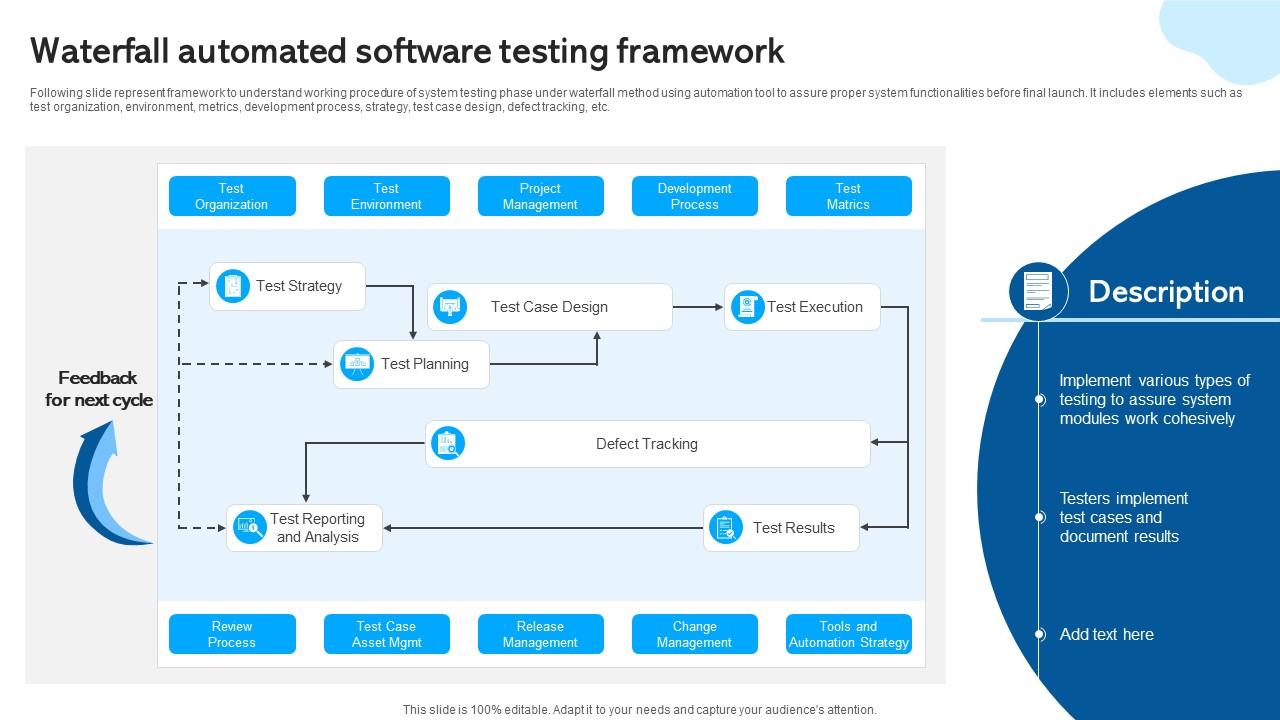
Following slide represent framework to understand working procedure of system testing phase under waterfall method using automation tool to assure proper system functionalities before final launch. It includes elements such as test organization, environment, metrics, development process, strategy, test case design, defect tracking, etc.Deliver an outstanding presentation on the topic using this Waterfall Automated Software Testing Framework Waterfall Project Management PM SS. Dispense information and present a thorough explanation of Test Organization, Test Environment, Change Management using the slides given. This template can be altered and personalized to fit your needs. It is also available for immediate download. So grab it now.

People who downloaded this PowerPoint presentation also viewed the following :

FAQs for Waterfall Automated Software Testing Framework Waterfall Project

The Waterfall Testing Framework operates on sequential phase completion, comprehensive documentation, early requirement definition, phase-gate approvals, and structured defect management. This methodology enables organizations to maintain clear project timelines, ensure thorough quality assurance, and deliver predictable outcomes, with many financial services and healthcare institutions finding that systematic testing approaches ultimately enhance regulatory compliance and reduce deployment risks.

Waterfall Testing Framework follows a sequential, phase-based approach where testing occurs after development completion, while Agile testing integrates continuously throughout iterative development cycles. Unlike Waterfall's comprehensive documentation and structured timelines, Agile emphasizes collaborative testing, rapid feedback loops, and adaptive quality assurance, with many software teams finding that Agile delivers faster deployments and enhanced responsiveness to changing requirements.

The key phases in Waterfall Testing include requirements analysis, test planning, test case design, test environment setup, test execution, and defect reporting. These sequential phases streamline quality assurance by establishing clear documentation, systematic validation processes, and structured defect tracking, with many software development teams finding that this methodical approach ultimately delivers predictable timelines and comprehensive test coverage.

Teams effectively manage documentation throughout the Waterfall Testing lifecycle by establishing comprehensive document templates, implementing version control systems, creating detailed test plans and requirements matrices, and maintaining regular review cycles with stakeholders. Through systematic documentation practices, organizations streamline compliance processes, enhance team communication, and ensure traceability across testing phases, ultimately delivering higher quality products while reducing project risks and facilitating knowledge transfer.

The Waterfall Testing Framework offers structured phase management, comprehensive documentation, clear milestone tracking, predictable resource allocation, and systematic risk assessment for large-scale projects. This approach enables organizations to maintain strict quality controls, ensure regulatory compliance, and deliver consistent outcomes across complex initiatives, with many enterprises finding that the framework's sequential nature minimizes costly rework while enhancing stakeholder confidence.

Teams implementing the Waterfall Testing Framework commonly encounter inflexibility to changing requirements, late defect discovery, resource bottlenecks during testing phases, and communication gaps between development stages. While these challenges can impact project timelines, many organizations find that structured documentation, early test planning, and stakeholder alignment ultimately deliver more predictable outcomes and clearer accountability across development cycles.

Risk management integrates into Waterfall Testing through early risk assessment during requirements analysis, comprehensive risk matrices at each phase gate, and structured mitigation strategies built into testing protocols. Organizations in finance and healthcare leverage these frameworks by implementing phase-specific risk reviews, automated risk tracking systems, and contingency testing scenarios, ultimately delivering more predictable project outcomes and enhanced quality assurance.

Common Waterfall Testing tools include test management platforms like TestRail and qTest, defect tracking systems such as Jira and Bugzilla, automated testing frameworks like Selenium and QTP, and documentation tools including Confluence and SharePoint. These technologies streamline testing workflows by centralizing test case management, automating repetitive validation processes, and enhancing traceability across project phases, ultimately delivering improved quality assurance efficiency and comprehensive audit trails for enterprise development teams.

The Waterfall Testing Framework addresses project requirements gathering through comprehensive upfront documentation, stakeholder interviews, detailed specification creation, and systematic requirement validation before development begins. This structured approach enables organizations to establish clear project scope, minimize costly mid-project changes, and ensure alignment across teams, ultimately delivering more predictable timelines and budget control.

**INPUT**: What strategies can be employed to ensure thorough test case design in Waterfall Testing? **OUTPUT**: Thorough test case design in Waterfall Testing involves requirement traceability matrices, boundary value analysis, equivalence partitioning, decision table testing, and comprehensive documentation reviews. These strategies streamline validation by ensuring complete coverage, identifying edge cases, and maintaining alignment with specifications, with many development teams finding that early test planning ultimately delivers faster deployment cycles and reduced post-release defects. **Word Count**: 57 words

Changes in project scope significantly impact the Waterfall Testing Framework by requiring extensive documentation updates, timeline recalibrations, and potential phase restarts, since testing strategies are defined early and built sequentially. While scope changes present challenges in traditional waterfall environments, organizations in sectors like manufacturing and construction find that structured change control processes, comprehensive impact assessments, and stakeholder alignment ultimately deliver more predictable outcomes than ad-hoc modifications.

Key metrics for evaluating Waterfall testing effectiveness include defect density, test coverage percentage, defect detection efficiency, test execution rates, and cost of quality measurements. These metrics enable organizations to assess testing thoroughness, identify process improvements, and demonstrate ROI, with many software development teams finding that comprehensive metric tracking ultimately delivers higher product quality, reduced post-release issues, and enhanced stakeholder confidence in deliverables.

The Waterfall Testing Framework proves most beneficial in projects with well-defined requirements, regulatory compliance needs, and minimal expected changes, such as government systems, banking applications, and medical device software. These structured environments leverage waterfall's sequential approach to ensure thorough documentation, predictable timelines, and comprehensive testing phases, ultimately delivering reliable systems where quality and compliance outweigh rapid iteration needs.

Teams ensure proper stakeholder communication during Waterfall Testing phases through structured reporting schedules, regular milestone reviews, clear documentation standards, and defined escalation protocols. Through comprehensive test reports and stakeholder dashboards, organizations streamline feedback loops, enhance transparency across project phases, and ultimately deliver more predictable outcomes, with many teams finding that consistent communication reduces late-stage surprises and accelerates final approvals.

Team collaboration ensures clear handoffs between development and testing phases, maintains comprehensive documentation, and enables systematic defect resolution within Waterfall's sequential structure. Effective collaboration helps teams coordinate requirements validation, test case reviews, and stakeholder communication, with many organizations finding that structured collaboration minimizes rework and delivers higher-quality software outcomes.

Ratings and Reviews

90% of 100
Write a review
Most Relevant Reviews
  1. 100%

    by John Walker

    I’ve been your client for a few years now. Couldn’t be more than happy after using your templates. Thank you!
  2. 80%

    by Coleman Henderson

    “Slides are formally built and the color theme is also very exciting. This went perfectly with my needs and saved a good amount of time.”

2 Item(s)

per page: