Web Application Firewall Infra Security
Try Before you Buy Download Free Sample Product
Audience
Editable
of Time
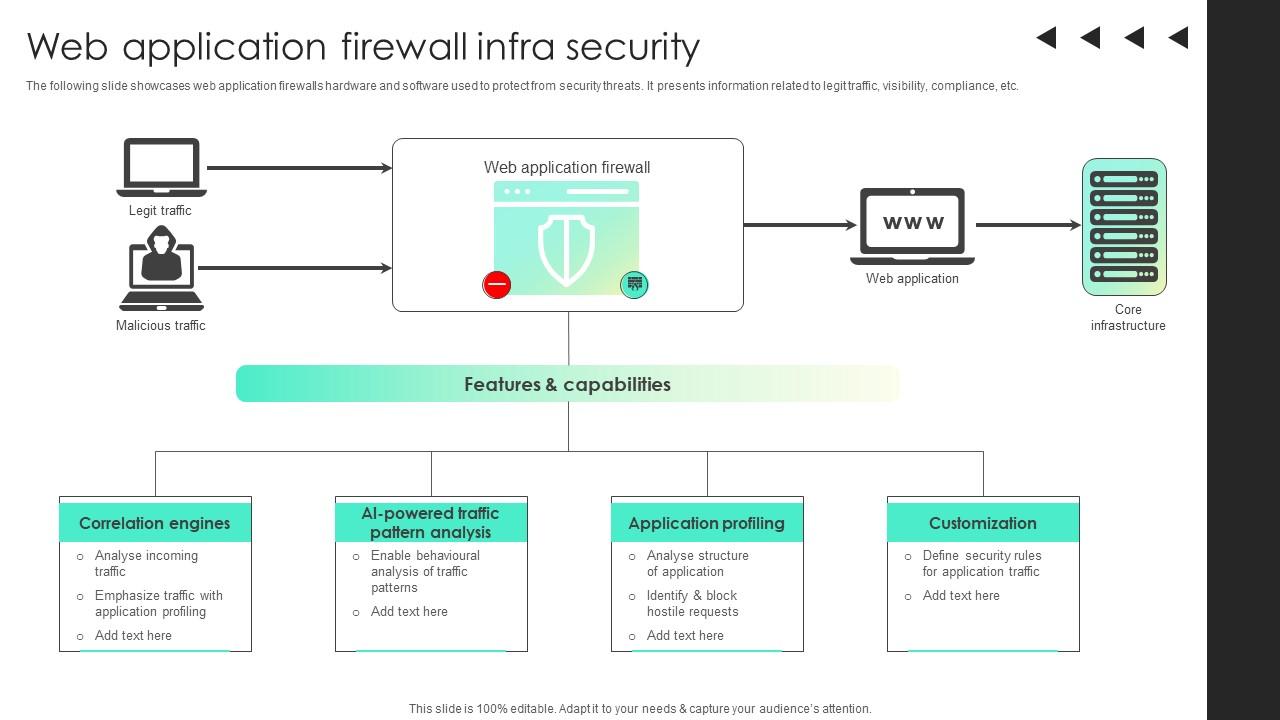
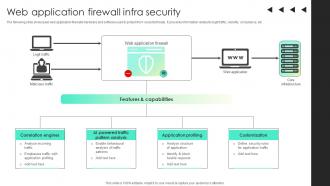
The following slide showcases web application firewalls hardware and software used to protect from security threats. It presents information related to legit traffic, visibility, compliance, etc.
People who downloaded this PowerPoint presentation also viewed the following :
Web Application Firewall Infra Security with all 6 slides:
Use our Web Application Firewall Infra Security to effectively help you save your valuable time. They are readymade to fit into any presentation structure.
FAQs for Web Application
A Web Application Firewall (WAF) is a security solution that monitors, filters, and blocks HTTP traffic between web applications and users, focusing on application-layer threats like SQL injection and cross-site scripting. Unlike traditional network firewalls that control traffic based on IP addresses and ports, WAFs analyze actual web content and application logic, enabling organizations to protect against sophisticated attacks targeting their web applications while maintaining seamless user experiences.
Web Application Firewall (WAF) most effectively mitigates SQL injection, cross-site scripting (XSS), cross-site request forgery (CSRF), DDoS attacks, and bot-based intrusions. These security layers streamline protection by filtering malicious traffic, blocking automated threats, and monitoring suspicious patterns, with many financial institutions and e-commerce platforms finding that WAFs ultimately deliver enhanced security posture and operational continuity.
A WAF improves web application security posture by filtering malicious traffic, blocking SQL injection and cross-site scripting attacks, and providing real-time threat monitoring and response capabilities. Through automated protection mechanisms, organizations streamline security operations, reduce vulnerability exposure, and enhance compliance readiness, while enabling faster incident response and ultimately delivering stronger customer trust and competitive advantage.
Key features to look for in a WAF solution include real-time threat detection, application-layer filtering, DDoS protection, SSL/TLS encryption support, and customizable security rules. These technologies enhance cybersecurity by blocking malicious traffic, preventing data breaches, and ensuring compliance standards, with many financial institutions and e-commerce platforms finding that comprehensive WAF solutions ultimately deliver stronger customer trust and operational resilience.
WAFs integrate with existing security frameworks through APIs, SIEM platforms, identity management systems, and threat intelligence feeds, creating comprehensive defense layers. These integrations enable organizations to centralize security monitoring, automate incident response, and correlate web attack data with broader network threats, ultimately delivering enhanced visibility and streamlined security operations across enterprise environments.
Machine learning enhances modern WAF solutions by enabling real-time threat detection, automated pattern recognition, behavioral analysis, and adaptive security responses that evolve with emerging attack vectors. Through ML algorithms, organizations can minimize false positives, accelerate threat identification, and streamline security operations, with many financial services and e-commerce platforms finding significantly improved protection against sophisticated, previously unknown attacks.
Regular WAF updates and patch management are crucial for maintaining protection against evolving cyber threats, ensuring optimal performance, and addressing newly discovered vulnerabilities. Without consistent updates, organizations face increased security gaps, with many financial services and e-commerce platforms finding that automated patch management significantly reduces breach risks while maintaining seamless operational efficiency.
A WAF assists compliance by implementing data protection controls, monitoring sensitive transactions, blocking unauthorized access attempts, and maintaining detailed audit logs required by GDPR and PCI DSS frameworks. Through automated threat detection and real-time monitoring, financial institutions and healthcare organizations streamline regulatory reporting while ensuring continuous protection of customer data, ultimately delivering compliance confidence and reduced audit complexities.
Web application firewalls typically introduce minimal latency, usually 1-5 milliseconds per request, while potentially reducing overall system load through traffic filtering, DDoS protection, and malicious request blocking. Modern cloud-based WAFs enable improved performance through content delivery networks and caching, with many organizations finding that enhanced security and reduced server strain ultimately deliver faster user experiences and lower infrastructure costs.
Businesses can measure WAF effectiveness through metrics like blocked attack attempts, false positive rates, response time impact, and successful threat detection accuracy. By monitoring these indicators alongside specific scenarios such as SQL injection prevention and DDoS mitigation, organizations can optimize their security posture, reduce breach risks, and ensure seamless user experiences while maintaining robust protection.
Network-based WAFs are deployed on-premises as hardware appliances or software within an organization's infrastructure, providing direct control over security policies and data handling. Cloud-based WAFs operate as managed services through providers like AWS or Cloudflare, offering scalable protection without hardware investment, automatic updates, and global threat intelligence, with many organizations finding that cloud solutions deliver faster deployment and reduced operational overhead.
WAFs handle false positives through machine learning algorithms, whitelist configurations, behavioral analysis, and continuous rule tuning that adapts to legitimate traffic patterns. Advanced WAF systems minimize false negatives by combining signature-based detection, anomaly detection, and threat intelligence feeds, with many organizations finding that modern WAFs achieve over 99% accuracy while enabling seamless user experiences.
Common WAF misconceptions include believing they provide complete security protection, can replace all other security measures, block every attack type, require no ongoing maintenance, and work effectively without proper configuration. Many organizations find that WAFs are strategic components within layered security architectures, requiring continuous tuning, regular updates, and skilled management to deliver optimal protection against evolving threats while maintaining application performance.
WAF integrates seamlessly with DDoS protection, SIEM systems, intrusion detection, and endpoint security to create comprehensive defense layers. This strategic combination enables organizations to filter malicious traffic at multiple points, automatically share threat intelligence across security tools, and maintain continuous protection, with many enterprises finding that layered security architectures significantly reduce breach risks while ensuring business continuity.
Best practices for configuring a WAF include implementing comprehensive rule sets, enabling real-time threat intelligence updates, configuring custom security policies based on application requirements, setting up proper logging and monitoring, and regularly tuning rules to minimize false positives. These configurations enhance protection by filtering malicious traffic, blocking SQL injection and cross-site scripting attacks, and providing detailed security analytics, with many organizations finding that strategic WAF deployment significantly reduces cyber threats while maintaining optimal application performance.
-
I am a big fan of their newsletters because that is how I found my perfect requirement at the time of urgency. Thank God, I kept opening those.
-
“Thanks to SlideTeam. Now I can make smart presentations in a fraction of time without any hassle.”