


What is phishing attack ppt powerpoint presentation model graphics pictures




Try Before you Buy Download Free Sample Product
 Impress Your
 Audience
 100%
100% Editable
 Save Hours
 of Time


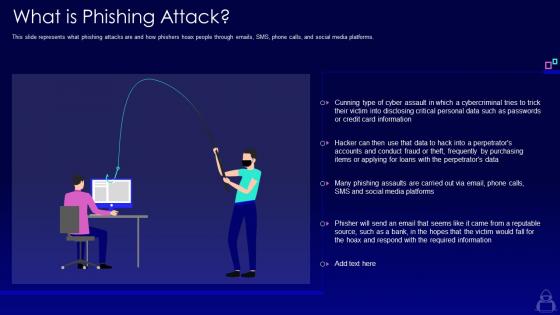
This slide represents what phishing attacks are and how phishers hoax people through emails, SMS, phone calls, and social media platforms.
People who downloaded this PowerPoint presentation also viewed the following :
What is phishing attack ppt powerpoint presentation model graphics pictures with all 6 slides:
Use our What Is Phishing Attack Ppt Powerpoint Presentation Model Graphics Pictures to effectively help you save your valuable time. They are readymade to fit into any presentation structure.





FAQs for What is phishing attack ppt powerpoint presentation
Common signs of a phishing attack include suspicious sender addresses, urgent language demanding immediate action, generic greetings, spelling errors, unexpected attachments, and requests for sensitive information. These warning signals help individuals identify fraudulent communications by recognizing inconsistent branding, unusual URLs, and pressure tactics, ultimately enabling organizations to strengthen their security awareness and reduce successful breach attempts across their workforce.
Businesses can train employees through simulated phishing exercises, interactive workshops, regular security awareness sessions, and clear reporting protocols for suspicious emails. These comprehensive programs enhance recognition skills by teaching employees to identify suspicious links, verify sender authenticity, and scrutinize urgent requests, while establishing immediate response procedures that ultimately reduce organizational vulnerability and strengthen overall cybersecurity posture.
Social engineering serves as the psychological foundation of phishing attacks, manipulating human emotions like urgency, fear, curiosity, and trust to bypass technical security measures. These tactics exploit cognitive biases and behavioral patterns, with attackers crafting convincing scenarios that prompt immediate action, ultimately making even security-aware individuals vulnerable to sophisticated deception techniques.
Organizations implement multi-factor authentication by combining passwords with secondary verification methods like SMS codes, authenticator apps, biometric scans, and hardware tokens. These layered security approaches significantly reduce phishing success rates by requiring attackers to compromise multiple authentication factors, with many financial institutions and healthcare organizations finding that MFA delivers enhanced security while maintaining seamless user experiences.
Latest phishing trends include AI-generated deepfake communications, business email compromise targeting supply chains, smishing through SMS platforms, voice phishing using caller ID spoofing, and sophisticated social engineering via LinkedIn profiles. These evolved techniques exploit remote work vulnerabilities, cryptocurrency platforms, and cloud service integrations, with cybercriminals increasingly leveraging automation and personalization to bypass traditional security measures, ultimately requiring organizations to adopt multi-layered defense strategies.
Phishing attacks severely damage organizational reputation by exposing customer data, creating security doubts, and demonstrating inadequate protection measures. These breaches erode customer confidence, trigger regulatory scrutiny, and generate negative publicity, with many financial institutions and retailers finding that recovery requires extensive transparency efforts, enhanced security investments, and sustained customer communication to rebuild trust.
Phishing detection and prevention tools include email security gateways, anti-phishing software, URL filtering systems, DNS protection services, and AI-powered threat intelligence platforms. These technologies streamline security by blocking malicious emails, scanning suspicious links, and analyzing behavioral patterns, with many financial institutions and healthcare organizations finding that layered approaches ultimately deliver enhanced protection and reduced breach risks.
Companies develop comprehensive phishing incident response plans by establishing clear detection protocols, defining response team roles, creating communication workflows, implementing containment procedures, and conducting regular training exercises. These frameworks enable organizations to minimize damage through rapid threat isolation, systematic evidence collection, and coordinated recovery efforts, with many financial institutions and healthcare providers finding that structured response plans reduce incident resolution time by sixty percent.
Organizations face significant legal implications including regulatory fines, compliance violations, breach notification requirements, potential lawsuits, and liability for compromised customer data. These consequences vary by industry and jurisdiction, with healthcare and financial sectors facing particularly severe penalties, while many companies finding that comprehensive cybersecurity frameworks and incident response plans help mitigate legal exposure.
Spear-phishing targets specific individuals or organizations with personalized, researched content, while broad email campaigns cast wide nets using generic messages to reach thousands of recipients simultaneously. Spear-phishing attacks typically achieve higher success rates through customized social engineering, often targeting executives in financial services or healthcare, whereas broad campaigns rely on volume and basic psychological triggers, ultimately making spear-phishing significantly more dangerous for organizations.
Effective email filtering practices include implementing domain authentication protocols, configuring sender reputation checks, enabling attachment scanning, setting up keyword-based filtering rules, and establishing user reporting mechanisms. These security measures work by blocking suspicious domains, quarantining questionable attachments, and flagging deceptive language patterns, with many organizations finding that layered filtering approaches reduce phishing incidents by over 90% while maintaining seamless communication flow.
Individuals can protect themselves from phishing scams by verifying sender authenticity, avoiding suspicious links, using multi-factor authentication, keeping software updated, and enabling email filters. These security practices work by creating multiple defense layers, reducing vulnerability to fraudulent communications, and ensuring personal data remains secure, with many users finding that consistent vigilance and proactive measures significantly minimize their exposure to cybercriminal tactics.
Immediately change all passwords, contact your bank and credit card companies, run antivirus scans, and report the incident to relevant authorities and your IT department. These rapid response measures help minimize damage by securing compromised accounts, monitoring for fraudulent activity, and removing malware, with many organizations finding that swift action significantly reduces financial losses and prevents further data breaches.
Organizations assess phishing resilience through simulated phishing campaigns, employee reporting metrics, click-through rate analysis, and security awareness assessments. These testing programs enable companies to identify vulnerable departments, measure behavioral improvements over time, and tailor training programs accordingly, with many financial services and healthcare organizations finding that regular simulations reduce susceptibility rates by 60-80%.
Continuous education and awareness serve as critical frontlines against phishing threats by keeping employees informed about evolving attack methods, recognizing suspicious communications, and implementing proper response protocols. Through regular training programs and simulated phishing exercises, organizations across sectors like banking, healthcare, and retail significantly reduce successful breach rates, while building a security-conscious culture that ultimately strengthens overall cybersecurity posture.
-
Use of icon with content is very relateable, informative and appealing.
-
Excellent work done on template design and graphics.