Workflow And Task Automation Through ERP Modernizing Production Through Robotic Process Automation

Rating:
100%
Workflow And Task Automation Through ERP Modernizing Production Through Robotic Process Automation
Slide 1 of 6
Favourites Favourites

Try Before you Buy Download Free Sample Product

Audience Impress Your
Audience
Editable 100%
Editable
Time Save Hours
of Time
The Biggest Sale is ending soon in
0
0
:
0
0
:
0
0
AI-Ready
Upload this template to AI and ask it to make any changes to content or color
100% editable Powerpoint Template for AI-assisted presentations. Finish your work in less time. Download Prompt Kit ​
Works with
Microsoft PowerPoint
Microsoft 365
Claude for PowerPoint
ChatGPT
Google Slides
Microsoft Copilot
Rating:
100%
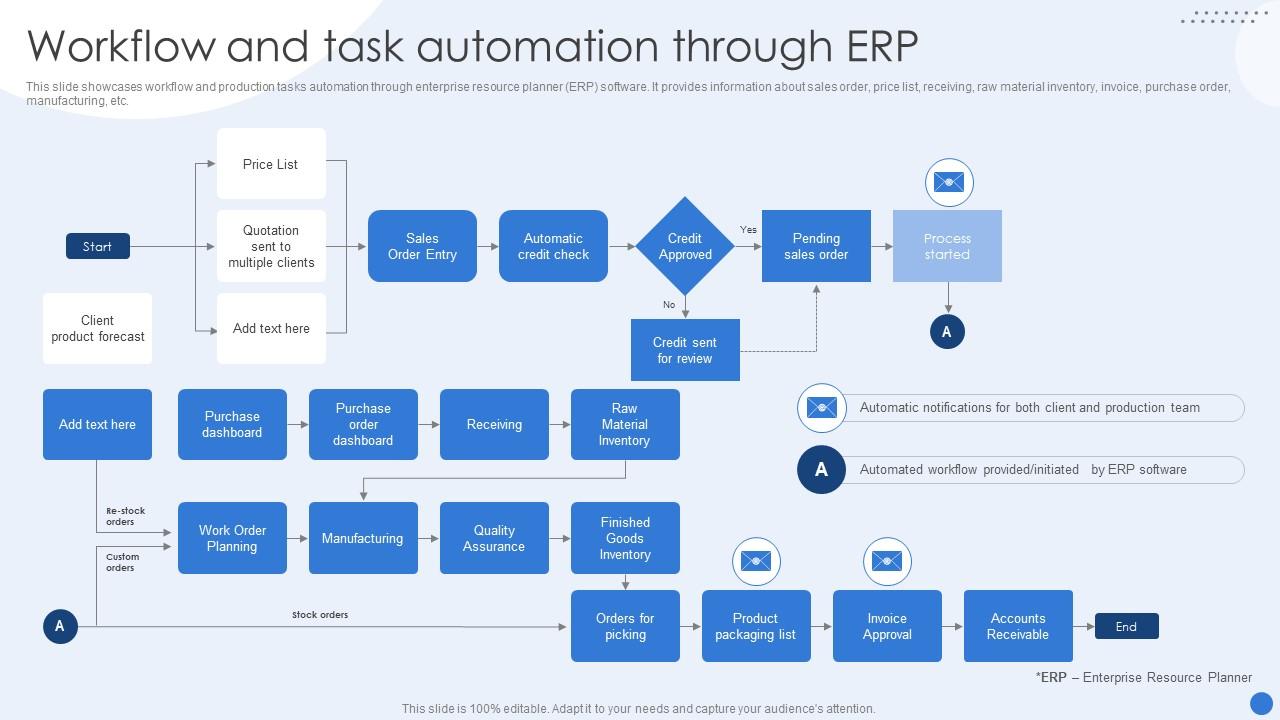
This slide showcases workflow and production tasks automation through enterprise resource planner ERP software. It provides information about sales order, price list, receiving, raw material inventory, invoice, purchase order, manufacturing, etc. Present the topic in a bit more detail with this Workflow And Task Automation Through ERP Modernizing Production Through Robotic Process Automation. Use it as a tool for discussion and navigation on Client Product Forecast, Purchase Dashboard, Quality Assurance. This template is free to edit as deemed fit for your organization. Therefore download it now.

FAQs for Workflow And Task Automation Through ERP Modernizing Production Through

Key benefits of implementing workflow automation include increased operational efficiency, reduced manual errors, faster task completion, improved resource allocation, and enhanced employee productivity. These technologies streamline repetitive processes by eliminating bottlenecks, standardizing procedures, and enabling real-time tracking, with many organizations finding that automation delivers significant cost savings while freeing staff for strategic work.

Workflow automation improves team collaboration and efficiency by eliminating manual handoffs, standardizing processes, and providing real-time visibility into project status. These systems streamline communication through automated notifications, reduce bottlenecks by routing tasks intelligently, and enable teams to focus on strategic work, ultimately delivering faster project completion and enhanced productivity across organizations.

Common mistakes include selecting overly complex processes initially, insufficient stakeholder training, poor change management, inadequate system integration planning, and unrealistic timeline expectations. Organizations often find success by starting with simple, repetitive tasks like invoice processing or employee onboarding, while ensuring comprehensive staff preparation and gradual implementation, ultimately delivering smoother transitions and higher adoption rates.

Small businesses can leverage workflow automation to compete with larger enterprises by streamlining repetitive tasks, reducing operational costs, and accelerating customer response times through automated processes. These technologies enable smaller organizations to deliver enterprise-level efficiency in areas like customer service, inventory management, and financial processing, with many finding that automation helps them operate leaner teams while maintaining higher service quality and faster delivery times.

Software integration serves as the foundational backbone of successful workflow automation, enabling seamless data flow between disparate systems, eliminating manual data entry, and creating unified operational processes. Through integrated platforms, organizations in sectors like healthcare, finance, and manufacturing can automate complex multi-system workflows, ultimately reducing errors by up to 90% while accelerating processing times and enhancing overall operational efficiency.

Workflow automation enhances customer experience by reducing response times, eliminating manual errors, and ensuring consistent service delivery across all touchpoints. Through automated processes, businesses streamline customer inquiries, accelerate order processing, and provide real-time updates, with many retail and financial services organizations finding that customers receive faster, more reliable interactions, ultimately delivering higher satisfaction and competitive advantage.

When selecting a workflow automation tool, consider integration capabilities, scalability, user interface complexity, customization options, and security features. Organizations should evaluate how well the platform connects with existing systems, handles increasing workloads, and supports diverse user skill levels, with many companies finding that comprehensive tools ultimately deliver better ROI and operational efficiency.

Workflow automation enhances regulatory compliance by standardizing processes, maintaining comprehensive audit trails, and ensuring consistent adherence to industry requirements. Through automated documentation and real-time monitoring, organizations in healthcare, financial services, and manufacturing can minimize human error, accelerate reporting timelines, and demonstrate regulatory adherence more effectively, ultimately reducing compliance costs while strengthening oversight capabilities.

Key metrics include process completion time, error reduction rates, cost per transaction, employee productivity scores, and customer satisfaction levels. These measurements enable organizations to quantify automation's impact across departments like finance, HR, and operations, with many companies finding that tracking throughput improvements and resource reallocation delivers measurable competitive advantage.

Workflow automation can be customized through configurable rule sets, industry-specific templates, flexible integration APIs, custom approval hierarchies, and tailored notification systems. Financial services customize automated compliance checks and loan processing workflows, while healthcare organizations streamline patient intake and insurance verification processes, ultimately delivering faster operations and reduced manual errors across diverse business requirements.

Scaling workflow automation presents challenges including integration complexity across diverse systems, maintaining data consistency, managing user adoption resistance, ensuring security compliance, and balancing customization with standardization. While these hurdles require strategic planning and resource allocation, many growing businesses find that phased implementation approaches, comprehensive staff training, and robust governance frameworks ultimately deliver enhanced operational efficiency and sustainable competitive advantage.

Teams ensure workflow flexibility by implementing modular automation architectures, establishing regular review cycles, and maintaining manual override capabilities. Through configurable rule engines and API-based integrations, organizations can quickly adjust automated processes as business requirements evolve, with many companies finding that flexible automation frameworks ultimately deliver greater ROI and operational resilience.

Organizations should implement structured onboarding programs, provide role-specific training modules, establish peer mentoring systems, and create accessible documentation with real-world scenarios. These approaches enhance adoption by offering hands-on practice sessions, regular feedback loops, and continuous learning opportunities, with many companies finding that combining formal training with practical application ultimately delivers improved productivity and employee confidence in automated workflows.

AI and machine learning enhance traditional workflow automation by enabling intelligent decision-making, predictive analytics, and adaptive process optimization rather than just rule-based task execution. These technologies streamline operations through pattern recognition, anomaly detection, and dynamic routing, with many organizations finding that AI-powered workflows reduce processing times, minimize errors, and deliver significantly improved operational efficiency.

Future trends in workflow automation include AI-driven intelligent automation, no-code/low-code platforms, hyper-automation combining multiple technologies, predictive analytics integration, and enhanced human-AI collaboration frameworks. These developments enable organizations to automate complex decision-making processes, democratize automation across departments, and deliver significantly improved operational efficiency, with many businesses finding that strategic automation adoption creates sustainable competitive advantages in increasingly dynamic markets.

Ratings and Reviews

100% of 100
Review Form
Write a review
Most Relevant Reviews
  1. 100%

    by Cleo Long

    Great templates that you can use in your next keynote or conference. They are perfect for quick and visually-engaging delivery. 
  2. 100%

    by Oscar Davis

    The website is jam-packed with fantastic and creative templates for a variety of business concepts. They are easy to use and customize.

2 Item(s)

per page: