Working set operating system ppt powerpoint presentation layouts maker cpb

Rating:
92%
Working set operating system ppt powerpoint presentation layouts maker cpb
Slide 1 of 2
Favourites Favourites

Try Before you Buy Download Free Sample Product

Audience Impress Your
Audience
Editable 100%
Editable
Time Save Hours
of Time
The Biggest Sale is ending soon in
0
0
:
0
0
:
0
0
Rating:
92%
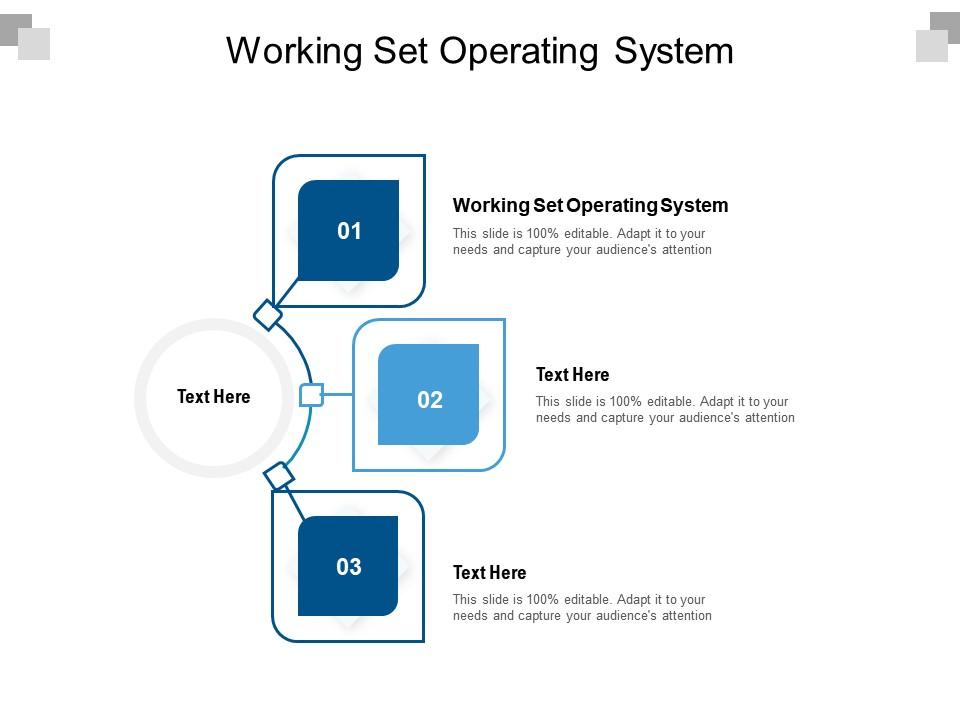
Presenting Working Set Operating System Ppt Powerpoint Presentation Layouts Maker Cpb slide which is completely adaptable. The graphics in this PowerPoint slide showcase three stages that will help you succinctly convey the information. In addition, you can alternate the color, font size, font type, and shapes of this PPT layout according to your content. This PPT presentation can be accessed with Google Slides and is available in both standard screen and widescreen aspect ratios. It is also a useful set to elucidate topics like Working Set Operating System. This well-structured design can be downloaded in different formats like PDF, JPG, and PNG. So, without any delay, click on the download button now.

People who downloaded this PowerPoint presentation also viewed the following :

FAQs for Working set operating system ppt powerpoint presentation

A working set represents the collection of memory pages that a process actively references during a specific time window, serving as a critical metric for predicting future memory access patterns and optimizing system performance. This concept enables operating systems to make intelligent decisions about page replacement, memory allocation, and process scheduling, with many enterprise systems finding that working set algorithms significantly reduce page faults, minimize thrashing, and ultimately deliver more efficient resource utilization across complex computational workloads.

The working set model enhances multitasking performance by tracking each process's actively used memory pages, enabling intelligent memory allocation, reducing page faults, and minimizing thrashing between competing processes. Through predictive memory management, operating systems streamline resource distribution across concurrent applications, ultimately delivering faster task switching, improved system responsiveness, and enhanced overall throughput in demanding multitasking environments.

Modern operating systems implement working sets through page reference tracking, demand paging algorithms, and memory management units that monitor access patterns over time windows. Systems like Windows and Linux use hardware-assisted tracking and software algorithms to identify frequently accessed pages, automatically adjusting memory allocation based on application behavior, ultimately delivering optimized performance and efficient resource utilization across enterprise environments.

The primary factors influencing working set size include program locality patterns, memory access frequency, process execution phase, available physical memory, and page replacement algorithms. These factors interact dynamically, with applications in data processing, database management, and scientific computing finding that optimized memory allocation significantly enhances performance while reducing system overhead, ultimately delivering faster processing and improved resource utilization.

Working set algorithms determine page retention by monitoring each process's recent memory access patterns, typically tracking pages referenced within a specific time window or number of recent page faults. These algorithms maintain pages that show active usage while swapping out those with longer idle periods, with many operating systems finding that this approach significantly reduces thrashing, minimizes unnecessary page faults, and ultimately delivers more efficient memory utilization across concurrent processes.

Operating systems face significant challenges in accurately estimating working sets for dynamic applications, including unpredictable memory access patterns, varying computational phases, and rapidly changing data structures that make historical prediction models less effective. These complexities require sophisticated monitoring algorithms and adaptive memory management strategies, with many enterprise systems finding that machine learning-based prediction models and real-time usage analytics ultimately deliver more accurate estimations and improved performance optimization.

The working set concept directly exploits locality of reference by identifying pages frequently accessed together within specific time windows, enabling operating systems to predict future memory needs based on recent usage patterns. Through temporal and spatial locality principles, systems can preload related pages, reduce page faults, and optimize memory allocation, with database management systems and enterprise applications finding significantly improved performance and reduced thrashing incidents.

**INPUT**: What techniques can be used to minimize page faults in systems that utilize a working set strategy? **OUTPUT**: Techniques include dynamic working set size adjustment, locality-aware prefetching, temporal prediction algorithms, memory compression, and intelligent page replacement policies. These strategies enhance system performance by reducing memory access latencies, optimizing resource allocation, and improving application responsiveness, with many organizations finding that strategic memory management ultimately delivers faster processing and competitive operational efficiency.

Workload variations significantly impact working set efficiency through memory access patterns, temporal locality changes, and resource allocation demands. Applications with frequent context switches or irregular access patterns challenge traditional algorithms, while predictable workloads enable better optimization, with many systems finding that adaptive management strategies ultimately deliver improved performance and reduced overhead.

Windows uses demand paging with working set trimming and memory balancing, Linux employs page replacement algorithms like LRU with swap management, and macOS utilizes compressed memory alongside traditional paging mechanisms. These approaches enable organizations to optimize system performance, reduce memory bottlenecks, and enhance application responsiveness, with many enterprises finding that proper working set management significantly improves operational efficiency and user productivity across diverse computing environments.

Cache memory and virtual memory are fundamental to working set efficiency, with cache providing high-speed access to frequently used pages while virtual memory enables seamless page swapping between RAM and storage. Through strategic page replacement algorithms, operating systems optimize memory hierarchies by keeping active working set pages in faster cache levels, while virtual memory manages overflow to secondary storage, ultimately delivering faster application performance and enhanced system resource utilization across enterprise environments.

Performance monitoring tools assist in analyzing working set behavior by tracking memory usage patterns, page fault frequencies, and resource allocation over time. These tools enable developers to identify memory bottlenecks, optimize application performance, and predict scaling requirements, with many organizations finding that proactive monitoring significantly reduces system crashes and enhances overall operational efficiency.

An improperly sized working set creates significant performance bottlenecks through excessive page faults, memory thrashing, and reduced application responsiveness across enterprise environments. These inefficiencies manifest in slower database queries, delayed transaction processing, and compromised user experiences, with many organizations finding that optimal working set management ultimately delivers improved resource utilization and competitive operational efficiency.

Hardware advancements like increased RAM and faster SSDs significantly enhance working set strategies by enabling larger active memory allocations, reducing page fault penalties, and streamlining memory management algorithms. These improvements allow operating systems to maintain more extensive working sets while delivering faster context switching, improved application responsiveness, and reduced I/O overhead, ultimately enabling better resource utilization across enterprise environments.

Future developments in working set theory include machine learning-driven memory prediction algorithms, containerized workload optimization, real-time adaptive page replacement, and cloud-native memory management systems. These advancements enable operating systems to anticipate application behavior patterns, optimize resource allocation across distributed environments, and deliver significantly improved performance while reducing memory overhead, with many cloud providers finding that intelligent working set management enhances scalability and cost efficiency.

Ratings and Reviews

92% of 100
Write a review
Most Relevant Reviews
  1. 80%

    by Duncan Berry

    Awesome use of colors and designs in product templates.
  2. 100%

    by Harry Williams

    Great product with highly impressive and engaging designs.
  3. 100%

    by Darron Hunter

    I discovered this website through a google search, the services matched my needs perfectly and the pricing was very reasonable. I was thrilled with the product and the customer service. I will definitely use their slides again for my presentations and recommend them to other colleagues.
  4. 80%

    by O'Sullivan Evans

    Really like the color and design of the presentation.
  5. 100%

    by Oscar Davis

    Helpful product design for delivering presentation.

5 Item(s)

per page: