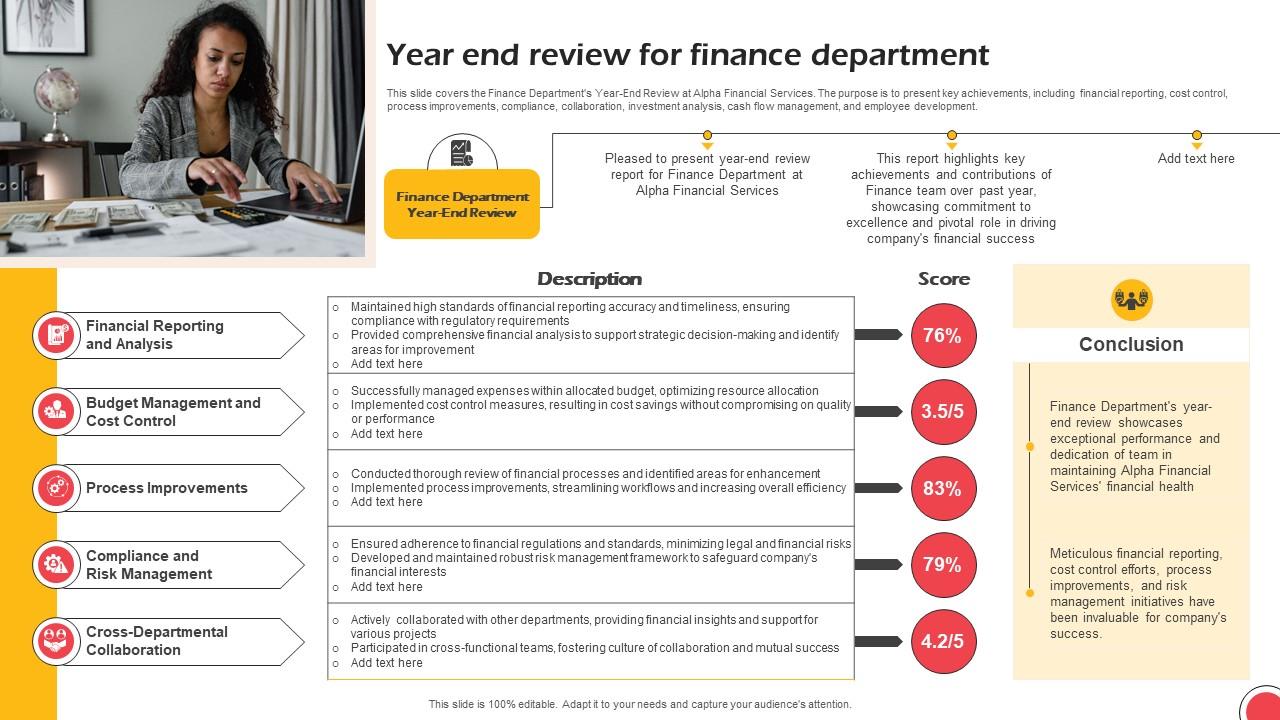
Year End Review For Finance Department

Rating:
90%
A slide detailing a year end review report for the Finance Department at Alpha Financial Services, highlighting achievements in financial reporting and analysis, budget management, process improvements, compliance, risk management, cross departmental coll
Slide 1 of 9
Favourites Favourites

Try Before you Buy Download Free Sample Product

Audience Impress Your
Audience
Editable 100%
Editable
Time Save Hours
of Time
The Biggest Sale is ending soon in
0
0
:
0
0
:
0
0
AI-Ready
Upload this template to AI and ask it to make any changes to content or color
100% editable Powerpoint Template for AI-assisted presentations. Finish your work in less time. Download Prompt Kit ​
Works with
Microsoft PowerPoint
Microsoft 365
Claude for PowerPoint
ChatGPT
Google Slides
Microsoft Copilot
Rating:
90%
This slide presents a year end review performance evaluation form for a Research Manager. It aims to assess KPIs, achievements, qualitative targets, identify areas of excellence, areas for development, and an action plan. It includes project completion, reports quality, etc.Introducing our Year End Review For Finance Department set of slides. The topics discussed in these slides are Research Project Completion, Quality Research, Timeliness Deliverables. This is an immediately available PowerPoint presentation that can be conveniently customized. Download it and convince your audience.

FAQs for Year End Review

Cash flow's the big one - you can be making money on paper but still crash if you run out of actual cash. Gross margins matter too. I'd watch your current ratio for liquidity stuff and maybe debt-to-equity if you're borrowing much. Oh, and accounts receivable turnover because slow customers are the worst for cash flow. Don't just check quarterly when your accountant makes you - do it monthly. Honestly, pick like 3-4 that actually apply to your business and throw them in a simple spreadsheet or something. Revenue growth's obvious but yeah, track that too.

Look at your cash flow from the same quarter last year first, then factor in any changes coming up - new contracts, big expenses, seasonal stuff. Break it down weekly instead of monthly because timing matters way more than you think. I always create three scenarios: best case, worst case, and realistic (spoiler: realistic usually wins). Pay close attention to when you'll actually collect receivables - that's where most forecasts fall apart. Update weekly and track how close your predictions were so you get better at this over time.

So interest rates are basically what makes borrowing expensive or cheap for your company. Low rates? Debt financing becomes a no-brainer for expansions or acquisitions. When they're high, you'll probably want to look at equity instead or just wait it out. The crazy thing is how fast this can change your whole capital structure plan. Your cost of capital shifts too, which messes with how you evaluate returns on investments. I always tell people to run a few different rate scenarios before making any big financing decisions - learned that one the hard way!

Honestly, cash flow is everything right now - protect that first. Cut the stuff that doesn't directly make you money, but don't touch anything that brings revenue in. I'd actually map out best and worst case scenarios (skip the overly optimistic projections for once). Keep way more cash on hand than you normally would. Avoid signing anything long-term if you can help it. The whole point is staying flexible so you can change direction fast when things get weird. Go through your expenses monthly and ask what's actually necessary vs just nice to have. Those regular check-ins will save you.

You gotta nail your cash conversion cycle - collect faster, keep inventory tight but not *too* tight (trust me on this one), and stretch out payments to suppliers without pissing them off. Automate invoicing and chase down late payments like your life depends on it. Offer early payment discounts to customers while sweet-talking vendors into longer terms. I swear by checking working capital ratios weekly instead of monthly - catches problems way earlier. Also maybe don't go as lean on inventory as I did last year... that was a nightmare lol.

So financial ratios are basically like a health checkup for companies - you're comparing numbers from their financial reports to see what's actually going on. Look at liquidity ratios first (can they pay their bills?), then profitability ones to see if they're making real money. Debt ratios show if they're buried under loans. I always check these three categories because honestly, most analysts overthink this stuff. You'll catch trends, spot problems early, and see how they stack up against competitors. It's way easier than reading through pages of financial statements.

Ugh, inflation totally messes with your money's buying power over time. Stocks and real estate usually beat inflation rates, so those are solid bets. TIPS are decent too - they're government bonds that adjust for inflation. Regular bonds though? They kinda suck when prices are rising because you're locked into those low returns. I got burned on that in 2021, not fun. Oh and if you're sitting on tons of cash right now, definitely look at moving some into these inflation-proof assets. Your portfolio needs to grow faster than inflation or you're basically losing money.

Honestly, cloud accounting software is a game changer for this stuff. It pulls data from everywhere automatically - journal entries, reconciliations, dashboards updating in real time. Power BI and Tableau make everything visual instead of boring spreadsheet hell (which I personally can't stand anymore). The trick is getting all your systems connected so they actually talk to each other. Oh, and don't try to automate everything at once - that's overwhelming. Just pick one annoying manual task you're doing and find a tech fix for that first. Build from there.

So basically, equity means you're giving away pieces of your company but never have to pay anyone back. No monthly stress about payments. Downside though? Those investors own part of your profits forever and get a say in decisions. Debt's the opposite - you keep everything but you're locked into those monthly payments whether business is good or terrible. At least the interest is tax-deductible, which helps a bit. Really depends on your situation. Got steady cash flow and hate sharing control? Go debt. Need breathing room and don't mind partners? Equity works.

Okay so market trends basically tell you what direction things are moving, which totally changes how risky something actually is. You can't just look at one stock or investment by itself - gotta see how the whole market's doing, what's happening in that sector, stuff like that. A solid company can still get crushed if their whole industry's going downhill, you know? Plus looking at past trends shows you how volatile things usually get and whether investments tend to move together. Honestly I think the worst mistake is only focusing on individual numbers without checking what the broader trends are saying first.

Honestly, you've got to think way beyond just the first year's numbers. Look at your cash flows and ROI across the whole timeline - maybe 5-10 years out. The total ownership costs will bite you if you're not careful (maintenance, upgrades, all that fun stuff). Market shifts can be brutal over that timeframe, so don't assume today's landscape stays the same. Regulatory stuff might screw with your plans too, especially if you're in tech or healthcare. Build out three scenarios - best case, worst case, and realistic. Oh, and make sure this actually fits where your company's heading long-term. Nothing worse than a big investment that becomes irrelevant because you pivoted strategies.

Get that emergency fund going first - like 3-6 months of expenses saved up. Diversify your income so you're not screwed if one client bails. Banks are weird about this, but build relationships with lenders BEFORE you need money. Seriously, apply for a credit line while business is good - they'll laugh you out when you're desperate. Keep expenses lean, obviously. Oh, and run those cash flow numbers every few months. Play the "what if everything goes wrong" game with your projections. Sounds paranoid but it works.

Look, aggressive financial reporting is basically playing with fire. Sure, you might make your numbers look prettier short-term, but you're setting yourself up for a world of hurt. Investors and creditors will lose trust when they figure out what's going on - and they always do eventually. The legal risks alone should scare you off this path. Regulatory scrutiny, lawsuits, reputation damage that lasts forever... honestly, I've seen companies never fully recover from this stuff. Just be conservative with your reporting. Yeah, it's boring, but at least you'll sleep at night knowing you're not walking into a disaster.

So you can dig into your financial data to spot trends and forecast cash flow - basically figure out what's actually making money vs what just looks busy. Most companies are sitting on tons of useful data they never touch, which is honestly pretty crazy. Start small though - automate your monthly reports first, then add trend analysis. The real win is moving past basic reporting into predictive stuff, like tracking customer payment patterns so you can see cash problems coming. Focus on metrics that help you make actual decisions, not just pretty dashboard numbers.

Green bonds are absolutely everywhere now - can't escape them. ESG stuff isn't optional anymore either, companies are basically forced into it. Climate risk is getting built into every decision too, which honestly makes sense but creates a ton of work. New regulations keep popping up constantly with disclosure requirements. It's kinda exhausting trying to track them all. Bottom line for planning: sustainability metrics need to be part of your investment calls and reporting now. Get on board and you'll have better capital access. Fall behind though? Good luck getting funding. The gap between leaders and laggards is getting pretty brutal.

Ratings and Reviews

90% of 100
Review Form
Write a review
Most Relevant Reviews
  1. 100%

    by Donnie Knight

    Excellent design and quick turnaround.
  2. 80%

    by Denver Fox

    Making a presentation has never been this easy for me. Thank you SlideTeam for offering a splendid template library.

2 Item(s)

per page: