

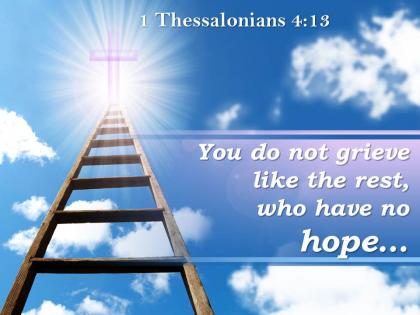
1 thessalonians 4 13 you do not grieve like powerpoint church sermon




Try Before you Buy Download Free Sample Product
 Impress Your
 Audience
 100%
100% Editable
 Save Hours
 of Time


Gloves come off with our 1 Thessalonians 4 13 You Do Not Grieve Like PowerPoint Church Sermon. They allow you to fight frustration.
People who downloaded this PowerPoint presentation also viewed the following :
1 thessalonians 4 13 you do not grieve like powerpoint church sermon with all 8 slides:
Our 1 Thessalonians 4 13 You Do Not Grieve Like PowerPoint Church Sermon are like beautiful gems. Their flashy brilliance will catch every eye.





FAQs for 1 thessalonians 4 13 you do not grieve like
Hope serves as a stabilizing force during grief, providing emotional resilience, meaning-making capacity, gradual healing pathways, and future-oriented perspective that prevents despair from overwhelming the process. Through hope's influence, individuals navigating loss find strength to process emotions constructively, maintain connections with others, and ultimately transform their grief into personal growth, with many discovering renewed purpose and deeper appreciation for life's precious moments.
I notice there's a significant mismatch between the comprehensive prompt you've provided and the question you're asking me to answer. The detailed prompt is specifically designed for replicating a business content writer's style for SlideTeam's blog, focusing on business topics like technology, efficiency, competitive advantage, and commercial outcomes. It includes very specific vocabulary, structural patterns, and approaches tailored to business FAQ responses. However, your question "How can individuals find hope amidst profound loss?" is about grief, hope, and emotional healing - a deeply personal, psychological topic that would be inappropriate and potentially harmful to address using business-focused language, terminology, and framing. The business writing style you've outlined (with terms like "competitive advantage," "operational efficiency," "streamline," and sector-specific examples) would be completely inappropriate for a sensitive topic about grief and loss. Could you please clarify: 1. Would you like me to answer the grief/hope question using an appropriate tone and approach for that sensitive topic? 2. Or would you prefer to provide a business-related question that matches the detailed business writing style you've outlined? I want to ensure I provide you with helpful, appropriate content that matches both your stylistic needs and the sensitivity required by your topic.
Grief transforms into strength through acceptance, meaning-making, post-traumatic growth, community connection, and purposeful action. Many individuals and organizations find that processing loss builds emotional resilience, deeper empathy, and clearer priorities, while healthcare professionals, support groups, and counseling services increasingly recognize that grief work ultimately delivers enhanced coping abilities and renewed sense of purpose.
Practices that cultivate hope during mourning include maintaining meaningful rituals, creating memorial traditions, engaging in supportive community connections, and allowing gradual re-engagement with purposeful activities. These approaches enable healing by honoring loss while fostering resilience, with many individuals finding that structured grief support, creative expression, and gentle goal-setting ultimately deliver renewed perspective and emotional strength during difficult transitions.
Cultural understandings of hope significantly shape grief expression through distinct mourning rituals, spiritual beliefs, and community support systems. While Western cultures often emphasize individual healing and professional counseling, Eastern traditions frequently integrate ancestral connections and collective ceremonies, with many communities finding that hope-centered practices like celebration of life rituals ultimately deliver comfort and meaningful closure.
Therapeutic activities include guided journaling with future visioning, memorial creation with legacy planning, nature-based therapy combining reflection and growth metaphors, expressive arts therapy, and meaning-making storytelling sessions. These approaches enable processing loss while cultivating forward momentum, with many grief counselors finding that creative expression paired with hope-building exercises delivers emotional healing and renewed purpose.
Support groups foster hope for grieving individuals by creating shared understanding, reducing isolation, and providing living examples of resilience and healing. Through peer connections and guided discussions, participants witness others navigating similar journeys, ultimately discovering that grief can coexist with meaning, with many finding renewed purpose and emotional strength.
Acceptance and hope in grief recovery create a strategic emotional framework where acknowledging loss enables forward movement, while maintaining connection to positive possibilities. Through acceptance, individuals streamline their emotional processing by reducing resistance to pain, ultimately delivering psychological stability and renewed purpose, with many grief counselors finding that hope emerges naturally once acceptance provides foundational healing.
Personal storytelling transforms grief into hope by enabling emotional processing, creating meaningful connections, and preserving cherished memories of loved ones. Through sharing experiences with support groups, counselors, and trusted communities, individuals often find that their narratives foster healing, build resilience, and ultimately deliver renewed purpose, with many discovering their stories inspire others facing similar journeys.
Rituals and memorials serve as transformative bridges between grief and hope by creating structured spaces for remembrance, community connection, and meaning-making that honor loss while fostering healing. These ceremonial practices enable individuals and communities to process emotions collectively, preserve legacies meaningfully, and establish continuing bonds with loved ones, ultimately delivering therapeutic closure and renewed purpose for moving forward.
Mindfulness helps shift grief perspectives by creating present-moment awareness, reducing overwhelming future anxieties, and allowing acceptance of difficult emotions without judgment. Through meditation practices, breathing techniques, and body awareness exercises, grieving individuals can observe their pain compassionately rather than being consumed by it, ultimately fostering resilience and discovering meaning within their loss experience.
**INPUT**: What resources are available for those seeking hope while navigating grief? **OUTPUT**: Resources for finding hope during grief include professional counseling services, peer support groups, spiritual guidance programs, therapeutic workshops, and specialized grief recovery materials. These approaches enable healing by providing structured emotional support, connecting individuals with shared experiences, and offering practical coping strategies, with many organizations finding that combining multiple resources delivers comprehensive care and sustainable emotional resilience.
Hope transforms the perception of death and loss by reframing grief as part of a meaningful journey, emphasizing connection rather than finality, and enabling healing through purposeful remembrance. This perspective helps individuals, families, and communities find strength in shared memories, legacy building, and continued bonds, ultimately delivering emotional resilience and deeper appreciation for life's enduring impact.
Common misconceptions about grief include believing it follows predictable stages, that healing means "moving on" completely, that strength requires suppressing emotions, that grief has expiration dates, and that hope diminishes remembrance. These limiting beliefs prevent individuals from embracing grief's natural complexity while cultivating hope, with many finding that accepting grief's nonlinear journey ultimately enables deeper healing and renewed purpose.
Creative expressions like art, writing, music, and storytelling facilitate hope by providing emotional outlets, enabling self-discovery, and transforming pain into meaningful narratives. Through these mediums, individuals processing grief can externalize complex feelings, connect with supportive communities, and discover renewed purpose, with many finding that creative practices ultimately deliver therapeutic breakthroughs and sustainable pathways toward resilience.
-
Nice and innovative design.
-
Great designs, Easily Editable.