1014 3d honey bee with comb image graphics for powerpoint

Rating:
80%
1014 3d honey bee with comb image graphics for powerpoint
Slide 1 of 3
Favourites Favourites

Try Before you Buy Download Free Sample Product

Audience Impress Your
Audience
Editable 100%
Editable
Time Save Hours
of Time
The Biggest Sale is ending soon in
0
0
:
0
0
:
0
0
Rating:
80%
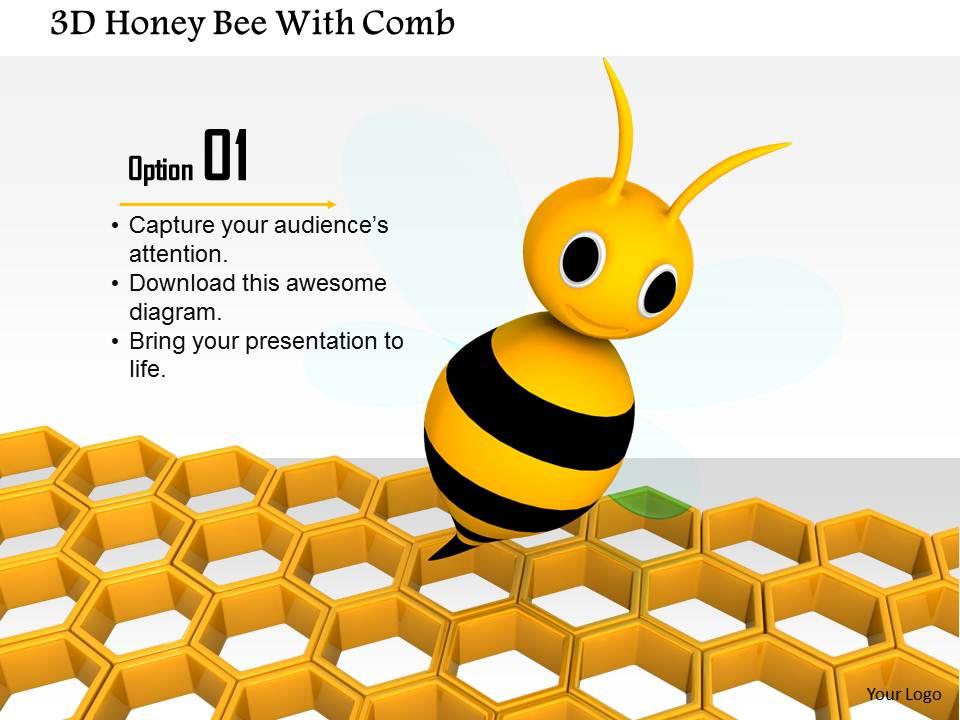
We are proud to present our 1014 3d honey bee with comb image graphics for powerpoint. This power point image template has been designed with graphic of 3d honey bee and comb. This PPT shows the concept of unity and hard work. Use this PPT for social and educational presentations.

People who downloaded this PowerPoint presentation also viewed the following :

FAQs for 1014 3d honey bee with comb image

3D honey bee graphics feature realistic textures, dynamic wing movement, detailed anatomical accuracy, vibrant color gradients, and interactive rotation capabilities that enhance visual engagement. These elements enable educators, researchers, and agricultural organizations to deliver compelling presentations about pollination processes, bee behavior studies, and environmental conservation, ultimately creating more impactful audience experiences and better knowledge retention.

3D honey bee graphics enhance educational presentations by providing detailed anatomical visualization, interactive pollination process demonstrations, and immersive biodiversity ecosystem models that make complex concepts accessible. These visual tools help students understand bee behavior, flower relationships, and environmental connections more effectively than traditional methods, with many educators finding that three-dimensional representations significantly improve comprehension and retention in biology and environmental science curricula.

**INPUT**: What software tools are best suited for creating 3D honey bee graphics? **OUTPUT**: Leading 3D honey bee graphics software includes Blender, Maya, Cinema 4D, ZBrush, and 3ds Max, each offering specialized modeling, texturing, and animation capabilities. These tools enable designers to create detailed anatomical features, realistic wing transparency, and natural movement patterns, with many educational institutions and nature documentaries finding that combining multiple platforms delivers enhanced visual storytelling and audience engagement.

Color choices in 3D honey bee graphics significantly influence audience perception by evoking emotions, enhancing brand recognition, and improving visual hierarchy through strategic use of warm yellows, natural browns, and vibrant accent colors. These design decisions impact engagement levels across marketing materials, educational content, and digital presentations, with many organizations finding that authentic, nature-inspired palettes increase memorability and emotional connection while supporting clear communication objectives.

Common mistakes when designing 3D honey bee models include overly complex anatomy that distracts from key messages, poor scaling that makes details invisible, inconsistent lighting that creates visual confusion, and neglecting color contrast for readability. These design oversights significantly impact audience engagement by reducing clarity, slowing comprehension, and diminishing professional credibility, with many presenters finding that simplified, well-proportioned models ultimately deliver stronger visual impact.

3D honey bee animations effectively communicate complex biological processes through detailed anatomical visualization, step-by-step pollination sequences, hive dynamics modeling, and multi-layered behavioral interactions. These visualizations enable educators, researchers, and agricultural professionals to demonstrate intricate concepts like pheromone communication and foraging patterns, ultimately enhancing understanding while delivering more engaging educational experiences across academic and commercial applications.

3D honey bee graphics deliver superior visual impact, depth perception, and audience engagement compared to traditional 2D illustrations through enhanced realism, interactive potential, and memorable presentation elements. These dimensional designs enable businesses, educational institutions, and environmental organizations to create more compelling presentations, marketing materials, and educational content, ultimately driving stronger audience retention and more effective communication of pollination concepts, sustainability messages, and nature-related themes.

Textures and lighting are fundamental to creating realistic 3D honey bee graphics, with textures providing surface detail like fuzzy body hair, translucent wing membranes, and segmented exoskeleton patterns, while lighting simulates natural conditions through subsurface scattering and shadow depth. These elements work together to enhance visual authenticity in educational materials, nature documentaries, and scientific presentations, with many designers finding that strategic texture mapping and dynamic lighting ultimately deliver compelling, lifelike representations that engage audiences effectively.

3D honey bee graphics can significantly enhance marketing campaigns for honey products by creating visual appeal, establishing brand authenticity, and communicating natural quality through realistic animations and detailed imagery. These graphics enable honey brands to showcase product origins, demonstrate bee-to-bottle processes, and create memorable packaging designs, with many food manufacturers finding that detailed 3D visuals increase consumer engagement and drive purchasing decisions across digital platforms.

Virtual reality combined with 3D honey bee graphics offers immersive educational experiences that enhance student understanding of bee biology, hive dynamics, pollination processes, and ecosystem relationships through interactive visualization. Educational institutions, science museums, and agricultural programs increasingly leverage these VR environments to deliver hands-on learning experiences, enabling students to explore bee behavior and environmental impact while improving engagement and retention.

User interaction with 3D honey bee models can be incorporated through clickable animations, rotatable views, hover effects for detailed information, and interactive pollination simulations that audiences can control during presentations. These interactive elements enhance engagement by allowing viewers to explore bee anatomy, flight patterns, and ecological relationships at their own pace, ultimately delivering more memorable educational experiences and stronger audience retention, with many educators and environmental organizations finding that hands-on digital interaction significantly improves comprehension.

3D honey bee graphics enhance research presentations by providing detailed anatomical visualization, improved audience engagement, clearer behavioral demonstrations, enhanced data representation, and memorable visual storytelling capabilities. These graphics enable researchers to showcase complex pollination processes, hive structures, and conservation strategies more effectively, with many environmental organizations and academic institutions finding that 3D visualizations significantly improve stakeholder understanding and funding support.

3D honey bee graphics enhance anatomical education by providing interactive visualization, detailed cross-sections, layered structural views, and rotational perspectives that reveal internal organs and external features simultaneously. These representations enable educators to demonstrate complex biological systems like digestive tracts, wing mechanics, and sensory organs more effectively than traditional diagrams, with many educational institutions finding that students retain anatomical knowledge significantly better through immersive visual learning experiences.

Emerging 3D modeling trends include photorealistic rendering, procedural animation, volumetric lighting, AI-assisted texturing, and real-time ray tracing capabilities. These technologies enhance honey bee visualization by creating lifelike wing translucency, dynamic flight patterns, and accurate anatomical details, with educational institutions and nature documentaries finding that enhanced realism significantly improves audience engagement and learning outcomes.

3D honey bee graphics foster environmental stewardship by creating immersive, detailed visualizations that showcase bees' critical pollination roles, habitat complexities, and ecosystem interconnections. These compelling visual experiences enable organizations, educational institutions, and conservation groups to deliver more impactful environmental messaging, with many finding that realistic 3D representations significantly enhance audience engagement and understanding of biodiversity importance.

Ratings and Reviews

80% of 100
Write a review
Most Relevant Reviews
  1. 80%

    by Williams Nelson

    Awesome presentation, really professional and easy to edit.
  2. 80%

    by Joe Thomas

    Very well designed and informative templates.

2 Item(s)

per page: