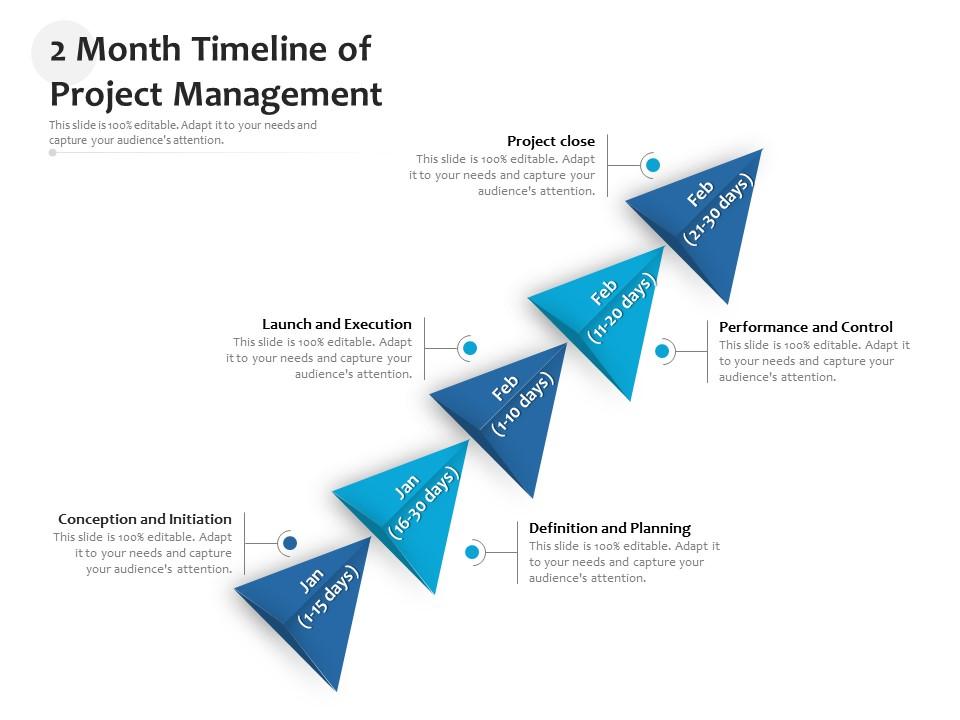
2 month timeline of project management
Try Before you Buy Download Free Sample Product
Audience
Editable
of Time
Our 2 Month Timeline Of Project Management are topically designed to provide an attractive backdrop to any subject. Use them to look like a presentation pro.
People who downloaded this PowerPoint presentation also viewed the following :
2 month timeline of project management with all 2 slides:
Use our 2 Month Timeline Of Project Management to effectively help you save your valuable time. They are readymade to fit into any presentation structure.
FAQs for 2 month timeline
Key project management timeline phases include initiation, planning, execution, monitoring, and closure, each building upon previous stages to ensure systematic progress. These phases contribute to success by establishing clear objectives, allocating resources strategically, tracking performance metrics, and delivering measurable outcomes, with many organizations finding that structured timelines reduce costs while enhancing stakeholder satisfaction.
Gantt charts effectively visualize project management timelines by displaying task sequences, dependencies, deadlines, and resource allocations in a clear horizontal bar format. These visual tools enable project managers to identify bottlenecks, track progress against milestones, and communicate status updates seamlessly, with many organizations finding that Gantt charts enhance team coordination and deliver improved project outcomes.
Milestones serve as critical checkpoints in project management timelines, marking significant achievements, deliverable completions, phase transitions, and decision points that keep projects on track. They should be defined as specific, measurable outcomes with clear success criteria and stakeholder approval requirements, enabling teams to monitor progress, identify potential delays, and maintain accountability while ultimately delivering projects within scope, budget, and timeline parameters.
Project managers can adjust timelines through scope reassessment, resource reallocation, task prioritization, stakeholder communication, and contingency activation. These strategies enable teams to maintain project momentum while accommodating changes, with many organizations finding that proactive timeline management, regular milestone reviews, and flexible resource deployment ultimately deliver better outcomes and stronger stakeholder relationships.
Common pitfalls include unrealistic deadlines, inadequate buffer time, poor task dependencies mapping, insufficient stakeholder input, and scope creep accommodation. These challenges can be avoided by conducting thorough historical analysis, building 15-20% contingency buffers, engaging cross-functional teams early, and implementing regular milestone reviews, ultimately delivering more predictable outcomes and enhanced project success rates.
Dependencies significantly influence project timelines by creating sequential constraints where delayed tasks cascade through interconnected activities, often extending completion dates and creating bottlenecks. Through proper dependency mapping, project managers can identify critical paths, allocate resources more strategically, and implement parallel workflows, ultimately reducing project duration while maintaining quality standards and minimizing scheduling risks.
**INPUT**: What software tools are most effective for developing and managing project management timelines? **OUTPUT**: Effective timeline management tools include Microsoft Project, Asana, Trello, Gantt chart software like Smartsheet, and integrated platforms such as Monday.com. These technologies streamline project oversight by automating task dependencies, enabling real-time collaboration, and providing visual progress tracking, with many organizations finding that strategic tool selection ultimately delivers faster project completion and enhanced resource allocation across teams.
Agile methodologies transform project management timelines by replacing rigid, linear schedules with iterative sprints, continuous feedback loops, and adaptive planning cycles. This approach enables project teams to respond quickly to changing requirements, deliver incremental value through regular releases, and maintain stakeholder engagement throughout development, with many organizations finding that agile timelines ultimately deliver faster time-to-market and improved project outcomes.
Best practices for communicating project management timelines include visual presentations with clear milestones, regular status updates, transparent risk assessments, stakeholder-specific summaries, and interactive dashboards. These approaches enhance stakeholder engagement by providing real-time visibility, enabling proactive decision-making, and building trust through transparency, ultimately delivering improved project success rates and stronger stakeholder relationships.
Resource allocations directly impact project timelines by determining task completion speed, creating potential bottlenecks, and influencing critical path dependencies across deliverables. Strategic mitigation includes cross-training team members, implementing flexible resource pools, prioritizing high-impact activities, and leveraging project management tools for real-time allocation optimization, ultimately delivering improved efficiency and timeline predictability.
Regular timeline reviews enhance project performance by identifying bottlenecks early, realigning resources strategically, and maintaining clear milestone visibility across all team members. These systematic assessments enable project managers to address delays proactively, improve task coordination, and foster accountability through transparent progress tracking, with many organizations finding that consistent review cycles ultimately deliver faster project completion and stronger team engagement.
**INPUT**: What techniques can be employed to estimate task durations accurately on a project timeline? **OUTPUT**: Task duration estimation techniques include expert judgment, analogous estimating, parametric modeling, three-point estimation, and bottom-up analysis. These methods enhance accuracy by leveraging historical data, statistical models, and stakeholder expertise, with many project managers finding that combining multiple techniques delivers more reliable timelines and improved resource allocation across complex initiatives.
Cultural differences among remote teams can significantly impact timeline adherence through varying communication styles, decision-making processes, time orientation preferences, and holiday schedules across different regions. While these differences present coordination challenges, many organizations find that establishing clear cultural protocols, implementing flexible milestone structures, and leveraging diverse perspectives ultimately enhances project outcomes and delivers more innovative solutions.
Project timeline implications on budget management include resource allocation timing, cash flow planning, overhead cost accumulation, and milestone-based spending controls. Extended timelines increase operational costs through prolonged resource commitments and administrative overhead, while compressed schedules often require premium pricing for expedited services, with many organizations finding that strategic timeline optimization delivers significant cost savings and improved financial predictability.
Lessons learned from past projects inform future timelines by identifying recurring bottlenecks, validating realistic task durations, and revealing dependencies that weren't initially apparent. Organizations leverage these insights to build buffer time strategically, anticipate resource constraints, and implement proven workflows, with many project management offices finding that historical data reduces timeline overruns by 30-40% while enhancing stakeholder confidence.
-
Great quality slides in rapid time.
-
Easily Understandable slides.