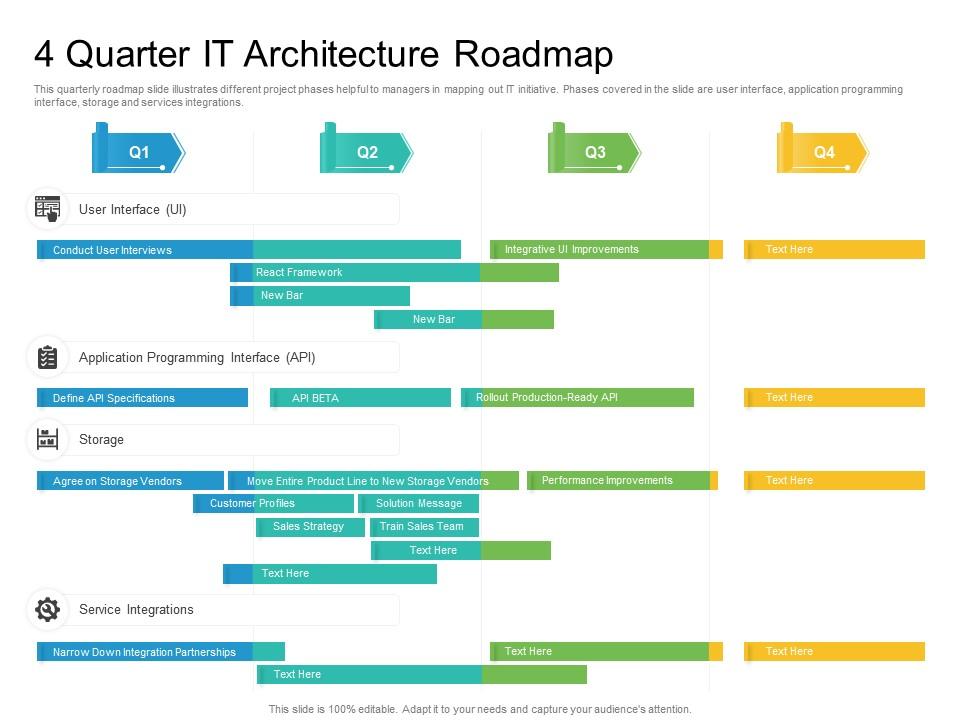
4 quarter it architecture roadmap timeline powerpoint template
Try Before you Buy Download Free Sample Product
Audience
Editable
of Time
Our 4 Quarter IT Architecture Roadmap Timeline Powerpoint Template are topically designed to provide an attractive backdrop to any subject. Use them to look like a presentation pro.
People who downloaded this PowerPoint presentation also viewed the following :
4 quarter it architecture roadmap timeline powerpoint template with all 2 slides:
Use our 4 Quarter IT Architecture Roadmap Timeline Powerpoint Template to effectively help you save your valuable time. They are readymade to fit into any presentation structure.
FAQs for 4 quarter it architecture roadmap
Key components of an effective IT architecture roadmap include current state assessment, future vision definition, gap analysis, technology stack evaluation, and implementation timeline planning. These elements work together by identifying existing infrastructure limitations, establishing clear transformation goals, and prioritizing strategic initiatives, with many organizations finding that comprehensive roadmaps deliver improved operational efficiency and competitive advantage.
Business goals directly shape IT architecture roadmaps by determining priority systems, required capabilities, scalability needs, and integration points that support strategic objectives. Organizations align their technology investments with revenue targets, operational efficiency goals, and customer experience improvements, with many companies finding that goal-driven roadmaps deliver faster ROI and competitive advantage.
Cloud computing fundamentally transforms IT architecture roadmaps by enabling scalable infrastructure, reducing capital expenditures, and supporting digital transformation initiatives through flexible resource allocation and rapid deployment capabilities. Organizations across sectors like healthcare, finance, and retail leverage cloud-first strategies to streamline operations, enhance agility, and deliver faster services while maintaining competitive advantage in increasingly dynamic markets.
Organizations assess their current IT architecture through comprehensive audits, stakeholder interviews, performance analytics, security evaluations, and technology stack analysis. These assessments enable businesses to identify integration bottlenecks, scalability limitations, and outdated systems, with many enterprises finding that systematic evaluations reveal critical gaps hindering digital transformation and competitive positioning.
Methodologies for developing IT architecture roadmaps include TOGAF, Zachman Framework, enterprise architecture planning, capability-based planning, and agile architecture approaches. These frameworks streamline strategic alignment by establishing clear governance structures, defining transformation phases, and ensuring stakeholder buy-in, with many organizations finding that structured methodologies reduce implementation risks while accelerating digital transformation initiatives.
IT architecture roadmaps should typically be reviewed quarterly and updated annually, though rapidly evolving organizations may require more frequent adjustments based on business priorities, technological advances, and market conditions. These regular reviews enable companies to maintain alignment between their technology investments and strategic objectives, while allowing flexibility to incorporate emerging technologies, address changing security requirements, and optimize resource allocation, ultimately ensuring competitive advantage in an increasingly dynamic business environment.
Common pitfalls include lack of stakeholder alignment, overly rigid timelines, insufficient consideration of legacy systems, inadequate budget planning, and poor change management strategies. These challenges can derail implementation, with many organizations finding that early engagement across departments, flexible milestone planning, and realistic resource allocation ultimately deliver more successful transformations and sustainable competitive advantages.
Stakeholder engagement during roadmap development requires structured communication through regular workshops, clear documentation of requirements and priorities, and transparent progress updates at key milestones. Establishing cross-functional committees with representatives from business units, IT operations, and executive leadership ensures alignment while maintaining momentum, with many organizations finding that early stakeholder buy-in significantly reduces implementation resistance and accelerates delivery timelines.
**INPUT**: What technologies should be prioritized in an IT architecture roadmap for digital transformation? **OUTPUT**: Digital transformation IT roadmaps should prioritize cloud infrastructure, API management platforms, data analytics tools, cybersecurity frameworks, and automation technologies. These strategic technologies streamline operations by enabling seamless integration, enhancing data-driven decision making, and accelerating service delivery, with many organizations finding that this combination ultimately delivers competitive advantage and operational efficiency. **Word count: 54 words**
Security considerations fundamentally shape IT architecture roadmaps by requiring integrated threat assessments, compliance frameworks, data protection protocols, and access management systems throughout every planning phase. These requirements drive strategic decisions around infrastructure investments, technology selections, and implementation timelines, with organizations increasingly finding that proactive security integration reduces costs while enabling faster, more resilient digital transformations.
Organizations can reference TOGAF (The Open Group Architecture Framework), Zachman Framework, FEAF (Federal Enterprise Architecture Framework), SABSA for security architecture, and COBIT for IT governance alignment. These frameworks provide structured methodologies for documenting current state, defining future vision, and creating transformation pathways, with many enterprises finding that combining elements from multiple frameworks delivers comprehensive roadmaps tailored to their specific industry requirements and strategic objectives.
Organizations align IT architecture roadmaps with agile development by implementing modular architectures, establishing cross-functional teams, creating flexible governance frameworks, and adopting incremental delivery cycles. This strategic combination enables faster adaptation to changing requirements, reduces technical debt, and enhances collaboration between architects and development teams, ultimately delivering more responsive systems while maintaining architectural integrity.
IT architecture roadmap success metrics include system performance indicators, cost reduction percentages, user adoption rates, security compliance scores, and business process efficiency improvements. These measurements enable organizations to track operational effectiveness, resource optimization, and strategic alignment, with many enterprises finding that combining technical metrics with business outcomes delivers clearer visibility into competitive advantage and transformation progress.
Organizations ensure scalability by implementing modular design principles, cloud-native architectures, microservices frameworks, containerization strategies, and API-first approaches in their IT roadmaps. These methodologies enable seamless resource allocation, horizontal scaling, and flexible infrastructure expansion, with many enterprises finding that strategic cloud adoption and automated scaling protocols ultimately deliver enhanced operational efficiency and competitive advantage.
Best practices for integrating legacy systems include comprehensive system assessment, phased migration planning, API-based connectivity solutions, data mapping strategies, and risk mitigation protocols. These approaches streamline modernization by maintaining operational continuity, reducing integration costs, and enabling seamless data flow, with many organizations finding that strategic legacy integration ultimately delivers competitive advantage while minimizing business disruption.
-
Really like the color and design of the presentation.
-
Excellent Designs.
-
Designs have enough space to add content.
-
Illustrative design with editable content. Exceptional value for money. Highly pleased with the product.
-
Helpful product design for delivering presentation.
-
Innovative and Colorful designs.
-
Content of slide is easy to understand and edit.
-
Informative presentations that are easily editable.