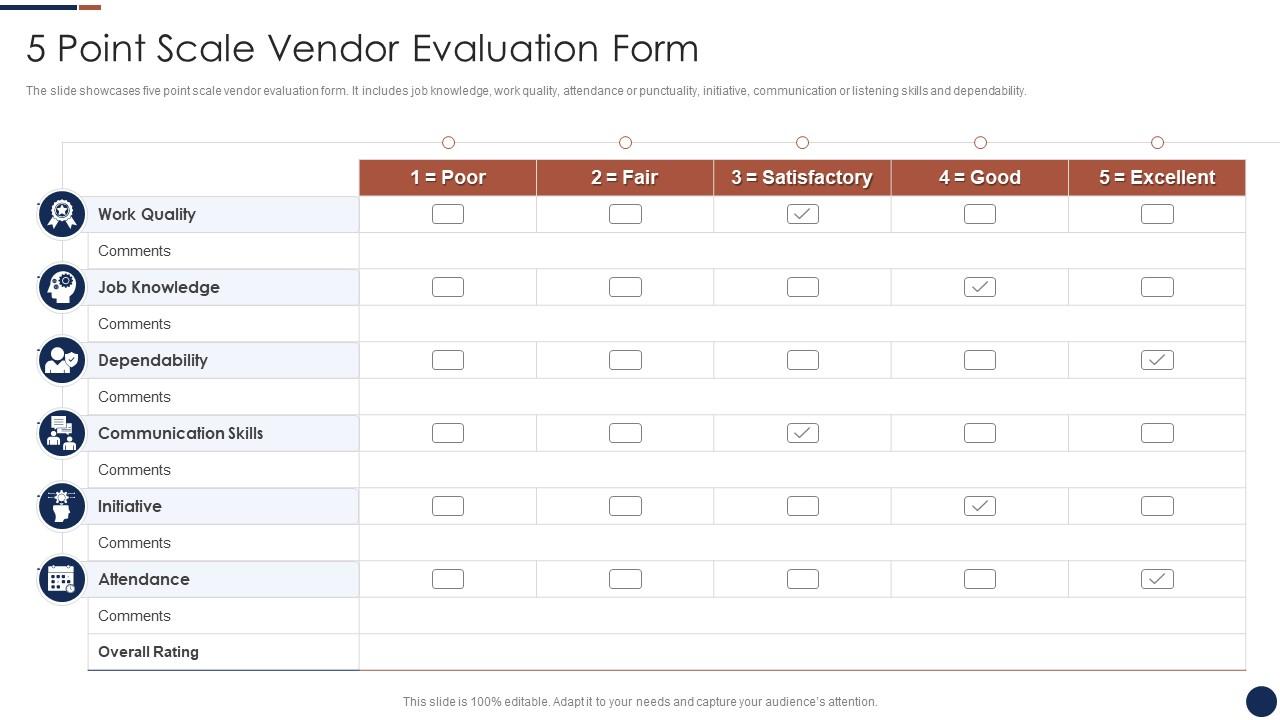
5 Point Scale Vendor Evaluation Form
Try Before you Buy Download Free Sample Product
Audience
Editable
of Time
The slide showcases five point scale vendor evaluation form. It includes job knowledge, work quality, attendance or punctuality, initiative, communication or listening skills and dependability.
People who downloaded this PowerPoint presentation also viewed the following :
5 Point Scale Vendor Evaluation Form with all 6 slides:
Use our 5 Point Scale Vendor Evaluation Form to effectively help you save your valuable time. They are readymade to fit into any presentation structure.
FAQs for 5 Point Scale
**INPUT**: What criteria should be prioritized when evaluating potential vendors for your business needs? **OUTPUT**: Priority criteria include financial stability, technical capabilities, service reliability, scalability potential, and compliance standards. These factors enable organizations to streamline vendor selection by assessing long-term viability, operational compatibility, and strategic alignment, with many businesses finding that thorough evaluation ultimately delivers enhanced partnerships and competitive advantage.
Performance metrics can be effectively integrated through establishing clear KPIs upfront, conducting regular performance reviews, implementing automated monitoring systems, and creating weighted scorecards that align with business objectives. Organizations across industries like manufacturing and healthcare find that combining quantitative metrics with qualitative assessments enables better vendor relationships, ultimately delivering improved service levels and strategic value.
Vendor reputation serves as a critical risk assessment factor, influencing trust, reliability expectations, and long-term partnership viability throughout the evaluation process. It provides insight into past performance, client satisfaction levels, and operational stability, with many organizations finding that strong vendor reputation correlates with smoother implementations, better support quality, and reduced project risks, ultimately delivering greater confidence in strategic sourcing decisions.
Assessing vendor financial stability involves reviewing audited financial statements, credit reports, cash flow analyses, debt-to-equity ratios, and annual revenue trends over multiple years. Through comprehensive due diligence, organizations can identify potential risks like bankruptcy or service disruptions, while evaluating payment histories and industry standing, ultimately ensuring reliable partnerships and minimizing supply chain vulnerabilities.
Techniques include reference calls with structured questions, third-party review platforms, industry peer networks, anonymous feedback surveys, and site visits to observe vendor implementations firsthand. These methods enable organizations to verify vendor claims, assess real-world performance across different client environments, and uncover potential issues, ultimately delivering comprehensive insights that minimize selection risks and enhance partnership outcomes.
Vendor compliance with industry regulations is critically important during evaluation, as non-compliance can result in legal penalties, operational disruptions, and reputational damage for your organization. This consideration becomes especially vital in highly regulated sectors like healthcare, financial services, and manufacturing, where regulatory violations can lead to significant fines, ultimately ensuring your business maintains competitive advantage while minimizing risk exposure.
Organizations can ensure transparency through standardized scoring matrices, documented evaluation criteria, cross-functional review panels, and open communication channels with all vendors. These methods streamline the process by eliminating bias, providing clear feedback mechanisms, and establishing audit trails, with many procurement teams finding that structured transparency ultimately delivers fairer outcomes and stronger vendor relationships.
Technology and software tools enhance vendor evaluation through automated data collection, real-time performance analytics, standardized scoring systems, and centralized vendor databases. These platforms streamline assessment workflows by tracking compliance metrics, financial stability indicators, and service quality benchmarks, while enabling organizations to make data-driven decisions faster, ultimately delivering more accurate vendor selections and stronger supply chain partnerships.
When evaluating a vendor's capacity for innovation, consider their R&D investment levels, patent portfolios, technology partnerships, talent acquisition strategies, and track record of product evolution. These factors reveal innovation potential by demonstrating resource commitment, intellectual property development, and collaborative capabilities, with many organizations finding that vendors showing consistent innovation investment deliver competitive advantages and future-ready solutions.
Cultural alignment between your organization and a vendor significantly impacts communication effectiveness, collaboration quality, and shared decision-making approaches throughout the partnership lifecycle. When values, work styles, and business philosophies align, organizations experience smoother project implementations, reduced conflicts, and enhanced trust-building, with many companies finding that culturally compatible vendors adapt more readily to changing requirements, ultimately delivering stronger long-term partnerships and sustained competitive advantage.
Best practices for conducting site visits during vendor evaluation include preparing detailed checklists, scheduling structured facility tours, interviewing key personnel, reviewing quality control processes, and assessing operational capabilities firsthand. These comprehensive visits enable organizations to verify vendor claims, evaluate workplace culture and safety standards, and identify potential risks, with many procurement teams finding that direct observation reveals critical insights about reliability and long-term partnership potential.
Standardizing vendor evaluation across departments requires establishing unified criteria, consistent scoring methodologies, cross-functional review committees, and centralized documentation systems. This approach enables organizations to maintain procurement consistency, reduce bias, and leverage collective insights, while departments like IT, finance, and operations can apply shared frameworks to their specific vendor relationships, ultimately delivering better contract terms and strategic supplier partnerships.
A vendor evaluation scorecard should include pricing transparency, technical capabilities, implementation timelines, customer support quality, financial stability, and compliance certifications. These criteria enable organizations to systematically compare vendors across critical dimensions, with many procurement teams finding that standardized scorecards streamline decision-making processes while ensuring comprehensive assessment of strategic partnerships and long-term vendor relationships.
Incorporating sustainability practices into vendor evaluation involves assessing environmental policies, carbon footprint reduction initiatives, waste management systems, renewable energy usage, and ethical labor practices. Organizations increasingly prioritize suppliers demonstrating measurable sustainability commitments, with many companies finding that sustainable vendors deliver long-term cost savings, enhanced brand reputation, and regulatory compliance advantages.
Risk mitigation involves establishing clear contractual terms, implementing performance monitoring systems, creating contingency plans, conducting regular vendor audits, and diversifying supplier relationships where feasible. Through strategic risk assessment frameworks, organizations streamline vendor oversight, enhance operational continuity, and minimize disruptions, with many companies finding that proactive vendor management ultimately delivers greater supply chain resilience and competitive advantage.
-
Placing an order on SlideTeam is very simple and convenient, saves you a lot of your time.Â
-
Great experience, I would definitely use your services further.