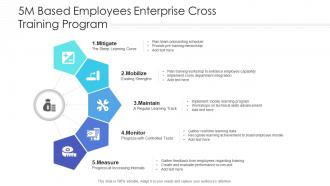
5m based employees enterprise cross training program
Try Before you Buy Download Free Sample Product
Audience
Editable
of Time
Our 5M Based Employees Enterprise Cross Training Program are topically designed to provide an attractive backdrop to any subject. Use them to look like a presentation pro.
People who downloaded this PowerPoint presentation also viewed the following :
5m based employees enterprise cross training program with all 2 slides:
Use our 5M Based Employees Enterprise Cross Training Program to effectively help you save your valuable time. They are readymade to fit into any presentation structure.
FAQs for 5m based employees enterprise
Cross-training delivers enhanced workforce flexibility, reduced operational risks, improved employee engagement, increased productivity, and stronger team collaboration across departments. Through strategic skill diversification, organizations streamline operations while minimizing disruptions from absences or turnover, with many companies finding that cross-trained employees demonstrate higher job satisfaction and retention rates, ultimately creating more resilient and adaptable business operations.
Cross-training improves teamwork by fostering mutual understanding of different roles, breaking down silos between departments, and creating shared knowledge across functions. When employees understand colleagues' responsibilities and challenges, they collaborate more effectively on projects, communicate with greater empathy, and adapt seamlessly during peak periods or staff absences, ultimately delivering stronger organizational cohesion.
Fast-paced industries should prioritize digital literacy, data analysis, communication skills, problem-solving abilities, and adaptability for cross-training programs. These competencies enhance operational efficiency by enabling seamless technology adoption, faster decision-making, and improved collaboration, with many organizations finding that employees skilled across multiple areas deliver superior customer experiences while maintaining competitive advantage in increasingly dynamic markets.
Cross-training contributes to employee morale and job satisfaction by reducing monotony, expanding skill sets, and creating career advancement opportunities within organizations. Through strategic cross-functional development, employees gain deeper understanding of business operations, enhanced job security, and increased engagement, with many companies finding that diversified roles ultimately deliver higher retention rates and improved workplace satisfaction.
Organizations implementing cross-training programs face challenges including initial productivity dips during learning periods, increased training costs, resistance from employees comfortable with current roles, and scheduling complexities. While these hurdles require strategic planning and resource allocation, many companies find that addressing concerns through phased implementation and clear communication ultimately delivers enhanced workforce flexibility, reduced operational bottlenecks, and improved employee engagement across departments.
Managers can assess cross-training effectiveness through employee skill assessments, productivity metrics, knowledge retention tests, performance reviews, and feedback surveys measuring confidence levels. These evaluation methods enable organizations to track competency development, operational flexibility improvements, and reduced dependency on individual employees, while identifying gaps in training delivery, ultimately ensuring the initiative delivers measurable workforce resilience and enhanced team capabilities.
Technology streamlines cross-training through learning management systems, virtual reality simulations, mobile learning apps, video conferencing platforms, and AI-powered personalized learning paths. These digital tools enable organizations to deliver consistent training across locations, track progress in real-time, and reduce training costs, while many companies find that technology-enhanced cross-training accelerates skill development and improves employee retention significantly.
Cross-training prepares organizations for unexpected staffing shortages by developing multi-skilled employees, creating flexible workforce capacity, reducing single points of failure, and enabling rapid role transitions during emergencies. This strategic approach delivers operational continuity, minimizes service disruptions, and maintains productivity levels, with many companies finding that cross-trained teams respond more effectively to sudden absences or market fluctuations.
Cross-training enhances career development by expanding skill sets, increasing versatility, and creating pathways to leadership roles across departments. Through exposure to multiple functions, employees develop broader business understanding, stronger problem-solving capabilities, and enhanced collaboration skills, with many organizations finding that cross-trained professionals become more competitive candidates for promotions and strategic positions.
Effective cross-training motivation strategies include career advancement opportunities, skill-based compensation increases, recognition programs, flexible scheduling options, and peer mentorship systems. These approaches enhance employee engagement by demonstrating clear professional growth paths, increased earning potential, and expanded responsibilities, with many organizations finding that linking cross-training to promotion criteria significantly boosts voluntary participation rates.
Cross-training adapts to remote environments through virtual job shadowing, online collaborative projects, digital mentoring sessions, and cloud-based skill-sharing platforms. These approaches enable employees to learn diverse functions seamlessly across locations, with many organizations finding that virtual cross-training actually increases participation rates while reducing travel costs and scheduling conflicts.
Cross-training success metrics include employee versatility scores, productivity levels across different roles, internal mobility rates, knowledge retention assessments, and operational flexibility measurements. These indicators help organizations track workforce adaptability, reduced dependency on specific individuals, faster project completion times, and improved team collaboration, with many companies finding that comprehensive measurement systems ultimately deliver enhanced operational resilience and competitive advantage.
Cross-training significantly enhances employee retention by expanding skill sets, increasing job satisfaction, and creating clearer advancement pathways within organizations. Companies implementing comprehensive cross-training programs often see retention rates improve by 15-25%, as employees feel more valued and versatile, while organizations benefit from reduced recruitment costs and stronger internal talent pipelines in competitive markets.
Effective cross-training programs incorporate structured skill mapping, rotational schedules, mentorship pairings, clear competency benchmarks, and regular progress assessments. These approaches streamline knowledge transfer by identifying critical skills, establishing systematic learning pathways, and creating accountability measures, with many organizations finding that strategic cross-training ultimately delivers enhanced workforce flexibility and operational resilience.
Cross-training enhances organizational resilience by creating workforce flexibility, reducing single-point failures, maintaining operational continuity during disruptions, and enabling rapid resource reallocation across departments. Through strategic skill diversification, companies streamline operations, minimize downtime risks, and accelerate response times to market changes, with many organizations finding that cross-trained teams deliver enhanced agility and competitive advantage.
-
Enough space for editing and adding your own content.
-
Very unique and reliable designs.
-
Excellent products for quick understanding.
-
Great product with highly impressive and engaging designs.
-
Qualitative and comprehensive slides.