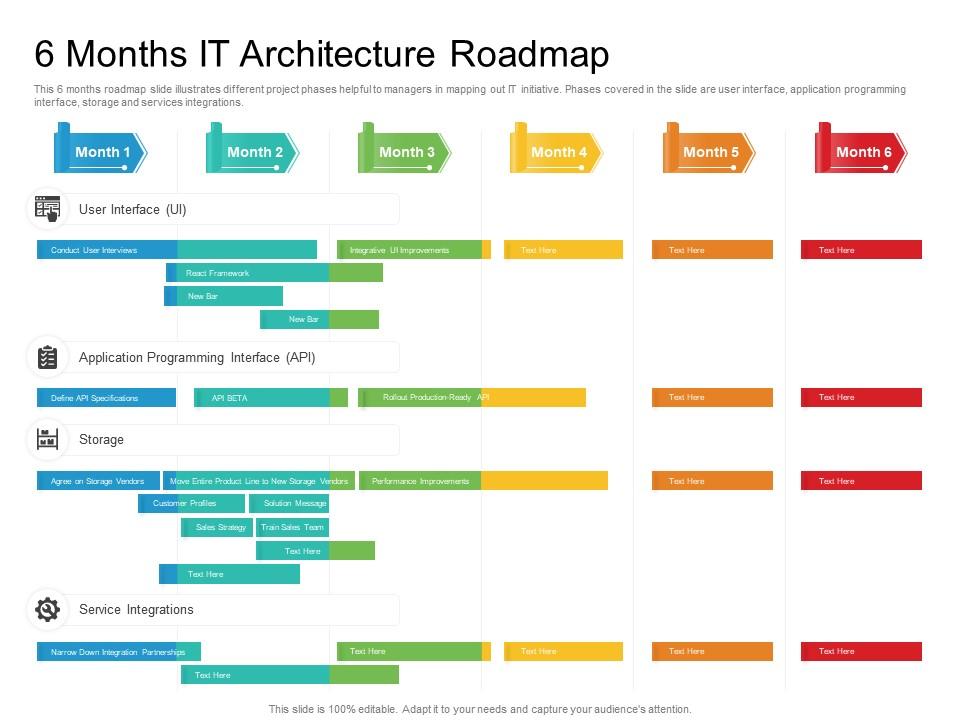
6 months it architecture roadmap timeline powerpoint template

Rating:
91%
6 months it architecture roadmap timeline powerpoint template
Slide 1 of 2

or

Favourites Favourites

Try Before you Buy Download Free Sample Product

Audience Impress Your
Audience
Editable 100%
Editable
Time Save Hours
of Time
The Biggest Sale is ending soon in
0
0
:
0
0
:
0
0
Rating:
91%
This is a 6 Months IT Architecture Roadmap Timeline Powerpoint Template featuring in built editable components to add your personal touches. Tailor this template as per your liking and display it on a widescreen or standard screen, the choice is yours.

FAQs for 6 months it architecture roadmap

A robust IT architecture roadmap includes current state assessment, future state vision, gap analysis, technology stack evaluation, and phased implementation timelines. These components work together by aligning business objectives with technical capabilities, identifying integration points, and establishing measurable milestones, ultimately delivering strategic transformation and competitive advantage for organizations navigating digital evolution.

Aligning an IT architecture roadmap with business goals requires comprehensive stakeholder engagement, strategic priority mapping, regular milestone assessments, and continuous feedback integration throughout the planning process. Through structured governance frameworks, organizations streamline technology investments, enhance operational efficiency, and accelerate digital transformation initiatives, while ensuring architectural decisions directly support revenue growth, cost optimization, and competitive positioning in increasingly dynamic markets.

Common methodologies for developing IT architecture roadmaps include TOGAF (The Open Group Architecture Framework), Zachman Framework, FEAF (Federal Enterprise Architecture Framework), ArchiMate, and SABSA for security architecture. These frameworks streamline roadmap development by providing structured governance models, standardized documentation processes, and systematic transition planning, with many organizations finding that combining multiple approaches delivers greater strategic alignment and operational efficiency.

Organizations assess their current IT architecture through comprehensive audits, performance analytics, security evaluations, integration mapping, and stakeholder feedback sessions. This strategic combination enables businesses to identify bottlenecks, redundancies, and gaps across systems, with many enterprises finding that thorough assessments streamline future investments, enhance operational efficiency, and ultimately deliver competitive advantage.

Stakeholder engagement ensures IT architecture roadmaps align with business objectives, user requirements, and organizational constraints through collaborative input gathering, priority setting, and consensus building. This strategic involvement enables organizations to develop more comprehensive roadmaps that address diverse departmental needs, minimize resistance during implementation, and ultimately deliver greater adoption rates and business value.

IT architecture roadmaps should typically be reviewed quarterly and updated annually, though factors like rapid technological change, business pivots, regulatory shifts, and budget cycles influence timing. Organizations in dynamic sectors like fintech or healthcare often require more frequent updates, while those with stable operations may extend cycles, with many finding that agile review processes enable better alignment with strategic objectives and market demands.

Project prioritization within IT architecture roadmaps involves assessing business value alignment, technical dependencies, resource requirements, risk factors, and implementation timelines. Organizations typically use scoring matrices combining strategic impact with complexity analysis, enabling leaders to sequence initiatives that deliver quick wins while building foundation for larger transformations, ultimately maximizing ROI and competitive advantage.

Emerging technologies significantly reshape IT architecture roadmaps by introducing new integration requirements, scalability considerations, and strategic capabilities like AI, cloud computing, and IoT frameworks. These technologies enable organizations to enhance operational efficiency, streamline data processing, and deliver improved customer experiences, with many enterprises finding that early adoption provides substantial competitive advantage in increasingly digital markets.

Common pitfalls include insufficient stakeholder alignment, unrealistic timelines, inadequate budget planning, overlooking legacy system constraints, and lack of change management processes. These challenges often stem from poor communication between IT and business units, with many organizations finding that successful roadmaps require continuous collaboration, phased implementation approaches, and regular reassessment to ensure strategic objectives remain achievable and relevant.

Scalability is critically important in IT architecture roadmaps, as it ensures systems can handle growing data volumes, user demands, and business expansion without performance degradation. Organizations plan for scalability by implementing cloud-native architectures, microservices designs, and modular infrastructure components, with many enterprises finding that proactive capacity planning and automated scaling mechanisms ultimately deliver cost efficiency and competitive advantage.

Successful IT architecture roadmap implementation requires stakeholder alignment, phased rollouts, continuous monitoring, risk assessment frameworks, and regular milestone reviews. Organizations across manufacturing, healthcare, and financial services find that combining cross-functional collaboration with automated tracking tools streamlines transitions, minimizes disruptions, and ultimately delivers measurable improvements in operational efficiency and strategic positioning.

Risk management integrates into IT architecture roadmap planning through comprehensive threat assessments, vulnerability analysis, compliance mapping, and business continuity planning at each development phase. Organizations embed risk frameworks by conducting regular security audits, implementing redundancy measures, and establishing governance protocols, ultimately delivering resilient infrastructure while minimizing operational disruptions and ensuring regulatory adherence.

Key metrics include system performance indicators, cost reduction percentages, security compliance scores, user satisfaction ratings, and project delivery timelines against planned milestones. These measurements enable organizations to assess operational efficiency, resource optimization, and strategic alignment, with many enterprises finding that tracking both technical performance and business outcomes delivers comprehensive insights into their architecture transformation success.

Organizations foster collaboration by establishing cross-functional committees with representatives from both IT and business units, conducting regular alignment workshops, and implementing shared governance frameworks that require joint decision-making. Through collaborative planning sessions, many companies streamline communication, ensure technical solutions address actual business needs, and create unified priorities, ultimately delivering faster implementations and stronger buy-in across departments.

Cloud computing serves as the foundational backbone of modern IT architecture roadmaps, enabling organizations to achieve scalability, flexibility, cost optimization, and enhanced security through strategic migration planning. Banks, healthcare systems, and retail companies increasingly leverage hybrid and multi-cloud strategies to streamline operations, accelerate digital transformation, and deliver improved customer experiences while maintaining competitive advantage in an increasingly connected business landscape.

Ratings and Reviews

91% of 100
Review Form
Write a review
Most Relevant Reviews
  1. 100%

    by Chi Ward

    Enough space for editing and adding your own content.
  2. 80%

    by Charlie Jackson

    Excellent template with unique design.
  3. 80%

    by Thomas Hill

    Easily Editable.
  4. 100%

    by Darnell Tucker

    Great designs, really helpful.
  5. 100%

    by Dale Tran

    Good research work and creative work done on every template.
  6. 100%

    by Daron Guzman

    Wonderful templates design to use in business meetings.
  7. 80%

    by Charlie Reed

    Wonderful templates design to use in business meetings.
  8. 100%

    by Dewayne Nichols

    Great designs, really helpful.
  9. 80%

    by Damian Martin

    Presentation Design is very nice, good work with the content as well.

9 Item(s)

per page: