

7 Steps Recruitment Framework To Improve Candidate Experience





Try Before you Buy Download Free Sample Product
 Impress Your
 Audience
 100%
100% Editable
 Save Hours
 of Time


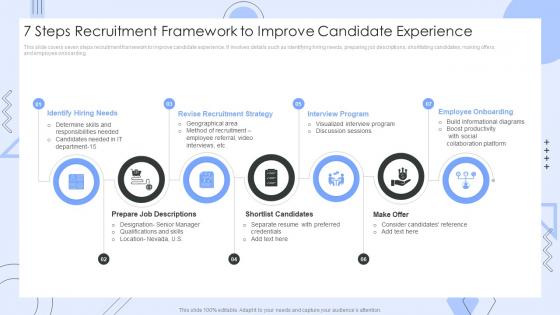
This slide covers seven steps recruitment framework to improve candidate experience. It involves details such as identifying hiring needs, preparing job descriptions, shortlisting candidates, making offers, and employee onboarding.
People who downloaded this PowerPoint presentation also viewed the following :
7 Steps Recruitment Framework To Improve Candidate Experience with all 6 slides:
Use our 7 Steps Recruitment Framework To Improve Candidate Experience to effectively help you save your valuable time. They are readymade to fit into any presentation structure.





FAQs for 7 Steps Recruitment Framework To
Essential components of an effective recruitment framework include job analysis and requirements definition, candidate sourcing strategies, structured screening processes, competency-based assessments, and onboarding protocols. These elements work together by streamlining talent acquisition, reducing hiring timelines, and improving candidate quality, with many organizations finding that systematic frameworks enhance retention rates and deliver better cultural alignment.
A recruitment framework improves hire quality by establishing standardized evaluation criteria, structured interview processes, and consistent candidate assessment methods across all positions. Through systematic screening stages and competency-based evaluations, organizations streamline decision-making, reduce hiring bias, and ensure better role-fit alignment, ultimately delivering stronger team performance and reduced turnover rates.
Employer branding serves as the foundation of effective recruitment frameworks by attracting quality candidates, reducing hiring costs, and accelerating time-to-fill positions through enhanced company reputation. Strong employer brands enable organizations to compete for top talent in competitive markets, with companies like Google and Microsoft leveraging authentic workplace cultures to streamline candidate attraction and ultimately deliver sustainable recruitment advantages.
Technology enhances recruitment frameworks through AI-powered candidate screening, automated resume parsing, video interviewing platforms, predictive analytics, and applicant tracking systems. These tools streamline hiring by reducing time-to-fill, improving candidate matching accuracy, and eliminating manual tasks, with many organizations finding that integrated recruitment technology ultimately delivers faster hiring decisions and enhanced candidate experiences.
Key recruitment framework metrics include time-to-hire, cost-per-hire, candidate quality scores, source effectiveness, and retention rates within the first year. These metrics enable organizations to streamline their hiring processes, optimize resource allocation, and enhance candidate experiences, with many companies finding that tracking these indicators ultimately delivers faster recruitment cycles and improved talent acquisition outcomes.
Diversity and inclusion initiatives integrate into recruitment frameworks through unbiased job descriptions, diverse hiring panels, structured interviews, and equitable candidate sourcing strategies. These approaches help organizations minimize unconscious bias while expanding talent pools, with companies like Johnson & Johnson and Salesforce finding that inclusive recruitment enhances innovation and delivers stronger business outcomes.
Effective candidate sourcing strategies include leveraging AI-powered recruitment platforms, utilizing employee referral programs, implementing social media recruiting, establishing talent pipeline databases, and partnering with specialized recruitment agencies. These approaches streamline the hiring process by expanding reach, reducing time-to-fill, and improving candidate quality, with many organizations finding that strategic combinations deliver faster placements and enhanced talent acquisition outcomes.
Recruitment frameworks can be tailored by adjusting evaluation criteria, interview formats, assessment methods, and timeline requirements to match specific industry demands and role characteristics. For example, tech companies emphasize coding assessments and cultural fit, while healthcare organizations prioritize certifications and patient interaction skills, ultimately delivering more targeted candidate selection and improved hiring outcomes.
Common challenges include inconsistent hiring standards, lengthy approval processes, inadequate technology integration, resistance to standardized procedures, and insufficient training for recruitment teams. These implementation hurdles often result from poor change management and unclear role definitions, with many organizations finding that gradual rollouts, comprehensive stakeholder training, and flexible framework customization help overcome initial resistance while ultimately delivering more efficient hiring processes.
Feedback loops enhance recruitment frameworks by collecting insights from candidates, hiring managers, and new employees throughout the process, enabling continuous refinement of sourcing strategies, interview techniques, and onboarding procedures. These systematic evaluations help organizations identify bottlenecks, reduce time-to-hire, and improve candidate experiences, with many companies finding that regular feedback analysis ultimately delivers higher-quality hires and stronger employer branding.
Candidate experience significantly influences recruitment framework design by determining touchpoint quality, communication strategies, and process efficiency throughout the hiring journey. A positive experience attracts top talent, enhances employer branding, and reduces time-to-hire, while poor experiences can damage reputation and limit candidate pools, ultimately affecting organizational competitiveness and talent acquisition success.
Collaboration between HR and hiring managers significantly streamlines recruitment by aligning job requirements, candidate expectations, and evaluation criteria from the outset. This partnership enhances decision-making speed, reduces miscommunication, and ensures cultural fit assessments, with many organizations finding that coordinated hiring approaches deliver faster placements, improved candidate experiences, and ultimately stronger long-term employee retention rates.
Legal considerations in recruitment frameworks include equal opportunity compliance, data protection regulations, background check authorization, wage transparency requirements, and anti-discrimination policies. These safeguards streamline hiring processes by ensuring GDPR compliance, preventing costly litigation, and maintaining consistent documentation standards, with many organizations finding that proactive legal frameworks ultimately deliver faster recruitment cycles and enhanced employer reputation.
Predictive analytics integrates into recruitment frameworks through candidate screening algorithms, performance prediction models, retention forecasting tools, and automated sourcing systems. These technologies streamline hiring by analyzing historical data patterns, identifying top-performing candidate profiles, and predicting long-term employee success, with many organizations finding significantly reduced turnover and faster placement times.
HR professionals need training in applicant tracking systems, data analytics for recruitment metrics, interview structuring techniques, legal compliance requirements, and bias-free selection processes. This comprehensive training enables teams to streamline candidate evaluation, enhance decision-making accuracy, and ensure regulatory adherence, with many organizations finding that skilled HR teams deliver faster hiring cycles and significantly improved candidate experiences.
-
Excellent work done on template design and graphics.
-
Slideteam offers pocket-friendly products. As a college student this is a really necessary thing to look at while paying for something.