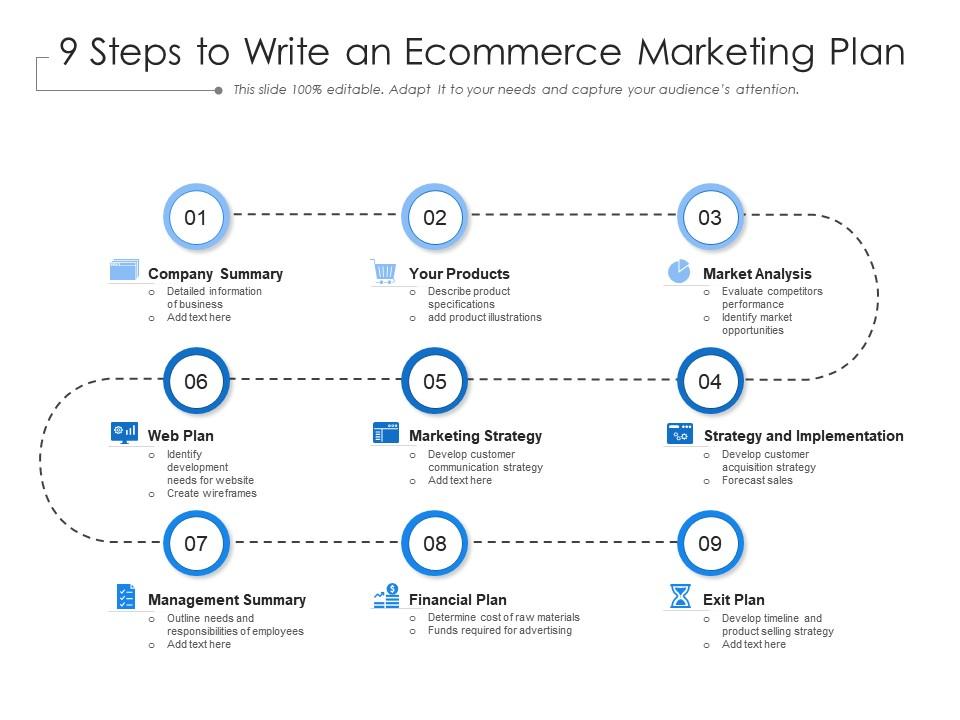
9 steps to write an ecommerce marketing plan
Try Before you Buy Download Free Sample Product
Audience
Editable
of Time
Our 9 Steps To Write An Ecommerce Marketing Plan are topically designed to provide an attractive backdrop to any subject. Use them to look like a presentation pro.
People who downloaded this PowerPoint presentation also viewed the following :
9 steps to write an ecommerce marketing plan with all 2 slides:
Use our 9 Steps To Write An Ecommerce Marketing Plan to effectively help you save your valuable time. They are readymade to fit into any presentation structure.
FAQs for 9 steps to write an
Effective ecommerce marketing plans include customer segmentation, SEO optimization, social media strategy, email campaigns, and conversion analytics. These components work together by targeting specific audiences, enhancing online visibility, and driving measurable sales growth, with many retailers finding that integrated approaches deliver significantly higher ROI and sustained competitive advantage.
Social media marketing integrates into ecommerce strategy through targeted advertising, influencer partnerships, user-generated content campaigns, social commerce features, and community building initiatives. These approaches streamline customer acquisition by enabling direct product discovery, enhancing brand authenticity through peer recommendations, and facilitating seamless purchasing experiences, ultimately delivering higher conversion rates and stronger customer loyalty.
SEO plays a crucial role in driving organic traffic to ecommerce sites by improving search engine rankings, increasing product visibility, enhancing user experience, and optimizing content for target keywords. Through strategic keyword placement, technical optimization, and quality content creation, online retailers attract qualified customers, reduce acquisition costs, and build sustainable traffic growth, ultimately delivering higher conversion rates and competitive market positioning.
Email marketing enhances customer retention by delivering personalized product recommendations, automated follow-up sequences, and targeted promotional campaigns based on purchase history and browsing behavior. Through strategic segmentation and lifecycle messaging, online retailers streamline customer engagement, reduce cart abandonment rates, and increase repeat purchase frequency, with many ecommerce businesses finding that consistent email touchpoints ultimately deliver higher customer lifetime value and sustained revenue growth.
**INPUT**: What are the best practices for creating engaging product descriptions? **OUTPUT**: Best practices for creating engaging product descriptions include focusing on benefits over features, using sensory language, incorporating social proof, optimizing for search keywords, and addressing customer pain points directly. These approaches streamline the purchasing decision by building emotional connections, enhancing discoverability, and reducing hesitation, with many ecommerce retailers finding that strategic storytelling ultimately delivers higher conversion rates and customer engagement. **Word count: 58 words**
Data analytics shapes ecommerce marketing plans by identifying customer behavior patterns, optimizing pricing strategies, and predicting purchasing trends through comprehensive data collection and analysis. These insights enable retailers to personalize product recommendations, streamline inventory management, and enhance targeted advertising campaigns, ultimately delivering higher conversion rates and improved customer retention across digital platforms.
Budget considerations for ecommerce campaigns include advertising spend allocation, platform fees, creative development costs, analytics tools, and contingency reserves for optimization. These investments should balance customer acquisition costs with lifetime value projections, with many retailers finding that strategic diversification across channels like social media, search, and email ultimately delivers higher ROI and sustainable growth.
User experience directly impacts conversion rates by streamlining navigation, reducing checkout friction, optimizing page load speeds, and ensuring mobile responsiveness across all touchpoints. Poor UX elements like complicated checkout processes or slow-loading product pages can decrease conversions by up to 40%, while intuitive design, clear calls-to-action, and seamless payment integration significantly boost sales, with many retailers finding that strategic UX improvements deliver measurable competitive advantage.
Effective influencer marketing methods include micro-influencer partnerships, product collaborations, affiliate programs, user-generated content campaigns, and strategic brand ambassadorships. These approaches enhance brand credibility by leveraging authentic audience connections, expanding reach through targeted demographics, and driving conversions through trusted recommendations, with many ecommerce businesses finding that micro-influencers deliver higher engagement rates and cost-effective customer acquisition.
Seasonal trends can be incorporated through strategic campaign timing, inventory optimization, targeted content creation, promotional calendar planning, and data-driven forecasting. Retailers leverage historical sales data and market analytics to anticipate demand spikes, with fashion and electronics companies finding that aligning product launches with seasonal patterns ultimately delivers higher conversion rates and enhanced customer engagement.
Marketing automation tools for ecommerce include email platforms like Mailchimp and Klaviyo, CRM systems such as HubSpot, social media schedulers like Hootsuite, and analytics tools including Google Analytics. These technologies streamline customer segmentation, personalized campaigns, and cross-channel messaging, with many retailers finding that automated workflows significantly enhance customer engagement while reducing operational costs.
Customer feedback enhances ecommerce marketing plans by identifying pain points, revealing product preferences, and uncovering messaging gaps that traditional analytics miss. Through review analysis, survey insights, and social listening, retailers can refine targeting strategies, optimize product positioning, and personalize campaigns, ultimately delivering higher conversion rates and stronger customer loyalty while reducing acquisition costs.
Essential ecommerce campaign metrics include conversion rate, customer acquisition cost, return on ad spend, average order value, and customer lifetime value. These metrics enable businesses to optimize marketing spend, identify high-performing channels, and maximize profitability, with many retailers finding that tracking these KPIs ultimately delivers improved ROI and sustainable growth.
A/B testing optimizes product page performance by comparing different versions of headlines, images, descriptions, pricing displays, and call-to-action buttons to identify which elements drive higher conversions. Through systematic testing of these variables, ecommerce retailers can enhance user engagement, reduce bounce rates, and increase sales, with many online shops finding that data-driven optimization delivers significantly improved customer experiences and revenue growth.
Multi-channel ecommerce marketing delivers enhanced customer reach, improved brand visibility, diversified revenue streams, reduced dependency risk, and comprehensive customer data collection. This strategic approach enables retailers to engage customers across social media, email, search engines, and marketplaces simultaneously, with many businesses finding that integrated campaigns generate significantly higher conversion rates and customer lifetime value than single-channel efforts.
-
Easily Understandable slides.
-
Really like the color and design of the presentation.
-
Best way of representation of the topic.
-
The Designed Graphic are very professional and classic.
-
Wonderful templates design to use in business meetings.
-
Really like the color and design of the presentation.
-
Great quality product.
-
Unique design & color.
-
Editable templates with innovative design and color combination.
-
Editable templates with innovative design and color combination.