

Accounting Proposal Powerpoint Presentation Slides





Try Before you Buy Download Free Sample Product
 Impress Your
 Audience
 100%
100% Editable
 Save Hours
 of Time


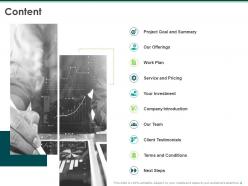
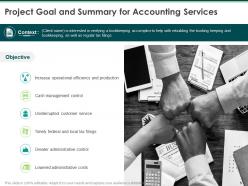
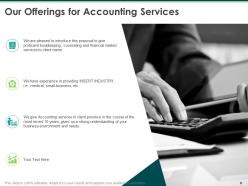
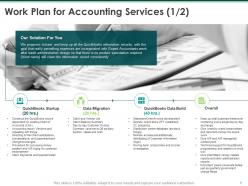
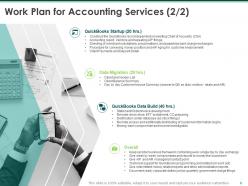
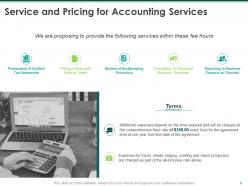
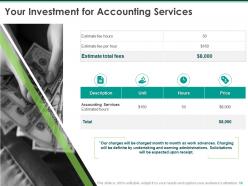
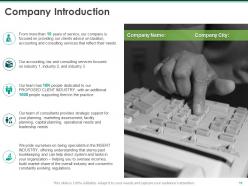
Accounting is a process of summarizing and analyzing the economic activities of an organization. It helps in keeping a record of the bookkeeping and monitors the financial statement of the company. The main objective of accounting is to enhance the cash flow of the organization. Provide your clients with your taxation and accounting services with the help of readymade proposals. You can give a brief introduction of your company to the clients by using our topic-specific Accounting Proposal PowerPoint Presentation Slides. With the aid of this visually-appealing accounting services proposal PPT layout, you can showcase the solution your company offers to overcome the business challenges faced by the clients. The accounting proposal presentation template includes a table of contents that consists of the project goal & summary, work plan, service & pricing, client testimonials, terms & conditions, etc. Take advantage of this eye-catching proposal PowerPoint theme and highlight your services such as the preparation of audited tax statements, filing of state and federal taxes, review of bookkeeping procedure, consulting on financial business practices, and reporting to the business partners. Portray the objectives of your project that involves increased operational efficiency & production, cash management control, uninterrupted customer service, timely federal & local tax fillings, greater administrative control, and lowered administrative costs. Employ this professionally designed accounting proposal PowerPoint presentation to explain a work plan your team requires while achieving the client’s project. It includes quick book startups, data migration, and QuickBooks data build. With the aid of our outwardly engaging accounting proposal PPT slide, you can mention the accreditations and certifications your company received over the past years. Take help of this proposal PPT slide, you can portray your accomplished projects that captivate your clients. Offer the best services to the clients and land more prospects by downloading our ready-to-use accounting services proposal PowerPoint presentation template.
People who downloaded this PowerPoint presentation also viewed the following :
Accounting Proposal Powerpoint Presentation Slides with all 29 slides:
Use our Accounting Proposal Powerpoint Presentation Slides to effectively help you save your valuable time. They are readymade to fit into any presentation structure.





FAQs for Accounting Proposal
So you need the usual stuff - what services you're doing, timeline, pricing, your background. List out the specific tasks like bookkeeping or tax prep. Mention your process and whatever software you use. Pricing is always weird to write but just be upfront about fees and payment terms. Throw in some client references if you've got them - people actually read those. Oh, and definitely include next steps so they know what happens next. Keep it skimmable since nobody reads the whole thing anyway. Most people just hunt for the price and scope then move on.
Dude, projections are honestly a game-changer for proposals. They prove you've done your homework instead of just winging it. Clients love seeing actual numbers - like "here's how I'll save you 50K" vs "trust me, I'm great at math." Cash flow forecasts and ROI estimates show real impact on their business. Just don't go crazy optimistic or you'll look like you don't know what you're doing. Keep the numbers conservative and realistic. It's basically the difference between looking professional and looking like every other accountant who promises the world but can't back it up with data.
Look, client understanding is everything when it comes to proposals. You've got to really dig into their business - what's broken, how they're currently handling their books, what's stressing out their finance team. Skip this step and you're basically just shotgunning random services their way. Not gonna work. Discovery questions should be your opening move, not rattling off what you do. The deeper you get into their specific headaches and where they want to grow, the easier it becomes to show them you're exactly what they need. Industry quirks matter too - don't overlook those.
Don't be vague about what you actually do - spell out your services clearly. State your fees upfront too, nobody wants surprise costs later. Those copy-paste proposals are the worst and clients see right through them. I swear, taking five extra minutes to customize it makes all the difference. Address their actual problems and timeline instead of just rattling off your resume. Proofread everything because typos from an accountant? That's embarrassing. End with clear next steps so they know how to hire you.
Honestly, visuals are a game-changer for accounting proposals. Your clients don't want to slog through paragraphs about budget breakdowns when they could just glance at a pie chart, you know? Charts and graphs make all those numbers way less intimidating. Plus they're perfect for showing trends and projections that would take forever to explain otherwise. I always throw in 2-3 charts minimum now - sometimes feels like overkill but clients actually get what I'm proposing instead of glazing over. Trust me, it's worth the extra effort.
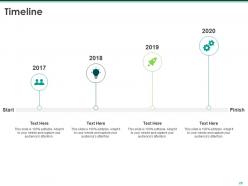
You absolutely need timelines in your proposals. Trust me - I've watched so many people lose deals because they were wishy-washy about when stuff would get done. Clients want to know exactly when they'll see results, especially around crunch times like month-end or tax season. Plus it shows you actually know what you're doing instead of just winging it. Build in extra time though - things always take longer than expected. The best part? When clients inevitably want everything rushed, you can just point to what they already agreed to.
Dude, put your pricing right at the front - don't bury it! Break it down by what you do (bookkeeping, taxes, consulting) and say if you charge hourly or flat rates. Bullet points are your friend here, nobody wants to hunt through paragraphs. Oh, and definitely spell out what costs extra - like if they need something rushed or their books are a total mess. I learned this the hard way lol. Connect your prices to what they're actually getting though. People need to see why you're worth it, not just get sticker shock.
You gotta speak their language, you know? Restaurants are always stressed about cash flow and inventory - those are goldmines to focus on. Manufacturing guys love cost accounting stuff and inventory valuation. Multi-location reporting is huge for retail, plus all that messy sales tax compliance. Professional services want project accounting and client profitability breakdowns - makes sense since that's how they bill. Healthcare's tricky though, they need that specialized revenue cycle management thing. Honestly, generic bookkeeping pitches don't work anymore. Figure out what's actually driving each industry crazy and sell yourself as the fix.
Honestly, case studies and testimonials are like your receipts - they prove you actually do what you say you do. I always tell people to think of them as before/after shots for money stuff instead of kitchen renovations. You want those specific wins like "cut their taxes by 15%" or "saved them 10 hours of bookkeeping hell every month." Makes everything way more believable than just saying you're good at your job. Oh, and start grabbing these stories from your current clients ASAP. Trust me, when you're scrambling to write proposals later, you'll be so glad you did.
Start with what's actually in it for them - skip the fluff. Real client examples with numbers beat promises every time. I hate those cookie-cutter proposals, so dig into their specific industry challenges. Be upfront about costs and give them a realistic timeline they can work with. Here's the thing - most firms are slow to respond, so get back to them fast. Suggest some tech improvements they haven't thought of yet. Following up consistently separates you from everyone else who sends one email and disappears.
Get ahead of their objections by baking responses right into your proposal. Cost concerns? Timeline worries? They're gonna bring these up anyway, so beat them to it. I always throw in phrases like "you're probably thinking about implementation time" then boom—hit them with your solution and maybe a case study. Shows you actually get their situation instead of just pitching blindly. Honestly, most clients stress about the same stuff anyway. Don't make it feel like you're being defensive either. It's more like you're anticipating their questions because you've been there before.
Focus on the metrics that actually matter - error reduction percentages, time savings like cutting month-end close in half, cost improvements. Client retention rates are gold if you're in public accounting. Numbers always win over fluff, trust me. Show compliance wins too - zero audit findings, clean regulatory reviews, that kind of thing. Automation efficiency gains are huge right now. Oh, and stakeholder satisfaction scores if you've got them (though honestly those can be pretty subjective). Pick maybe 3-4 solid metrics that align with what your new client actually cares about. Don't overwhelm them with everything.
Look, your tone in accounting proposals makes or breaks whether clients will trust you with their money. Think about it - messy writing signals messy bookkeeping, right? So yeah, you've got to sound competent and reliable. Clear language is key, skip the jargon unless you really need it. Definitely proofread twice (learned that the hard way). Don't be so formal that you sound like a robot, though. People still want to work with an actual person. Your expertise should come through naturally in polished writing that makes them think "this person knows their stuff."
Definitely call or email within a week just to make sure they got it. People forget about proposals super fast - it's crazy how quickly stuff falls off their radar. I'd check in every 2-3 weeks after that. Be ready for random questions or if they want more documents. Honestly, don't feel bad about being persistent because everyone's swamped these days. If a month goes by with nothing, send a casual "hey, just checking in" message. Set calendar reminders though - you'll totally forget otherwise. The trick is staying on their radar without being that annoying person who calls every other day.
Honestly, tech can totally transform your proposals. Use Tableau or Power BI to create actual engaging charts - way better than boring spreadsheet dumps that make everyone's eyes glaze over. Interactive dashboards are clutch. Cloud tools help with collaboration, and project management platforms keep everything transparent with milestones. Oh, and video walkthroughs? Game changer for explaining complex stuff - clients get it so much faster than reading through static docs. Just match whatever tech level your client's comfortable with. Don't go overboard trying to look fancy if it doesn't actually help them understand better.
-
Thanks for all your great templates they have saved me lots of time and accelerate my presentations. Great product, keep them up!
-
Enough space for editing and adding your own content.
-
Content of slide is easy to understand and edit.
-
Great product with effective design. Helped a lot in our corporate presentations. Easy to edit and stunning visuals.