


Action matrix of business project execution plan




Try Before you Buy Download Free Sample Product
 Impress Your
 Audience
 100%
100% Editable
 Save Hours
 of Time


Get them all eager and charged with our Action Matrix Of Business Project Execution Plan. They will experience a flood of energy.
People who downloaded this PowerPoint presentation also viewed the following :
Content of this Powerpoint Presentation
Description:
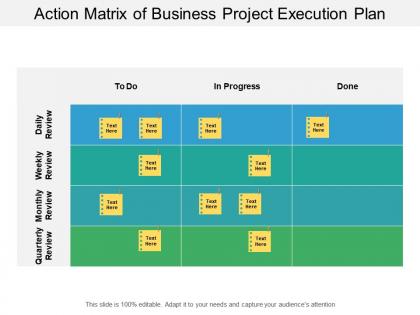
The image is of a professional PowerPoint slide that displays an "Action Matrix of Business Project Execution Plan." This matrix is a strategic tool utilized for project management, ensuring that tasks are monitored, reviewed, and executed efficiently. The slide is organized into a table format with specific color-coded rows and columns that serve distinct purposes:
1. Column Categories:
There are three main columns titled "To Do," "In Progress," and "Done." These columns categorize tasks based on their current status, providing a clear workflow state of each task within the project lifecycle.
"To Do" indicates tasks that are scheduled to be started.
"In Progress" signifies tasks that are currently being worked on.
"Done" denotes tasks that have been completed.
2. Row Categories:
The rows are divided into "Daily Review," "Weekly Review," and "Monthly / Quarterly Review." This categorization represents the review frequency of tasks, allowing for regular monitoring and updates.
"Daily Review" suggests tasks that should be checked or updated daily.
"Weekly Review" indicates a longer-term check-in that happens once a week.
"Monthly / Quarterly Review" is for tasks that need less frequent monitoring or are strategic and require higher-level oversight.
3. Color Coding:
Each cell within the matrix alternates between a blue or green background. This color-coding can help in visually distinguishing between different types of tasks or priority levels.
4. Editable Content:
Inside each matrix cell, there is a placeholder with the text "Text Here," alongside a pin icon, implying these are points where specific tasks or notes can be inserted. This suggests that the template is designed to be interactive and customizable according to the needs of the project.
5. Customization and Usability:
The bottom notice on the slide states, "This slide is 100% editable. Adapt it to your needs and capture your audience's attention." It emphasizes the slide's adaptability and its utility as a dynamic project management tool that can be tailored to various project scopes and industries.
Use Cases:
Here are seven specific industries where such a slideshow could be effectively utilized:
1. Software Development:
Use: Tracking development phases, feature implementations, and updates.
Presenter: Project Manager
Audience: Development team, stakeholders
2. Construction:
Use: Monitoring construction stages, supply inventory, and inspection schedules.
Presenter: Construction Manager
Audience: Construction crew, contractors, investors
3. Marketing:
Use: Managing campaign launches, content creation, and performance analysis.
Presenter: Marketing Coordinator
Audience: Marketing team, advertising partners
4. Manufacturing:
Use: Overseeing production runs, quality checks, and machine maintenance.
Presenter: Operations Manager
Audience: Production staff, quality assurance team
5. Education:
Use: Organizing curriculum development, teaching material updates, and assessment timelines.
Presenter: Curriculum Specialist
Audience: Educators, administrative staff
6. Healthcare:
Use: Coordinating patient care plans, medical procedures, and follow-up appointments.
Presenter: Healthcare Administrator
Audience: Medical staff, department heads
7. Event Planning:
Use: Arranging event logistics, vendor coordination, and post-event debriefings.
Presenter: Event Planner
Audience: Event team, clients, suppliers
Action matrix of business project execution plan with all 5 slides:
Do not compromise with your high standards. Our Action Matrix Of Business Project Execution Plan will meet your exacting checks.


FAQs for Action matrix of business
An action matrix in project management serves to organize tasks, assign responsibilities, set deadlines, and track progress systematically across all project components. This strategic tool enhances accountability, streamlines communication between team members, and ensures critical deliverables remain on schedule, with many organizations finding that structured matrices significantly reduce project delays and improve overall execution efficiency.
An action matrix helps prioritize tasks by categorizing them based on urgency and importance, enabling project managers to focus resources on high-impact activities first. This systematic approach streamlines decision-making, reduces bottlenecks, and ensures critical deliverables receive attention, with many organizations finding that structured prioritization accelerates project timelines and enhances overall efficiency.
An effective action matrix should include clearly defined tasks, responsible parties, specific deadlines, priority levels, and measurable success metrics. These components work together by ensuring accountability, streamlining project management, and enabling systematic progress tracking, with many organizations finding that well-structured matrices significantly enhance operational efficiency and team coordination.
An action matrix differs from traditional task lists by incorporating priority levels, deadlines, responsibility assignments, and progress tracking in a structured grid format, rather than simple sequential listings. This strategic approach enables teams to visualize dependencies, allocate resources more effectively, and maintain accountability across complex projects, ultimately delivering enhanced coordination and faster project completion than basic task management methods.
Action matrices prove most beneficial in complex project management scenarios, strategic planning initiatives, team coordination challenges, resource allocation decisions, and crisis response situations. These frameworks streamline decision-making by clearly defining responsibilities, prioritizing tasks, and establishing accountability structures, with many organizations finding that systematic approaches significantly enhance operational efficiency and reduce costly miscommunication delays.
An action matrix facilitates team collaboration by clearly defining roles, responsibilities, deadlines, and decision-making authority for each task or project component. This structured approach eliminates confusion about ownership, streamlines communication between departments, and creates transparent accountability mechanisms, with many organizations finding that it significantly reduces project delays, enhances cross-functional coordination, and ultimately delivers faster execution and improved team performance.
Common mistakes include creating overly complex matrices that confuse rather than clarify, failing to define clear ownership for each action item, setting unrealistic timelines, and neglecting to establish measurable outcomes. These oversights undermine effectiveness by reducing accountability, creating bottlenecks in execution, and hampering progress tracking, with many organizations finding that simple, well-defined matrices with designated owners ultimately deliver better strategic results.
Determining criteria for action matrix prioritization involves evaluating impact potential, resource requirements, implementation timeframe, strategic alignment, and stakeholder influence across each proposed action. Organizations typically assess factors like revenue generation, cost reduction, and competitive advantage, with many finding that combining quantitative metrics with qualitative strategic considerations delivers the most balanced and actionable prioritization framework.
**INPUT**: Can an action matrix be integrated with other project management tools, and how? **OUTPUT**: Action matrices integrate seamlessly with project management platforms like Asana, Trello, Microsoft Project, and Gantt chart software through data synchronization, automated task updates, and shared dashboards. This strategic combination enables teams to maintain centralized task tracking, streamline workflow coordination, and enhance resource allocation, with many organizations finding that integrated systems deliver faster project completion and improved accountability. [Word count: 58 words]
An action matrix in risk management systematically organizes identified risks by priority, assigns specific mitigation strategies, and designates responsible stakeholders with clear timelines for implementation. This structured approach enables organizations, particularly in financial services and healthcare, to proactively address high-impact vulnerabilities while allocating resources efficiently, ultimately delivering enhanced operational resilience and regulatory compliance.
Visual elements enhance action matrix effectiveness by incorporating color coding for priority levels, icons for task categories, progress bars for completion tracking, and clear typography hierarchies. These design features streamline information processing, reduce cognitive load, and enable faster decision-making, with many project managers finding that well-designed matrices improve team alignment and accelerate task execution across complex initiatives.
Projects with multiple stakeholders, complex dependencies, and clear deliverables benefit most from action matrix approaches, including product launches, organizational restructuring, event planning, software implementations, and marketing campaigns. These initiatives require coordinated task allocation, accountability tracking, and resource management across teams, with many organizations finding that action matrices streamline communication, minimize overlap, and accelerate project completion while enhancing overall operational efficiency.
Action matrices should be reviewed monthly for routine updates and quarterly for comprehensive assessments, with additional reviews triggered by major project changes or strategic shifts. Many organizations find that regular reviews enhance accountability, ensure priorities remain aligned with business objectives, and enable teams to adapt quickly to changing circumstances, ultimately delivering better project outcomes and operational efficiency.
Successful action matrix implementations include Toyota's production system prioritizing high-impact quality issues, McKinsey's strategic consulting framework for client priorities, and Amazon's logistics optimization categorizing delivery urgency versus cost. These matrices streamline decision-making by systematically ranking initiatives, eliminating low-value activities, and focusing resources on high-impact opportunities, with organizations finding significantly improved operational efficiency and strategic outcomes.
Technology and software aid action matrix development by automating task prioritization, enabling real-time collaboration, and providing data-driven insights for strategic decision-making. Through project management platforms and analytics tools, organizations streamline resource allocation, enhance team coordination, and maintain dynamic tracking of priorities, ultimately delivering improved operational efficiency and faster strategic execution across departments.
No Reviews