Advanced Procurement Maturity Model With Business Innovation

Rating:
100%
Advanced Procurement Maturity Model With Business Innovation
Slide 1 of 6
Favourites Favourites

Try Before you Buy Download Free Sample Product

Audience Impress Your
Audience
Editable 100%
Editable
Time Save Hours
of Time
The Biggest Sale is ending soon in
0
0
:
0
0
:
0
0
Rating:
100%
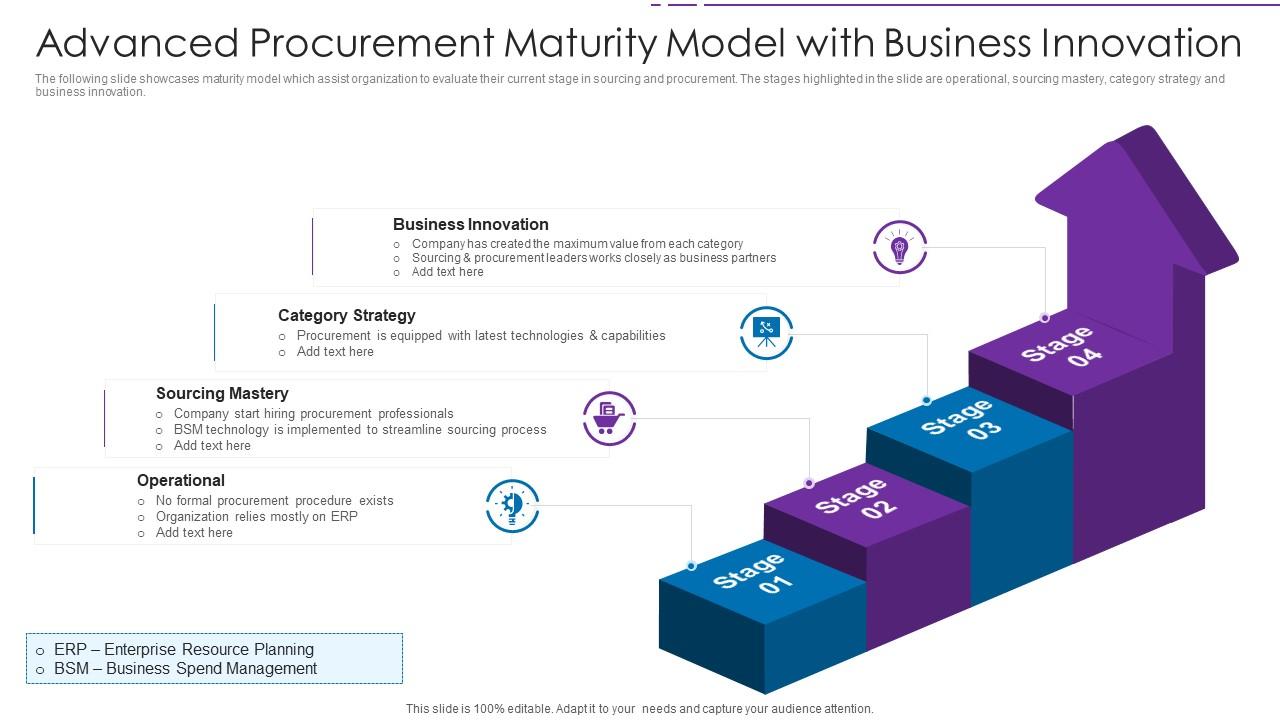
The following slide showcases maturity model which assist organization to evaluate their current stage in sourcing and procurement. The stages highlighted in the slide are operational, sourcing mastery, category strategy and business innovation. Introducing our premium set of slides with Advanced Procurement Maturity Model With Business Innovation. Elucidate the four stages and present information using this PPT slide. This is a completely adaptable PowerPoint template design that can be used to interpret topics like Business Innovation, Category Strategy, Sourcing Mastery. So download instantly and tailor it with your information.

FAQs for Advanced Procurement Maturity Model

The Procurement Maturity Model includes foundational compliance, strategic sourcing, integrated supply management, value optimization, and innovation leadership stages. These progressive levels enhance organizational procurement by streamlining processes, improving supplier relationships, and delivering cost reductions, with many enterprises finding that advancing through these stages ultimately provides significant competitive advantage and operational efficiency.

Organizations can assess their current procurement maturity level through comprehensive evaluations of technology adoption, process standardization, supplier relationship management, strategic alignment, and data analytics capabilities. Many companies utilize structured assessment frameworks, benchmarking studies, and third-party audits to evaluate performance across these dimensions, ultimately identifying gaps and prioritizing improvements that enhance operational efficiency and competitive advantage.

Progressing through the Procurement Maturity Model delivers enhanced cost savings, improved supplier relationships, streamlined processes, better risk management, and increased strategic value creation. Organizations advancing through these stages achieve significant operational efficiency, with many companies finding that mature procurement functions reduce costs by 10-15% while enabling competitive advantage through strategic sourcing capabilities.

Technology significantly enhances procurement maturity by automating manual processes, providing data-driven insights, enabling strategic sourcing, and facilitating supplier collaboration across all stages. Advanced analytics, AI-powered spend analysis, and integrated platforms help organizations progress from reactive purchasing to strategic procurement, with many enterprises finding that digital transformation accelerates their maturity journey while delivering cost savings and operational efficiency.

Data analytics transforms procurement maturity by enabling predictive forecasting, supplier performance optimization, spend analysis, risk assessment, and strategic sourcing decisions. Through advanced analytics platforms, organizations streamline contract negotiations, identify cost-saving opportunities, and enhance supplier relationships, with many enterprises finding that data-driven procurement delivers improved operational efficiency and competitive advantage.

Organizations can benchmark their procurement processes against industry standards through procurement maturity assessments, third-party benchmarking services, industry association studies, peer networking groups, and standardized frameworks like CIPS or SCOR models. These approaches enable companies to identify performance gaps, compare cycle times and cost ratios with competitors, and develop strategic roadmaps, with many finding that structured benchmarking accelerates procurement transformation and delivers measurable competitive advantages.

Common pitfalls include inadequate change management, insufficient stakeholder buy-in, lack of clear metrics, poor technology integration, and underestimating cultural resistance. These challenges often derail transformation efforts by creating operational silos, inconsistent processes, and limited adoption, with many organizations finding that addressing people and process alignment upfront ultimately delivers more sustainable procurement improvements.

Supplier relationship management evolves from transactional, price-focused interactions in early stages to strategic partnerships emphasizing collaboration, innovation, and mutual value creation in mature stages. Advanced organizations develop integrated supplier ecosystems with shared technology platforms, joint planning processes, and performance dashboards, ultimately delivering enhanced supply chain resilience, cost optimization, and competitive advantage through strategic supplier alliances.

Cost savings, spend under management, supplier performance scores, contract compliance rates, and procurement cycle times serve as foundational metrics across maturity levels. Advanced organizations increasingly incorporate strategic metrics like supplier innovation contributions, sustainability scores, and risk mitigation effectiveness, with many finding that combining financial and operational indicators delivers comprehensive visibility into procurement's strategic value and competitive advantage.

Cross-functional collaboration enhances procurement maturity by breaking down organizational silos, aligning strategic objectives across departments, and enabling data-driven decision making throughout the sourcing process. Through integrated teams involving finance, operations, and IT, organizations streamline vendor management, accelerate approval cycles, and optimize resource allocation, ultimately delivering improved cost efficiency and stronger supplier relationships across enterprise operations.

Best practices for developing procurement strategies aligned with maturity goals include conducting comprehensive spend analysis, establishing clear governance frameworks, implementing technology-enabled processes, developing supplier relationship management capabilities, and creating performance measurement systems. These practices enable organizations to systematically advance through maturity stages, with companies in manufacturing, healthcare, and financial services finding that strategic alignment delivers enhanced cost savings, operational efficiency, and competitive advantage.

Regulatory changes significantly accelerate procurement maturity progression by demanding enhanced compliance frameworks, transparent reporting systems, and standardized processes across organizational operations. Many companies find that adapting to new regulations, particularly in healthcare, financial services, and manufacturing sectors, drives automation adoption, supplier risk assessment improvements, and documentation capabilities, ultimately delivering stronger governance and competitive advantages in regulated markets.

**INPUT**: What training or skills development is necessary to support procurement maturity? **OUTPUT**: Training for procurement maturity includes strategic sourcing, supplier relationship management, contract negotiation, risk assessment, data analytics, and digital procurement technologies. These competencies enhance organizational capabilities by improving cost efficiency, streamlining vendor partnerships, and enabling data-driven decision-making, with many companies finding that comprehensive skills development ultimately delivers competitive advantage and operational excellence. [Word count: 53 words]

Procurement teams can effectively communicate their maturity journey through visual dashboards, regular progress reports, stakeholder-specific presentations, and clear ROI metrics that demonstrate tangible value creation. By showcasing specific achievements like cost savings percentages, process efficiency improvements, and supplier relationship enhancements, teams build stakeholder confidence while securing continued investment in procurement transformation initiatives.

Successful procurement maturity cases include Boeing streamlining supplier management, Unilever automating purchase-to-pay processes, and P&G implementing strategic sourcing analytics. These organizations advanced by centralizing procurement functions, leveraging digital technologies for spend visibility, and developing supplier partnerships, ultimately delivering 15-25% cost reductions and enhanced operational efficiency across their global operations.

Ratings and Reviews

100% of 100
Review Form
Write a review
Most Relevant Reviews
  1. 100%

    by Dong Santos

    SlideTeam offers so many variations of designs and topics. It’s unbelievable! Easy to create such stunning presentations now.
  2. 100%

    by Donnie Knight

    The best collection of PPT templates!! Totally worth the money. 

2 Item(s)

per page: