

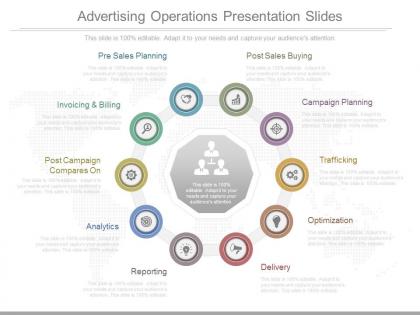
Advertising operations presentation slides




Try Before you Buy Download Free Sample Product
 Impress Your
 Audience
 100%
100% Editable
 Save Hours
 of Time


Develop a gutsy feel with our Advertising Operations Presentation Slides. The adrenaline will begin to flow.
People who downloaded this PowerPoint presentation also viewed the following :
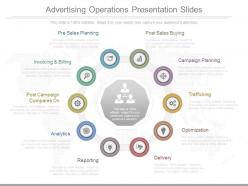
Advertising operations presentation slides with all 7 slides:
Discard archaic beliefs with our Advertising Operations Presentation Slides. They build faith in a free and fresh approach.
FAQs for Advertising
So ad ops teams are basically the people who make sure your campaigns actually work. They set everything up, get ads into the right systems, handle all the targeting stuff. When things break - like tags not firing or weird numbers that don't add up - they're the ones fixing it. Honestly, they're not the flashiest team but you'd be screwed without them. Performance reports, delivery problems, optimization tweaks - all their thing. Pro tip though: bring them into campaign planning super early. They'll catch issues before they become headaches.
Honestly, it depends on what you're trying to accomplish. Brand awareness? Track reach and impressions. Going for conversions? CTR and ROAS are your best friends. Just don't get obsessed with vanity metrics - like, total impressions sound cool but they don't pay the bills. Attribution gets weird when people bounce between devices (ugh), so set up tracking right from the start. I always tell people to make a simple dashboard with your main goal plus maybe 2-3 other metrics that actually matter. Way easier than drowning in data.
Data analytics is like having a GPS for your ads - shows you what's actually working vs what's just bleeding money. Track your CTR, conversion rates, and cost-per-acquisition to find patterns. But honestly, don't get stuck on vanity metrics. Dig into audience segments and see how people actually move through your funnel. A/B testing different creative approaches beats guessing every time. Set up proper tracking first though (learned this the hard way). Then focus on metrics that connect to real business results, not just pretty numbers.
Honestly, automation is a lifesaver for all that tedious stuff - bid adjustments, budget pacing, creative swaps. The reporting alone used to kill me every week. Set up some basic pause/play rules based on your performance thresholds and you'll barely need to babysit campaigns anymore. It runs constantly too, so your ads keep optimizing while you're stuck in meetings or whatever. I'd start simple with bid rules first, then maybe automated reports. Once you see how much time you get back, you'll wonder why you waited so long to set it up.
Start with floor prices based on your historical data - adjust them weekly or you'll get burned. We oversold 150% once and had to scramble like crazy to make good on it! Real-time reporting is your best friend for tracking fill rates and eCPMs daily. Segment inventory by audience and device so you can bundle the premium stuff separately. Honestly, most problems come from sales and ops not talking to each other about what's actually available. Set up alerts when fill rates hit below 85%. Also forecast your inventory properly - nothing worse than leaving money on the table because you didn't plan ahead.
So programmatic tech handles all the tedious stuff for you - bidding, targeting, where ads show up. Real-time algorithms do the heavy lifting instead of you tweaking campaigns constantly. Your job becomes more about strategy than execution, which is honestly way better. You'll set the parameters and monitor dashboards while the platform optimizes automatically. Pretty crazy how well it works once you get the hang of it. Just focus on learning each platform's automation features and how to read their reports properly.
First things first - brand safety and platform guidelines. Trust me, getting flagged sucks. Double-check your creative actually matches your campaign goals and audience (I've seen teams mess this up more than you'd think). Technical stuff matters too: file formats, dimensions, load times. Landing page needs to match the ad, plus any legal disclaimers. Honestly, set up your approval workflow early or you'll be chasing people down last minute. Oh, and make a checklist template - future you will thank me for this one!
Dude, the whole cookie situation has completely screwed traditional advertising. Third-party tracking is basically dead, so your targeting's getting way less precise and attribution is all over the place. GDPR and those privacy laws mean everyone's opting out left and right. Retargeting campaigns? Good luck with that mess. But honestly, this might be a blessing in disguise - first-party data is where it's at now. Build your email list, create loyalty programs, own your audience directly. Server-side tracking and contextual ads are your best bet moving forward. The old cookie playbook is toast, so might as well adapt now before you're completely behind.
Honestly, get a dashboard that shows everything in one place or you'll lose your mind. Make sure you're tracking the same metrics across channels so you can actually compare stuff. Weekly team meetings sound boring but they actually help a ton - learned that the hard way. Set up your audience segments so they work everywhere, and automate budget moves between what's working and what's not. Oh and double-check your tracking pixels aren't broken because that screws everything up. Investing in good integration tools upfront saves you so much headache later.
Okay so three main things you need: ad servers (Google Ad Manager, Amazon DSP), analytics stuff like Google Analytics, and some kind of project management tool - I swear by Asana but Monday.com works too. Fair warning though, you're gonna have like 15 tabs open constantly and it gets chaotic fast. Oh, and get Zapier to connect everything automatically because nobody has time for manual data entry. Don't go crazy buying every tool at once - pick one good option from each category first. You can always add more later when you're not drowning in logins.
Attribution models basically decide which campaigns get credit for your conversions, and trust me, it makes a huge difference in how things look. Last-click makes search seem like a rockstar while display looks useless - even when display is actually driving awareness. First-click has the opposite issue. I swear this causes more budget fights than anything else! Multi-touch models spread the love across touchpoints, so you get a clearer picture. Definitely compare your current setup against another model. You'll be shocked how different the story becomes.
Ugh mobile ad ops is such a pain. Tracking users is a nightmare without cookies, and don't even get me started on all the different screen sizes you have to deal with. Attribution gets super messy too - way more complex than desktop. App store approvals? Total wildcard that can mess up your whole timeline. Oh and multiple SDKs rarely work together smoothly, which is fun. Mobile inventory is still pretty scattered compared to desktop. Honestly the measurement stuff trips people up the most though. User journeys are just chaos on mobile. I'd say nail down your attribution first, then work through the tech integration problems one at a time. Way less overwhelming that way.
So basically you wanna focus on ROAS, cost per acquisition, and conversion rates - that's where the money actually is. Click-through rates are fine but honestly who cares if people aren't buying anything, you know? Watch your frequency caps too so you're not being that annoying brand that shows up everywhere. Attribution windows are kinda messy depending on what you're selling, but I usually stick with 7-day post-click and 1-day post-view. Oh and set up UTM tracking right away or you'll hate yourself later when you can't figure out what's actually working.
Dude, audience segmentation is a total game changer. You basically split your audience into smaller groups - like by age, buying habits, interests, whatever makes sense for your business. Way better than just blasting the same boring ad at everyone. Think of it like this: would you talk to your mom the same way you talk to your college buddies? Hell no. Same logic here - different groups want different messages. I'd start with maybe 3 or 4 main customer types and create separate campaigns for each. Your engagement will probably go through the roof, and you'll actually see better returns on your ad spend.
Honestly, there's three main things happening right now that you can't ignore. Third-party cookies are basically dead, so you need your own first-party data setup. AI automation is taking over campaign optimization too - way better than doing it manually. Connected TV advertising is blowing up everywhere. Privacy laws keep getting tougher, which makes having solid customer data infrastructure super important. Even traditional channels are going programmatic now, which is kinda wild if you think about it. Teams moving fast on this stuff are gonna crush their competition. I'd start by looking at how you're collecting data right now, then figure out what you can automate first.
-
Great quality product.
-
Professional and unique presentations.