Agile Project Management Dashboard With Backlog Status

Rating:
100%
Agile Project Management Dashboard With Backlog Status
Slide 1 of 7

or

Favourites Favourites

Try Before you Buy Download Free Sample Product

Audience Impress Your
Audience
Editable 100%
Editable
Time Save Hours
of Time
The Biggest Sale is ending soon in
0
0
:
0
0
:
0
0
Rating:
100%
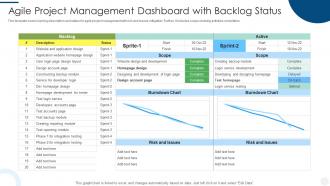
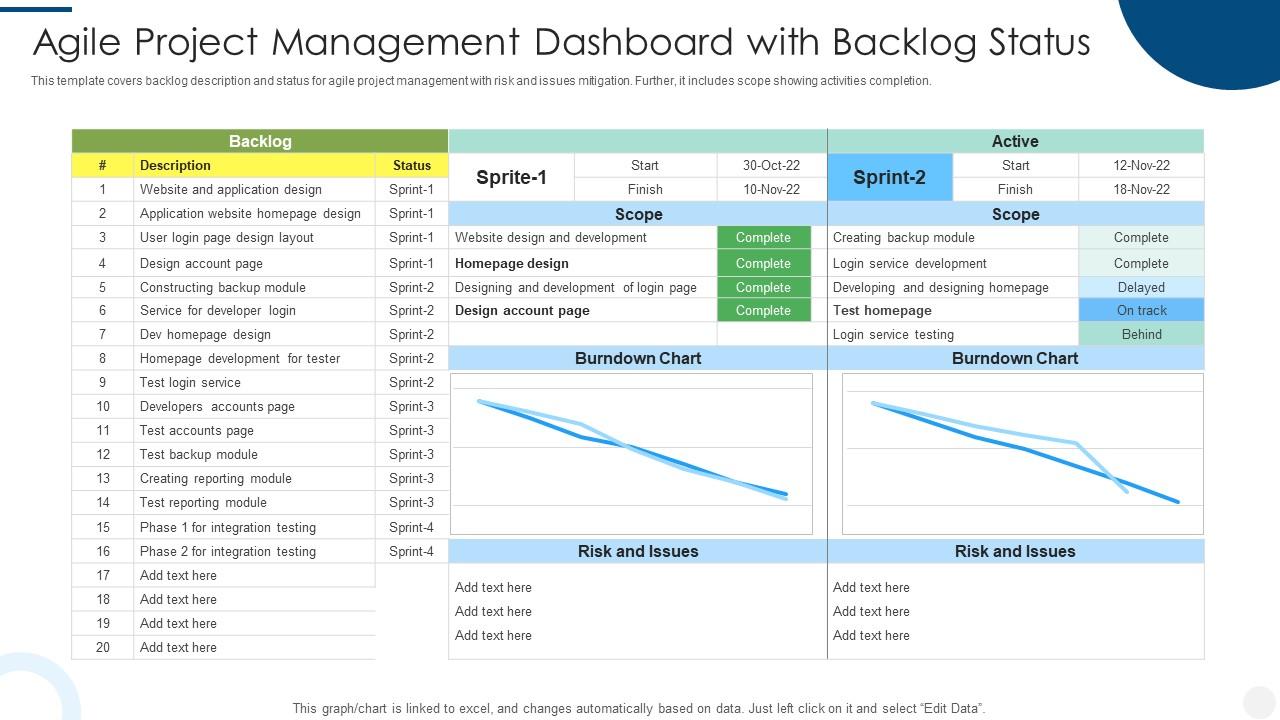
This template covers backlog description and status for agile project management with risk and issues mitigation. Further, it includes scope showing activities completion. Presenting our well structured Agile Project Management Dashboard With Backlog Status. The topics discussed in this slide are Website And Application Design, Design Account Page, Application Website Homepage Design. This is an instantly available PowerPoint presentation that can be edited conveniently. Download it right away and captivate your audience.
FAQs for Agile Project Management Dashboard

So Agile basically flips everything backwards from normal project management. Instead of planning every tiny detail upfront, you build stuff in short bursts and get feedback constantly. The whole thing centers on four ideas: prioritize people over rigid processes, actually working software beats endless documentation, collaborate with customers instead of hiding behind contracts, and adapt to changes rather than sticking to some perfect plan. It feels super uncomfortable at first - like you're flying blind or something. Your team basically runs itself, customers stay involved the whole time, and you deliver every couple weeks. Maybe try two-week sprints? That seems to work for most people.

Honestly, just pick one team to start with - transforming the whole company at once is a nightmare. Keep doing standups, sprint planning, retrospectives but don't stress about being "perfect" Agile. Big companies have their bureaucracy and that's fine. Show some quick wins first. Better collaboration, faster delivery, stuff like that. Then you can expand once leadership actually sees results. Oh, and this is huge - get middle management on your side early. They can totally kill your momentum if they're not bought in. I've watched so many good initiatives die there.

So your Scrum Master is basically the person who shields your team from all the chaos. They run standups, retros, all that ceremony stuff. Think part coach, part referee - honestly, the good ones are worth their weight in gold. They don't manage you directly but they'll fight scope creep and help when things get messy between teammates. When your process feels broken or you're drowning in blockers, that's when you really need them. They keep everyone honest about actually doing Agile instead of just pretending to.

So traditional PM is all about hitting those preset milestones and staying on schedule - very "did we stick to the original plan?" energy. Agile metrics are totally different though. You're tracking things like velocity, burndown rates, and cycle time instead of just timeline stuff. Honestly, Gantt charts make me want to cry. The whole point is measuring how well you deliver value and adapt, not whether you followed some rigid schedule from six months ago. Customer satisfaction matters way more than hitting arbitrary dates. Start with velocity tracking - it's super easy to set up and you'll actually use the data.

Honestly? People hate change, especially teams stuck in old waterfall habits. Daily standups feel super awkward at first - like why are we meeting THIS much? Story point estimates will be terrible initially, and half your user stories won't make sense. Role confusion is huge too. The real killer though is when leadership doesn't actually support the cultural shift. You can't just slap "agile" on the same rigid processes and call it a day. My advice? Pick one team that's actually excited about it and prove it works there first. Way easier than forcing everyone at once.

So you want to measure if your Agile thing is actually working? Focus on the obvious stuff first - how fast are you shipping, what's your defect rate, are customers happier. But here's what I've learned: the team vibe is honestly just as crucial. Are people actually enjoying work more? Do they feel safe speaking up? Survey them regularly about that psychological safety stuff. Also track how quickly you pivot when plans change - that's where Agile really shines. My advice? Pick 3-4 metrics max that actually matter to your company. Don't go crazy trying to measure everything or you'll just overwhelm yourself.

Dude, you gotta show them working stuff constantly - like every 2-3 weeks. I've watched so many projects crash because stakeholders thought they'd get everything at the final reveal (spoiler: they didn't). Get your product owner actually chatting with real users instead of just making stuff up. Weekly quick check-ins beat those painful formal meetings every time. Also, be super clear about what "done" means each sprint - saves you from those awkward "wait, this isn't what I wanted" moments later. Oh, and definitely get them involved in deciding what's most important. Start this rhythm from day one or you'll regret it.

So basically, Agile forces everyone to actually talk to each other instead of working in separate bubbles. Daily standups keep the whole team in the loop - you know, quick check-ins about what's happening. Sprint planning gets messy but in a good way since everyone's weighing in on priorities together. The retrospectives are honestly my favorite part because you can finally call out what's broken without it being weird. Cross-functional teams mean developers aren't just tossing stuff to designers anymore; they're actually collaborating. If you're skeptical, maybe just try 15-minute daily huddles first and see how it feels.

Honestly? Jira's probably your best bet - handles sprints and backlogs like a champ. But if your team finds it overwhelming, Trello's way more visual and easier to pick up. Microsoft shop? Azure DevOps makes sense then. Here's the thing though - I've literally seen teams crush it with just sticky notes on a whiteboard. Sounds old school but whatever works, right? Pick something everyone will actually use instead of fighting against. You can always switch later if you outgrow it. Start simple and see how it feels.

Yeah, scope creep's totally manageable in Agile - way better than waterfall honestly. When new stuff comes up, just toss it in your backlog. Your product owner needs to be the bad guy who decides what's actually worth doing vs nice-to-have fluff. Don't cave to every request (stakeholders can be relentless, I get it). During sprint planning, you'll prioritize new things against what's already there. Retrospectives are perfect for talking through how scope changes mess with timelines. Document everything and be super clear about trade-offs when you talk to stakeholders.

So retrospectives are your team's chance to pause and actually talk about what's working versus what's making everyone want to scream. Happens after each sprint - maybe an hour tops. You go through what went well, what sucked, and what you'll do differently. Honestly, it's like group therapy but for work stuff. The key is bringing real examples instead of just "communication was bad" or whatever. Oh and you actually have to follow through on the changes you decide on, otherwise it's just complaining for an hour. Trust me, I've been in those useless ones before.

Honestly, SAFe or LeSS are your best bet here - they're built exactly for this mess. SAFe can get pretty bureaucratic though, fair warning. The trick is keeping individual teams agile while adding coordination layers on top. Don't organize around departments anymore - think value streams instead. Each team stays nimble, but you create structure for handling dependencies between them. I'd start small with just one product line as a pilot. See how it goes before you try to change everything at once. LeSS might feel lighter if SAFe seems too corporate for your culture.

MoSCoW method is your best friend here - Must have, Should have, Could have, Won't have. Stakeholders get it immediately. User story mapping works great too since you can actually see the customer journey laid out. For understanding what users really want vs. just tolerate, try the Kano model. Dot voting's clutch when you need quick team consensus. Honestly, I always come back to MoSCoW because it's impossible to mess up. Pick whatever clicks with your team though - consistency matters way more than using the "perfect" method. Oh, and user story mapping looks impressive in meetings if that helps sell it to leadership.

Honestly, agile's pretty genius for this. Short sprints mean you can test stuff without huge consequences - like, if something bombs in a 2-week sprint, whatever, you pivot next time. The retrospectives are where the magic happens though. Every few weeks your team sits down and actually talks about what sucked and what didn't. Customer feedback comes in constantly too, so you're not just guessing what people want. My advice? Don't let those retrospectives turn into complaint sessions. Pick one real thing to fix each time and actually do it.

So basically there are three key roles - Product Owner handles what gets built and prioritizes stuff, Scrum Master runs meetings and clears roadblocks, and the Dev Team does the actual building. It's like a three-legged stool honestly. They work together through daily standups, sprint planning, all that. The real magic happens when they actually talk to each other instead of working in silos (which happens way more than it should). Make sure everyone knows their job but also gets how they need each other. Trust is huge here - without it you're basically screwed.

Ratings and Reviews

100% of 100
Review Form
Write a review
Most Relevant Reviews
  1. 100%

    by Williams Nelson

    A beautiful, professional design paired with high-quality images and content that is sure to impress. It is a must-use PPT template in my opinion. 
  2. 100%

    by Derick Meyer

    SlideTeam is my go-to resource for professional PPT templates. They have an exhaustive library, giving you the option to download the best slide!

2 Item(s)

per page: