Agile testing development initiate project powerpoint slides

Rating:
90%
Agile testing development initiate project powerpoint slides
Slide 1 of 5
Favourites Favourites

Try Before you Buy Download Free Sample Product

Audience Impress Your
Audience
Editable 100%
Editable
Time Save Hours
of Time
The Biggest Sale is ending soon in
0
0
:
0
0
:
0
0
AI-Ready
Upload this template to AI and ask it to make any changes to content or color
100% editable Powerpoint Template for AI-assisted presentations. Finish your work in less time. ​
Works with
Microsoft PowerPoint
Microsoft 365
Claude for PowerPoint
ChatGPT
Google Slides
Microsoft Copilot
Rating:
90%
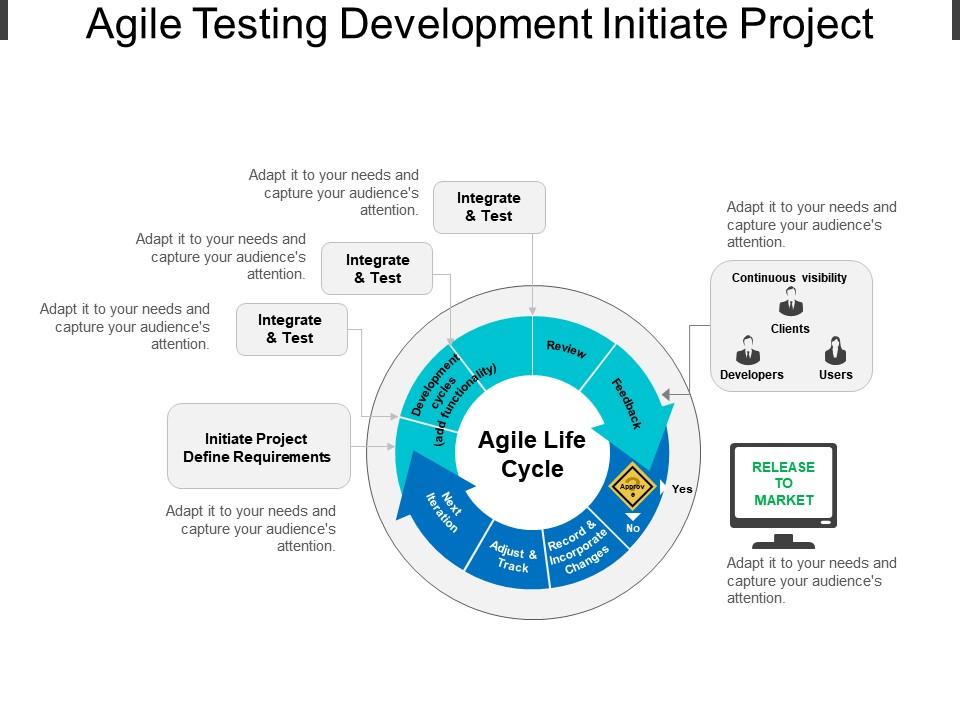
Presenting Agile Testing Development Initiate Project PPT slideshow. Fully editable PPT slide for agile methodology. Valuable for the business presenters, management and entrepreneurs. Compatible with Google Slides as well. Replace the watermark with your company’s name or logo. Convertible into numerous format options like JPEG, JPG or PDF. Access to edit the content, style, size, and orientation of the PPT slides. Use of high-resolution images and the graphics. Ease to share the presentation slide in standard and widescreen view.

FAQs for Agile testing development initiate

Agile Testing principles include continuous testing throughout development, early defect detection, collaborative cross-functional teams, customer feedback integration, and adaptive test planning based on changing requirements. These approaches streamline quality assurance by eliminating lengthy testing phases, enabling faster releases, and fostering real-time communication between developers and testers, ultimately delivering higher-quality software with reduced time-to-market compared to traditional waterfall testing methods.

Agile Testing integrates into DevOps pipelines through automated testing frameworks, continuous integration workflows, and shift-left testing approaches that embed quality checks throughout development cycles. By implementing test-driven development, automated regression suites, and real-time feedback loops, organizations streamline deployment processes, reduce defect rates, and accelerate release cycles, ultimately delivering higher-quality software with enhanced operational efficiency.

Collaboration among cross-functional teams is fundamental to Agile Testing, enabling developers, testers, and business analysts to share knowledge, identify defects early, and ensure comprehensive test coverage throughout development cycles. This integrated approach streamlines communication, accelerates feedback loops, and enhances product quality, with many organizations finding that collaborative testing ultimately delivers faster releases and superior customer experiences.

Agile Testing techniques adapt through continuous test case refinement, iterative feedback loops, automated regression testing, and collaborative sprint planning sessions. These approaches enable teams to quickly modify test scenarios, prioritize critical functionalities, and maintain quality standards while accommodating evolving requirements, ultimately delivering faster development cycles and more responsive product iterations.

Common Agile Testing frameworks include Behavior-Driven Development (BDD), Test-Driven Development (TDD), Acceptance Test-Driven Development (ATDD), Exploratory Testing, and Continuous Integration testing approaches. These frameworks enhance testing processes by enabling early defect detection, streamlining collaboration between development and QA teams, and automating repetitive tasks, ultimately delivering faster release cycles and improved software quality across organizations.

Automated testing in Agile environments enhances efficiency through continuous integration, regression testing, faster feedback loops, and parallel test execution across multiple environments. These capabilities streamline development cycles by reducing manual testing overhead, enabling rapid feature validation, and maintaining comprehensive test coverage, with many development teams finding that automation delivers significantly faster release cycles and improved software quality.

Teams can ensure continuous feedback in Agile Testing through daily standups, sprint reviews, automated testing pipelines, pair programming sessions, and regular retrospectives. These strategies streamline communication by enabling real-time issue identification, faster bug resolution, and immediate stakeholder input, with many development teams finding that continuous integration tools and frequent customer demos ultimately deliver higher quality products and enhanced team collaboration.

Agile Testing metrics focus on continuous feedback through velocity, burn-down charts, defect escape rates, and sprint-based quality indicators, while Waterfall emphasizes phase-gate completion and end-stage defect density measurements. These real-time metrics enable development teams to adjust testing strategies mid-sprint, identify bottlenecks faster, and deliver higher quality software with shorter feedback loops, ultimately enhancing product reliability and accelerating time-to-market.

**INPUT**: What are the challenges teams face when implementing Agile Testing, and how can they be overcome? **OUTPUT**: Agile testing challenges include shifting from traditional testing phases, maintaining test coverage in compressed timelines, coordinating continuous integration, and balancing speed with quality assurance. Teams overcome these obstacles by implementing automated testing frameworks, fostering cross-functional collaboration, and establishing clear communication protocols, ultimately delivering faster releases while maintaining product reliability and customer satisfaction. **Word count: 54 words**

Exploratory testing integrates seamlessly into Agile sprints through continuous, unscripted investigation that complements formal test cases, happening alongside development rather than after completion. This approach enables testing teams to uncover unexpected issues, validate user experience assumptions, and provide immediate feedback to developers, ultimately delivering faster bug detection and enhanced product quality in rapidly iterating environments.

Effective acceptance criteria in Agile Testing include using clear, testable language, defining specific user scenarios, establishing measurable success metrics, incorporating edge cases, and ensuring stakeholder alignment. These practices streamline development by reducing ambiguity, accelerating sprint velocity, and minimizing rework, with many development teams finding that well-crafted criteria ultimately enhance product quality and delivery predictability.

Agile Testing contributes to faster, high-quality software delivery by enabling continuous feedback loops, early defect detection, automated test execution, and integrated development-testing cycles. Through parallel testing and development processes, organizations streamline release timelines while maintaining quality standards, with many software companies finding that this approach reduces time-to-market significantly while enhancing customer satisfaction.

Testers maintain balance by embedding quality practices throughout Agile sprints through continuous testing, early defect detection, and collaborative planning with development teams. This approach enables faster feedback loops, reduces technical debt, and ensures deliverables meet quality standards, while many organizations finding that integrated testing accelerates releases without compromising reliability.

Essential Agile testing tools include Selenium for automated web testing, JIRA for project management, Jenkins for continuous integration, Cucumber for behavior-driven development, and TestRail for test case management. These technologies streamline testing workflows by enabling faster feedback loops, seamless collaboration between development teams, and continuous delivery pipelines, ultimately delivering enhanced software quality and accelerated release cycles.

Agile methodologies like Scrum, Kanban, and Extreme Programming fundamentally reshape testing through continuous integration, sprint-based cycles, and collaborative team structures that embed quality assurance throughout development. These frameworks enable organizations to deliver faster feedback loops, reduce defect costs, and maintain higher product quality, with many software companies finding that iterative testing approaches ultimately enhance both development velocity and customer satisfaction.

Ratings and Reviews

90% of 100
Review Form
Write a review
Most Relevant Reviews
  1. 80%

    by Cortez Graham

    Awesomely designed templates, Easy to understand.
  2. 100%

    by Thomas Hill

    Enough space for editing and adding your own content.

2 Item(s)

per page: