


Agile testing product backlog sprint ppt example professional
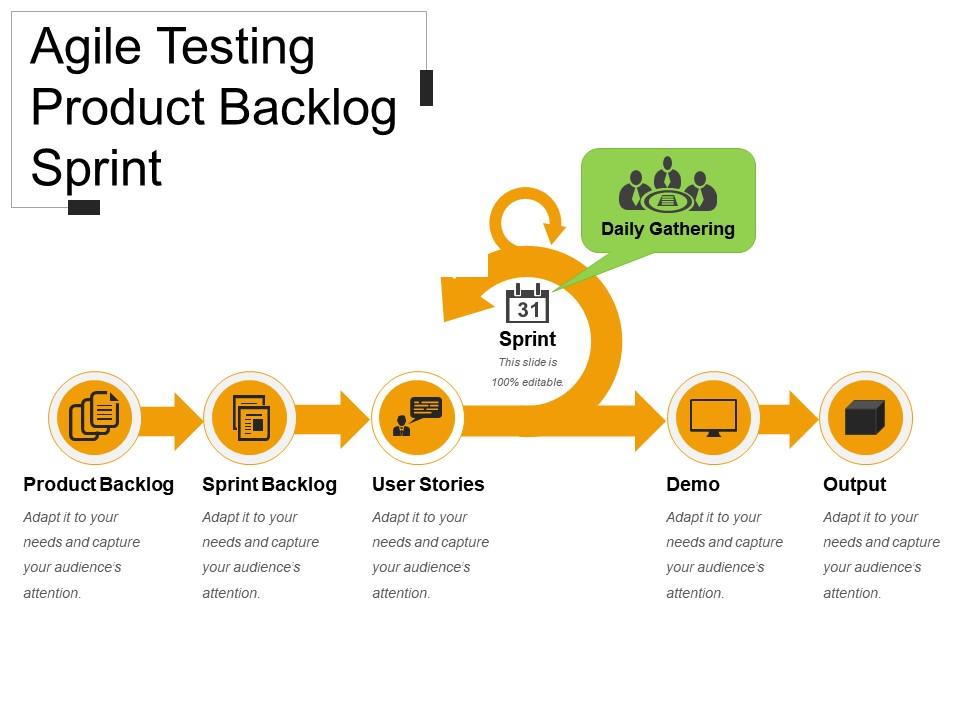
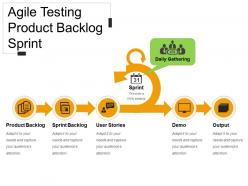
Here is a professionally designed Agile Testing Product Backlog Sprint PowerPoint slide that gives you an insight into the testing process from developing product backlog till the output. To get the desired output, we must have a stable and reliable data on the product backlog. Utilize our scrum testing slide to define it to the viewers about the scrum product backlog. It is simply a list of all the things that need to be done within the project. It replaces the traditional requirements in specification artifacts. Download this sprint testing slides to present the amount of work planned to be completed by the team in a sprint and made ready for review. Sprint is one time-boxed iteration of a continuous development cycle. Be able to present the data from the point it leaves sprint backlog to the sprint gathering where it is reviewed. With our slide, you will be able to keep the viewers connected with the dataflow throughout the process helping the product reach the demo stage seamlessly. Use the slide to review the end product. High-quality presentations are the ones that get remembered long after the presentation is done. Making use of professionally designed Agile Testing Product Backlog Sprint Ppt Example Professional is the first step towards high-quality presentations.
Here is a professionally designed Agile Testing Product Backlog Sprint PowerPoint slide that gives you an insight into the ..

-

- Google Slides is a new FREE Presentation software from Google.
- All our content is 100% compatible with Google Slides.
- Just download our designs, and upload them to Google Slides and they will work automatically.
- Amaze your audience with SlideTeam and Google Slides.
-

Want Changes to This PPT Slide? Check out our Presentation Design Services
-

- WideScreen Aspect ratio is becoming a very popular format. When you download this product, the downloaded ZIP will contain this product in both standard and widescreen format.
-

- Some older products that we have may only be in standard format, but they can easily be converted to widescreen.
- To do this, please open the SlideTeam product in Powerpoint, and go to
- Design ( On the top bar) -> Page Setup -> and select "On-screen Show (16:9)” in the drop down for "Slides Sized for".
- The slide or theme will change to widescreen, and all graphics will adjust automatically. You can similarly convert our content to any other desired screen aspect ratio.
Compatible With Google Slides

Get This In WideScreen
You must be logged in to download this presentation.


Do you want to remove this product from your favourites?
PowerPoint presentation slides
Presenting a professionally designed Agile Testing Product Backlog Sprint PowerPoint slide. It is completely editable in PowerPoint and the slide can be modified as per your requirements. Edit the fonts, colors, and slide background if you wish to. When you download the presentation, you get the PPT files in both widescreens (16:9) and standard screen (4:3) aspect ratio. The presentation is compatible with Google Slides and can be saved in JPG or PDF format.

People who downloaded this PowerPoint presentation also viewed the following :
Content of this Powerpoint Presentation
Description:
The image showcases a slide from a presentation based on Agile testing during a product development sprint. The slide provides a high-level overview of the key elements of Agile testing methodology: Product Backlog, Sprint Backlog, User Stories, Sprint, Daily Gathering, Demo, and Output.
Starting from the left, the "Product Backlog" is highlighted with the note to "adapt it to your needs and capture your audience's attention." The Product Backlog is a prioritized list of features, enhancements, and bug fixes that guides the development team on what needs to be worked on.
Next is the "Sprint Backlog," which similarly should be adapted to meet the team's needs and capture attention. The Sprint Backlog is a specific set of items from the Product Backlog that the team commits to completing during a Sprint.
The "User Stories" element emphasizes the need to adapt user stories to the team's requirements, which should be concise, end-user-focused descriptions of a feature or function.
The diagram then moves to the "Sprint" section, indicating the slide is fully editable, and a 31-day calendar icon, represents a standard timeframe for a sprint in Agile methodology.
At the top right corner, "Daily Gathering" represents daily stand-up meetings where the team discusses the progress and obstacles.
The "Demo" step suggests adapting this stage to your needs to showcase the working product increments to stakeholders for feedback.
Finally, "Output" covers the deliverable or working product resulting from the Sprint, directing to adapt the process according to the audience's needs.
Use Cases:
These slides can be applied across various industries for different purposes:
1. Software Development:
Use: To guide Agile methodology training
Presenter: Agile Coach or Scrum Master
Audience: Development teams
2. Information Technology Services:
Use: Explaining project workflow to clients
Presenter: Project Manager
Audience: Clients or Stakeholders
3. Educational Services:
Use: Teaching Agile frameworks in a classroom setting
Presenter: Educator or Trainer
Audience: Students or Trainees
4. Financial Services:
Use: Implementing Agile in new FinTech product development
Presenter: Product Owner
Audience: Cross-functional product development team
5. Telecommunications:
Use: To streamline the process of rolling out new features
Presenter: Team Lead
Audience: Product and Software Engineers
6. Marketing and Advertising:
Use: Managing and tracking marketing campaigns
Presenter: Marketing Manager
Audience: Marketing team
7. Healthcare Technology:
Use: Development of healthcare software using Agile frameworks
Presenter: Health IT Manager
Audience: Health IT professionals
Agile testing product backlog sprint ppt example professional with all 5 slides:
Global acclaim follows with our Agile Testing Product Backlog Sprint Ppt Example Professional. Get counted among the best across continents.
-
Design layout is very impressive.
-
Professional and unique presentations.
