


Airlines org chart corporate management and communication





Try Before you Buy Download Free Sample Product
 Impress Your
 Audience
 100%
100% Editable
 Save Hours
 of Time


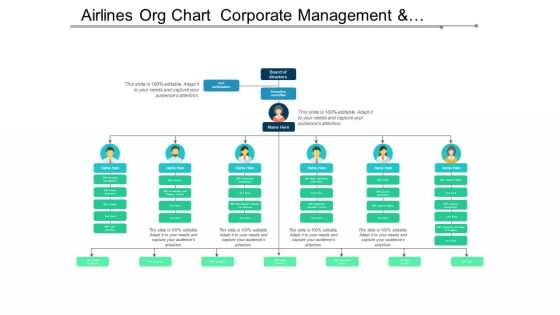
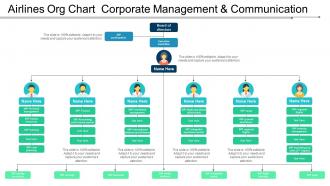
Visualize the structure of an airline company with our airlines org chart corporate management and communication PowerPoint layout. This presentation slide of airline organizational structure chart has been designed by our professional team members and helps you present the impact of the organizational structure on airline operations. Our effective organizational structure for airlines power point slide can be used to represent work practice modeling and simulation to assess and evolve the airline organizational structure performance. This template of the of air industry structure is a helpful tool to portray structure of air-industry as a set of entities collectively collaborating and contributing toward one common goal. With the help of this air industry organizational chart, it is easy to show the hierarchy of groups of workers, each one with its own responsibilities and must report their activity to a supervisor, translating a multi level chain of command system. Download this editable chart to show to display the chain of command within the enterprise. Earn the garlands with our Airlines Org Chart Corporate Management And Communication. Demonstrate that you are genuinely a champion.
People who downloaded this PowerPoint presentation also viewed the following :
Airlines org chart corporate management and communication with all 5 slides:
Extol acts of indomitable courage with our Airlines Org Chart Corporate Management And Communication. Highlight instances of great bravery.




FAQs for Airlines org chart corporate
So basically every airline breaks down into like five main chunks: operations (pilots, mechanics, ground crew), commercial stuff (sales and marketing), customer service, finance, and then corporate - HR, legal, whatever. Operations is massive since that's what actually keeps planes flying without crashing. Most bigger airlines split things up by region too, especially if they're flying internationally. Oh and cargo vs passengers usually get separate teams if they do both. Honestly the whole structure gets pretty messy with all the aviation regulations they have to deal with. I'd just google some airline org charts - you'll see how Delta does it versus Southwest and get a better picture.
Dude, the structure difference is crazy. Major airlines are basically corporate giants - you've got VPs everywhere, regional divisions, tons of specialized departments at places like Delta or United. Meanwhile regional carriers? Way more straightforward. CEO, ops director, maybe a few department heads and that's it. Makes sense though since they're only running like 50-200 planes max while the big airlines are managing thousands of people across multiple continents. Honestly depends what you want - climbing some massive corporate ladder or actually being able to talk to the people making decisions without going through five layers of management first.
Look, when airlines have crazy hierarchies with tons of management layers, everything slows to a crawl. Simple stuff like maintenance approvals or crew changes get stuck in bureaucracy hell. Flatter structures? They can actually respond when weather screws things up or a plane breaks down. Plus the whole setup decides whether operations, maintenance, and customer service actually communicate - which honestly makes or breaks the passenger experience. Southwest nails this with their lean approach, that's why they flip planes so much faster than the big legacy carriers still drowning in red tape.
So the executive team is where all the big stuff happens - CEO, CFO, COO and the commercial heads basically decide everything from new routes to whether they're going budget or premium. They're sitting in those boardrooms figuring out fleet expansion, pricing, you know, the major moves. What's kinda interesting is how their decisions just cascade down to every department. Like if your airline suddenly starts pushing some random new initiative, you can probably trace it back to whatever they discussed in their last strategy meeting. It's really the nerve center for industry shifts.
Honestly, it all comes down to how many hoops customer service reps have to jump through. Too many management layers? Your gate agent can't do anything without getting approval first - super annoying when you're standing there with a problem. Airlines with flatter structures actually let their frontline people make decisions. Like, they can rebook your flight or comp a meal without calling their supervisor every time. I've noticed the best airlines give their staff clear guidelines about what they can handle directly. Way better than hearing "let me check with my manager" for the hundredth time.
So with centralized stuff, you get way better cost control - Southwest's basically built their whole thing on this. Decision-making's faster too, plus you can strong-arm suppliers for better deals. Problem is you're gonna be slow as hell responding to local market shifts. Decentralized lets your regional teams actually adapt to what customers want in different areas, which is pretty critical for international routes. But yeah, costs go up and coordinating between divisions becomes a nightmare. Most airlines that aren't completely dysfunctional do a mix now - keep maintenance and purchasing centralized but let regions handle their own marketing and routes. Makes sense tbh.
Airlines basically have to rebuild their entire org structure when they join partnerships. They'll set up new alliance management teams and joint venture departments that never existed before. Route planning gets reorganized. Revenue management too. Even their IT systems have to work around these partnerships now - which honestly seems like a nightmare to coordinate. Code-sharing makes them integrate operations across departments that used to work separately. The biggest headache? Every decision becomes this collaborative mess since you're always checking with partner airlines first. Pro tip: look up when an airline joined their major alliance - that's usually when their whole structure changed.
So airlines basically have no choice - they've gotta structure everything around what regulators demand. The FAA makes them have specific departments for maintenance, flight ops, safety stuff. It creates this whole bureaucratic mess honestly, but I get why when people's lives are on the line. Their org charts literally map out who's responsible for pilot training, plane maintenance, emergency procedures - can't just wing it. Oh and here's a tip: when you're looking at any airline's setup, check out their compliance teams first. Those departments shape pretty much everything else in the company.
Honestly, culture makes or breaks airline operations. Your crew won't speak up about safety issues if they're scared of the hierarchy - that's terrifying when you think about it. Some airlines are super rigid with every protocol, others let frontline staff actually use their brains and adapt. Plus you've got all these different nationalities working together, each bringing totally different views on authority and teamwork. I'd probably check in on your culture regularly since it affects everything from keeping good employees to whether customers actually enjoy flying with you.
Airlines are basically tearing down their old department walls and mixing everyone together - IT folks working directly with flight ops, that kind of thing. They're all scrambling to make decisions faster, especially for stuff like pricing that changes every five minutes. Most have these new innovation teams that report straight to the CEO now. Honestly feels like they finally figured out they're tech companies first, airlines second. Oh, and this means you'll see way more system updates rolling out than before - like, constantly. The whole "let's test this for two years" approach is pretty much dead.
So airlines basically run on constant communication - they have these daily briefings that start at corporate and work their way down to baggage handlers and gate agents. Real-time dashboards track everything from weather delays to broken seat belts. What's smart is they set up cross-department teams because, let's be real, when a plane's stuck on the tarmac, operations can't just throw customer service under the bus. They need formal chains of command but also quick ways for ground staff to flag problems up the ladder. Otherwise it's chaos - and nobody wants that when you're dealing with thousands of passengers.
Dude, budget airlines basically forced the big legacy carriers to gut their bloated management structures. They had to - otherwise they'd get crushed on pricing. Most traditional airlines started creating separate low-cost subsidiaries with way fewer managers and more streamlined operations. The whole rigid department thing? Pretty much gone. Now they're all about cross-functional teams that can move fast. Honestly, some airlines that dragged their feet on this stuff are still playing catch-up. It's wild how quickly the industry shifted - like, we're talking major restructuring happening in just a few years.
Look, your org structure basically makes or breaks employee morale. Clear reporting lines help people know who to bug when they need answers. Flat structures are usually better for engagement - your frontline folks can actually make decisions that matter, which is critical when flights are delayed and passengers are losing it. But too flat gets messy real quick. Nobody knows who's accountable for what. The sweet spot? Give people enough freedom to do their jobs without creating total chaos. I've seen airlines where the structure was so confusing that good employees just checked out mentally.
So basically, when airlines hit a crisis they throw the normal corporate BS out the window and actually get stuff done. They'll create these emergency teams that cut across departments instead of everyone staying in their little silos. Decision-making gets way more centralized - like, forget about your usual chain of command. Routes and hubs get consolidated to simplify operations. Frontline managers suddenly have real power to make calls on the spot. Oh, and they temporarily flatten management layers because who has time for bureaucracy? Check out how Southwest and Delta handled COVID if you want solid examples.
Departments working together literally makes or breaks airlines. Marketing sets crazy expectations while ops can't deliver? Total disaster. Safety delays happen but nobody tells customers? Nightmare. Here's the thing though - airlines that get their teams actually talking see way fewer complaints and better on-time stuff. Marketing starts being realistic about what ops can handle. Safety gets baked into schedules early. Customer service knows what's happening in real time. I know it sounds boring, but regular cross-department meetings fix most of this chaos. Works every time.
No Reviews