Algorithmic Trading Market Size By Asset Class

Rating:
80%
Algorithmic Trading Market Size By Asset Class Algorithmic Trading Market Size By Asset Class
Slide 1 of 7

or

Favourites Favourites

Try Before you Buy Download Free Sample Product

Audience Impress Your
Audience
Editable 100%
Editable
Time Save Hours
of Time
The Biggest Sale is ending soon in
0
0
:
0
0
:
0
0
Rating:
80%
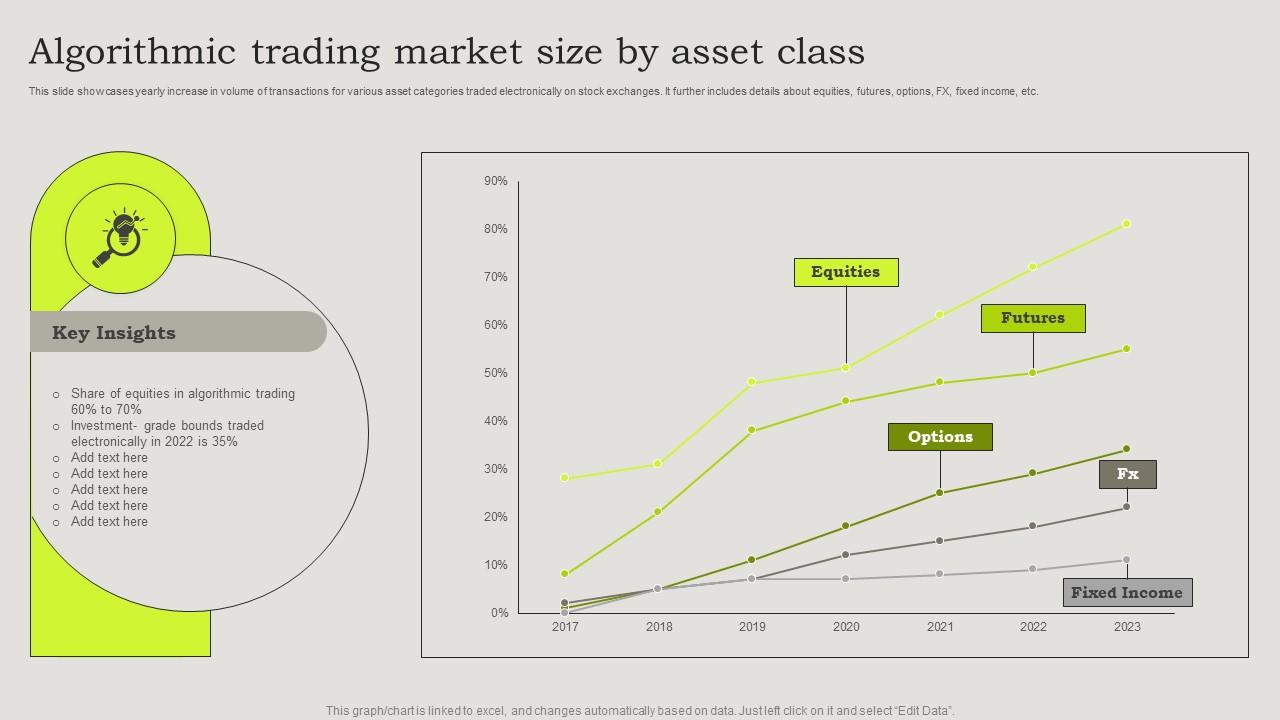
This slide showcases yearly increase in volume of transactions for various asset categories traded electronically on stock exchanges. It further includes details about equities, futures, options, FX, fixed income, etc. Introducing our Algorithmic Trading Market Size By Asset Class set of slides. The topics discussed in these slides are Algorithmic Trading Market, Size By Asset Class. This is an immediately available PowerPoint presentation that can be conveniently customized. Download it and convince your audience.

People who downloaded this PowerPoint presentation also viewed the following :

FAQs for Algorithmic Trading Market Size

Key drivers include technological advancements in AI and machine learning, increasing demand for faster trade execution, regulatory changes promoting transparency, growing institutional adoption, and the need for cost reduction in trading operations. These factors streamline market operations by minimizing human error, enhancing liquidity management, and delivering superior risk assessment capabilities, with many financial institutions finding that algorithmic solutions ultimately provide significant competitive advantages.

Artificial intelligence and machine learning have revolutionized algorithmic trading by enabling predictive analytics, real-time pattern recognition, automated decision-making, and adaptive strategy optimization. These technologies streamline market analysis, enhance risk management, and accelerate trade execution, with many financial institutions finding that AI-driven algorithms deliver significantly improved returns and competitive advantages in increasingly volatile markets.

Regulatory changes significantly influence algorithmic trading by establishing compliance frameworks, risk management protocols, and transparency requirements that firms must integrate into their systems. While these regulations can increase operational complexity and costs, they ultimately enhance market stability, reduce systemic risks, and build investor confidence, with many financial institutions finding that robust compliance infrastructure creates competitive advantages.

Primary players in the algorithmic trading market include Goldman Sachs, JPMorgan Chase, Citadel Securities, Virtu Financial, and Two Sigma, each leveraging proprietary algorithms, extensive data analytics capabilities, and advanced technology infrastructure. These firms deliver competitive advantages through ultra-low latency execution, sophisticated risk management systems, and massive capital resources, with many financial institutions finding that strategic partnerships and continuous algorithm refinement ultimately enhance trading performance and market positioning.

Big data availability has revolutionized algorithmic trading by enabling more sophisticated pattern recognition, real-time market analysis, and predictive modeling capabilities. Financial institutions now process vast datasets from social media, news feeds, and market indicators to enhance trading accuracy, reduce latency, and identify profitable opportunities, with many hedge funds finding that data-driven strategies deliver significantly improved returns and competitive advantage.

Algorithmic trading strategies include momentum trading, mean reversion, arbitrage, market making, and statistical analysis models. These approaches streamline portfolio management by automating trade execution, minimizing human error, and capitalizing on market inefficiencies, with many hedge funds finding that systematic strategies deliver enhanced returns and risk management across volatile market conditions.

Essential technologies include high-frequency trading platforms, low-latency network infrastructure, real-time data feeds, advanced analytics engines, and robust risk management systems. These technologies streamline trading operations by enabling microsecond execution speeds, processing vast market data streams, and automating complex strategies, with many financial institutions finding that strategic infrastructure investments ultimately deliver significant competitive advantages and enhanced trading performance.

Market volatility and liquidity significantly impact algorithmic trading by affecting execution speed, price slippage, and risk management effectiveness. High volatility creates profit opportunities through price movements while requiring sophisticated risk controls, and strong liquidity enables faster execution with minimal slippage, ultimately delivering competitive advantages for institutions that can adapt their algorithms to changing market conditions effectively.

Algorithmic trading presents ethical challenges including market manipulation risks, unequal access advantages for well-funded institutions, transparency concerns in decision-making processes, and potential systemic risks from automated behaviors. While these technologies can enhance market efficiency and liquidity, they also create information asymmetries between algorithmic and traditional traders, with many financial regulators increasingly implementing oversight frameworks to balance innovation with fair market practices and investor protection.

Retail investors utilize algorithmic trading tools through automated strategies for portfolio rebalancing, systematic buying and selling, and risk management, while accessing previously institutional-only technologies via user-friendly platforms and mobile apps. However, they face challenges including limited market data access, higher costs relative to trading volumes, and the need for technical expertise, with many finding that successful implementation requires balancing automated efficiency with manual oversight and continuous strategy refinement.

Equity markets, foreign exchange, and commodities demonstrate the highest algorithmic trading adoption rates, followed by fixed income and derivatives segments. Investment banks, hedge funds, and institutional asset managers increasingly leverage these automated solutions for high-frequency trading, portfolio rebalancing, and risk management, ultimately delivering enhanced execution speeds, reduced transaction costs, and improved market liquidity across global financial markets.

Emerging markets experience faster algorithmic trading growth rates but lower absolute adoption levels compared to developed markets, driven by increasing market infrastructure development, regulatory modernization, and growing institutional participation. While developed markets like the US and Europe maintain higher trading volumes and sophisticated strategies, emerging economies in Asia and Latin America are rapidly implementing automated systems, with many financial institutions finding that algorithmic solutions deliver significant competitive advantages in volatile, high-growth environments.

COVID-19 significantly accelerated algorithmic trading adoption as markets experienced unprecedented volatility, liquidity challenges, and remote working requirements that favored automated systems. The pandemic drove institutions to enhance risk management algorithms, develop new volatility-based strategies, and increase high-frequency trading volumes, with many financial firms finding that algorithmic approaches delivered better execution and reduced operational risks during market uncertainty.

Algorithmic trading is predicted to grow significantly over the next five years, driven by increased AI adoption, regulatory technology integration, enhanced risk management capabilities, and expanding market access across emerging economies. Financial institutions, hedge funds, and retail brokers are increasingly leveraging machine learning algorithms and cloud-based platforms, ultimately delivering faster execution speeds, reduced operational costs, and improved portfolio performance in an increasingly competitive trading landscape.

Algorithmic trading firms measure strategy effectiveness through key performance metrics including Sharpe ratio, maximum drawdown, alpha generation, volatility-adjusted returns, and execution quality scores. These comprehensive analytics enable firms to optimize risk management, enhance portfolio performance, and maintain competitive advantages, with many institutional investors finding that consistent measurement across multiple timeframes ultimately delivers superior long-term profitability and strategic market positioning.

Ratings and Reviews

80% of 100
Review Form
Write a review
Most Relevant Reviews
  1. 80%

    by George Miller

    Very unique and reliable designs.
  2. 80%

    by Rodriguez Morgan

    I am extremely pleased with these PPT slides that we used for our event. They were easy to modify and came out great in all aspects!

2 Item(s)

per page: