Alignment maturity model to determine organisational culture success
Try Before you Buy Download Free Sample Product
Audience
Editable
of Time
Highlight critical inputs with our Alignment Maturity Model To Determine Organisational Culture Success. Focus on important bits of information.
People who downloaded this PowerPoint presentation also viewed the following :
Content of this Powerpoint Presentation
Description:
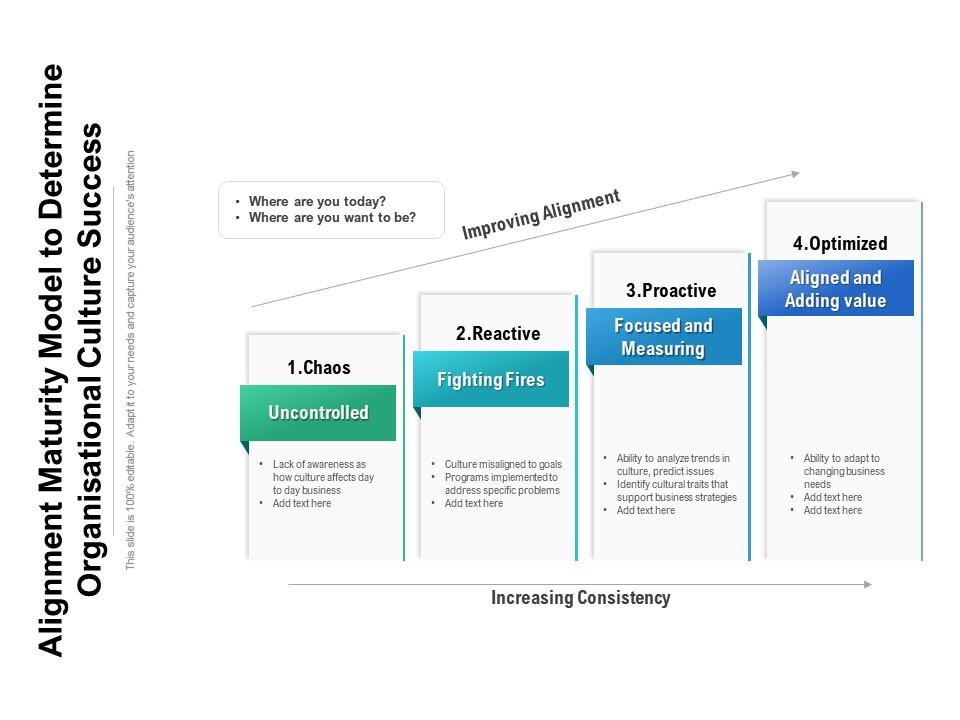
This image is a PowerPoint slide titled "Alignment Maturity Model to Determine Organisational Culture Success." It showcases a four-stage maturity model that assesses an organization's cultural alignment and its impact on success. The model is displayed as an ascending diagonal path, indicating progression from chaos to optimization. The four stages are:
1. Chaos (Uncontrolled) -
Characterized by a lack of awareness of how culture affects day-to-day business. There is a placeholder to add more text.
2. Reactive (Fighting Fires) -
Describes a culture misaligned with goals, with programs implemented to address specific problems. More text can be added.
3. Proactive (Focused and Measuring) -
Highlights the ability to analyze trends in culture, predict issues, and identify cultural traits that support business strategies with space for additional text.
4. Optimized (Aligned and Adding Value) -
Depicts the ability to adapt to changing business needs and an aligned culture that adds value, with extra space for text.
Each stage provides improvement hints for organizations, reflecting an evolution from a disorganized state to a strategic and value-adding culture. Questions like "Where are you today?" and "Where are you want to be?" prompt the audience to think about their current state and desired future state in terms of cultural maturity.
Use Cases:
This type of slide can be utilized across various industries for multiple purposes:
1. Consulting:
Use: Guiding organizational change initiatives.
Presenter: Management Consultant.
Audience: Corporate leaders, change managers.
2. Human Resources:
Use: Developing company culture and employee engagement strategies.
Presenter: HR Director.
Audience: HR professionals, company leadership.
3. Information Technology:
Use: Aligning IT initiatives with company culture for successful digital transformation.
Presenter: CIO or IT Manager.
Audience: IT department, cross-functional teams.
4. Education:
Use: Aligning institutional culture with educational goals and values.
Presenter: Educational Administrator.
Audience: Faculty, staff, stakeholders.
5. Healthcare:
Use: Improving patient care by aligning organizational culture with care standards.
Presenter: Healthcare Administrator.
Audience: Medical staff, hospital management.
6. Manufacturing:
Use: Enhancing productivity by aligning plant culture with operational excellence.
Presenter: Plant Manager.
Audience: Operational teams, supervisors.
7. Non-Profit:
Use: Aligning organizational culture with mission and community impact goals.
Presenter: Executive Director.
Audience: Board members, volunteers, staff.
Alignment maturity model to determine organisational culture success with all 2 slides:
Focus on important bits of information with our Alignment Maturity Model To Determine Organisational Culture Success. It helps highlight critical inputs.
FAQs for Alignment maturity model to determine
Key components of an alignment maturity model include strategic clarity, cross-functional collaboration, performance measurement systems, communication frameworks, and continuous improvement processes. These elements work together by establishing clear organizational direction, breaking down departmental silos, and creating accountability mechanisms, with many organizations finding that higher alignment maturity levels deliver improved operational efficiency, faster decision-making, and sustainable competitive advantage.
Organizations assess their alignment maturity level through comprehensive evaluation frameworks that examine strategic clarity, communication effectiveness, cross-functional collaboration, performance measurement systems, and cultural integration across all organizational levels. These assessments typically involve stakeholder surveys, leadership interviews, and operational audits, with many enterprises finding that regular maturity assessments enable targeted improvements and sustained competitive advantage.
Leadership drives alignment maturity by establishing clear strategic vision, fostering cross-functional collaboration, and consistently modeling aligned behaviors throughout the organization. Executive commitment enables systematic communication processes, resource allocation decisions, and performance metrics that reinforce strategic priorities, with many organizations finding that visible leadership engagement accelerates cultural transformation and sustainable alignment practices.
Common pitfalls include inadequate stakeholder buy-in, misaligned performance metrics, insufficient communication channels, lack of dedicated resources, and unrealistic timelines for transformation. Organizations often underestimate the cultural shift required, with many finding that rushing implementation without proper change management ultimately compromises long-term strategic alignment and operational effectiveness.
Businesses can measure alignment effectiveness through key performance indicators like cross-departmental collaboration scores, project completion rates, revenue per employee, and strategic goal achievement percentages. By implementing quarterly alignment assessments and tracking metrics such as communication frequency between teams, decision-making speed, and customer satisfaction improvements, organizations ultimately gain measurable insights into their operational efficiency and competitive positioning.
**INPUT**: What tools or frameworks can complement an alignment maturity model for better results? **OUTPUT**: Tools complementing alignment maturity models include balanced scorecards, OKR frameworks, strategic planning software, performance dashboards, and stakeholder mapping platforms. These frameworks enhance organizational alignment by streamlining goal-setting processes, improving communication transparency, and enabling real-time progress tracking, with many enterprises finding that strategic combinations ultimately deliver measurable improvements in cross-functional collaboration and execution efficiency. [Word count: 60 words]
Employee engagement significantly influences alignment maturity by driving consistent goal execution, fostering cross-departmental collaboration, and accelerating strategic initiative adoption throughout organizational levels. Engaged employees actively participate in alignment processes, communicate objectives more effectively, and demonstrate higher commitment to shared outcomes, with many organizations finding that stronger engagement correlates directly with faster alignment maturity progression and sustained competitive advantage.
Strategic alignment focuses on ensuring organizational vision, goals, and long-term strategic initiatives are synchronized across leadership, departments, and business units. Operational alignment emphasizes day-to-day execution, coordinating processes, resources, workflows, and tactical activities to deliver consistent results. While strategic alignment drives direction and competitive positioning, operational alignment ensures seamless implementation, with many organizations finding that both levels must work together to achieve sustainable performance and market advantage.
Technology enhances alignment maturity through collaborative platforms, real-time dashboards, automated reporting systems, and integrated communication tools that streamline cross-departmental workflows. These solutions enable organizations to track shared metrics, facilitate transparent decision-making, and maintain consistent strategic focus, with many enterprises finding that digital alignment tools significantly reduce silos while accelerating coordinated execution.
Organizations across financial services, healthcare, manufacturing, and technology sectors benefit most from alignment maturity models, particularly those managing complex regulatory requirements, digital transformations, and multi-departmental initiatives. These industries find that structured alignment frameworks streamline strategic execution, enhance cross-functional collaboration, and deliver measurable improvements in operational efficiency, with many discovering significant competitive advantages through better resource allocation and faster decision-making processes.
Organizations should reevaluate their alignment maturity annually at minimum, with additional assessments triggered by major strategic shifts, leadership changes, market disruptions, or significant operational restructuring. Through regular evaluation cycles, companies can identify misalignment gaps, adapt to evolving business environments, and maintain strategic coherence, with many finding that quarterly reviews enable faster course corrections and ultimately deliver sustained competitive advantage.
Organizations can advance maturity levels by establishing clear governance frameworks, implementing regular cross-functional alignment sessions, developing shared metrics and KPIs, investing in collaborative tools and platforms, and creating formal feedback loops. These practices enable companies to systematically break down silos, enhance communication transparency, and build strategic consensus, with many enterprises finding that structured progression ultimately delivers improved decision-making speed and organizational agility.
The alignment maturity model improves team collaboration by establishing shared objectives, standardizing communication protocols, and implementing cross-functional feedback mechanisms. Through structured assessment frameworks, organizations systematically identify collaboration gaps, streamline decision-making processes, and enhance resource coordination across departments, with many finding that higher maturity levels deliver faster project execution, reduced silos, and ultimately stronger competitive positioning.
Organizational culture significantly influences alignment maturity by shaping communication patterns, collaboration willingness, resistance to change, and leadership accountability across departments. Companies with open, collaborative cultures typically advance faster through maturity stages, while hierarchical or siloed environments face greater challenges in achieving strategic alignment, ultimately requiring cultural transformation alongside process improvements to deliver sustainable competitive advantage.
Alignment maturity drives innovation by creating structured frameworks for cross-functional collaboration, eliminating organizational silos, and establishing clear innovation processes and accountability measures. Organizations with higher alignment maturity demonstrate faster product development cycles, more effective resource allocation for R&D initiatives, and enhanced ability to translate creative ideas into market-ready solutions, ultimately delivering sustained competitive advantage.
No Reviews