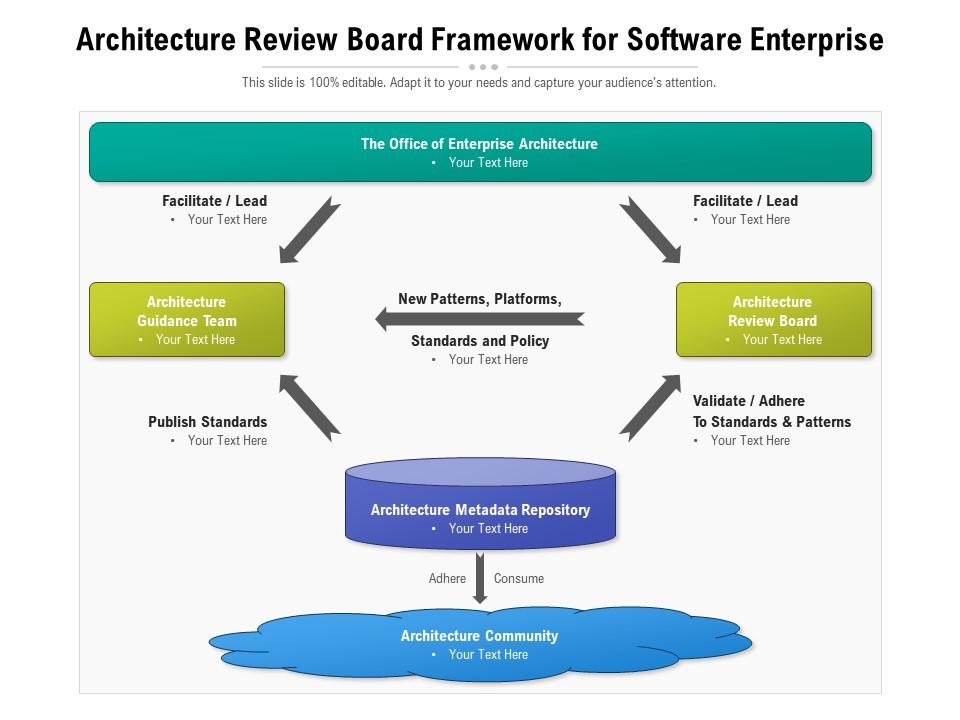
Architecture review board framework for software enterprise
Try Before you Buy Download Free Sample Product
Audience
Editable
of Time
Our Architecture Review Board Framework For Software Enterprise are topically designed to provide an attractive backdrop to any subject. Use them to look like a presentation pro.
People who downloaded this PowerPoint presentation also viewed the following :
Architecture review board framework for software enterprise with all 2 slides:
Use our Architecture Review Board Framework For Software Enterprise to effectively help you save your valuable time. They are readymade to fit into any presentation structure.
FAQs for Architecture review board framework
The primary purpose of an Architecture Review Board is to ensure technical decisions align with organizational strategy, maintain architectural standards, and minimize technical debt through systematic review processes. These boards enable organizations to achieve consistent technology implementations, reduce integration risks, and accelerate project delivery, with many enterprises finding that structured architectural oversight ultimately delivers cost savings and competitive advantage.
An Architecture Review Board influences project outcomes by ensuring technical decisions align with enterprise standards, evaluating design proposals for scalability and integration, and identifying potential risks before implementation. Through systematic reviews and governance oversight, organizations streamline development processes, reduce technical debt, and maintain consistent architectural patterns across projects, ultimately delivering faster deployment cycles and enhanced system interoperability.
An Architecture Review Board oversees technology architecture decisions, ensures alignment with organizational standards, evaluates proposed system designs, manages technical debt, and governs integration strategies across enterprise systems. These boards streamline decision-making by establishing clear governance frameworks, reducing redundant investments, and maintaining architectural consistency, with many organizations finding that structured oversight ultimately delivers faster project approvals and enhanced operational efficiency.
Architecture Review Board reviews should occur monthly for routine assessments, with quarterly comprehensive evaluations and ad-hoc sessions for critical project milestones or emerging technology decisions. This strategic cadence enables organizations to maintain architectural consistency, address integration challenges proactively, and ensure alignment with business objectives, while many enterprises find that regular touchpoints ultimately deliver faster project approvals and reduced technical debt across their technology landscape.
Architecture Review Board evaluation criteria include technical feasibility, alignment with enterprise standards, security compliance, scalability requirements, and cost-benefit analysis. These assessments streamline decision-making by ensuring proposals meet organizational objectives, regulatory requirements, and integration capabilities, with many enterprises finding that standardized evaluation frameworks ultimately deliver faster approval cycles and stronger architectural governance.
An Architecture Review Board fosters collaboration by establishing shared governance frameworks, standardizing communication protocols, creating cross-functional representation, and implementing regular stakeholder touchpoints. Through structured review processes, teams align on technical decisions, share architectural knowledge, and resolve integration challenges early, with many organizations finding that centralized oversight streamlines project coordination while enhancing transparency across departments.
An Architecture Review Board ensures compliance by evaluating proposed systems against established industry standards, regulatory requirements, security protocols, and organizational best practices through systematic review processes. These boards streamline governance by identifying potential risks, enforcing design consistency, and validating technical decisions, with many enterprises finding that structured oversight ultimately delivers reduced compliance costs, faster audit processes, and enhanced system reliability across their technology landscape.
An Architecture Review Board addresses emerging technologies by establishing evaluation frameworks, conducting regular technology assessments, engaging with vendor communities, and creating pilot programs for promising innovations. Through systematic monitoring of industry trends, architectural pattern evolution, and emerging standards, organizations can strategically integrate new technologies while maintaining system coherence, ultimately delivering competitive advantage and future-ready infrastructure capabilities.
Architecture Review Board members should possess technical architecture expertise, strategic business acumen, risk assessment capabilities, stakeholder management skills, and cross-functional collaboration abilities. These professionals typically combine deep technology knowledge with business understanding, enabling them to evaluate proposed solutions against enterprise standards, assess scalability and security implications, and guide organizations toward architectures that deliver operational efficiency and competitive advantage.
An Architecture Review Board ensures strategic alignment by establishing clear governance frameworks that evaluate proposed architectures against business objectives, scalability requirements, and long-term technology roadmaps. Through regular assessment processes, stakeholder collaboration, and standardized evaluation criteria, organizations streamline decision-making while maintaining architectural consistency, ultimately delivering reduced technical debt, enhanced operational efficiency, and stronger competitive positioning in an increasingly complex digital landscape.
Architecture review processes include initial design submission requirements, stakeholder impact assessments, technical compliance evaluations, security and scalability reviews, and formal approval workflows. These frameworks streamline decision-making by establishing clear documentation standards, automated validation checkpoints, and cross-functional review cycles, with many organizations finding that structured ARB processes reduce project delays while ensuring architectural consistency and strategic alignment.
An Architecture Review Board can measure effectiveness through project compliance rates, architecture standard adoption metrics, decision turnaround times, and stakeholder satisfaction scores. By tracking reduced technical debt, faster project delivery cycles, and improved system integration across departments, organizations can quantify the board's strategic impact, with many enterprises finding that effective governance ultimately delivers 20-30% improvements in development efficiency.
Architecture Review Boards can adopt assessment frameworks like TOGAF and Zachman, collaborative tools such as Confluence and SharePoint for documentation, and specialized platforms like LeanIX or Sparx Enterprise Architect for modeling. These methodologies streamline evaluation processes by standardizing criteria, centralizing feedback, and automating compliance tracking, with many organizations finding that integrated toolsets significantly reduce review cycles while enhancing decision transparency.
An Architecture Review Board encourages innovation by establishing flexible frameworks that allow experimentation within defined parameters, promoting cross-functional collaboration, and implementing tiered approval processes for different risk levels. Through strategic guidance rather than rigid restrictions, these boards enable teams to explore emerging technologies while ensuring alignment with organizational standards, ultimately delivering both creative solutions and operational stability.
Architecture Review Boards typically face challenges including inconsistent evaluation criteria, lengthy review cycles, resistance from development teams, limited technical expertise, and balancing innovation with governance requirements. These obstacles can be overcome by establishing clear architectural standards, streamlining approval processes, fostering collaborative relationships between architects and developers, and implementing automated compliance checking tools, ultimately delivering faster project delivery while maintaining quality standards.
-
Great product with highly impressive and engaging designs.
-
Easily Understandable slides.
-
Much better than the original! Thanks for the quick turnaround.