Attractive opportunities for nanotechnology 2019 to 2029 ppt powerpoint presentation
Try Before you Buy Download Free Sample Product
Audience
Editable
of Time
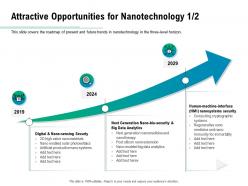
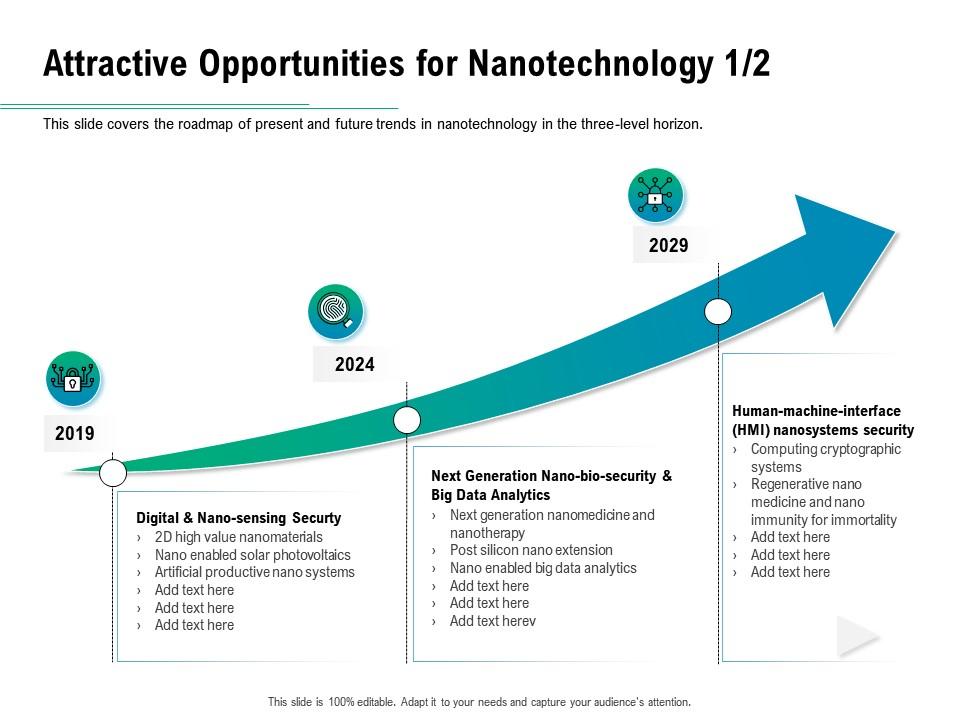
This slide covers the roadmap of present and future trends in nanotechnology in the three-level horizon.
People who downloaded this PowerPoint presentation also viewed the following :
Attractive opportunities for nanotechnology 2019 to 2029 ppt powerpoint presentation with all 2 slides:
Use our Attractive Opportunities For Nanotechnology 2019 To 2029 Ppt Powerpoint Presentation to effectively help you save your valuable time. They are readymade to fit into any presentation structure.
FAQs for Attractive opportunities for nanotechnology 2019 to 2029
Healthcare and electronics are crushing it right now. Medical stuff like drug delivery and diagnostics have insane profit margins, plus the approval process isn't as brutal as it used to be. Asia's where the real action is - cheaper manufacturing, people actually adopting this tech fast. Flexible electronics are huge too. Energy storage is kinda flying under the radar but it's solid gold. Oh, and don't sleep on automotive - EV batteries with nanotech are gonna be everywhere soon. Honestly though? Start with medical applications if you can swing it. The money's just too good to ignore.
So basically these tiny nanoparticles work like little delivery trucks for medicine. They can actually find the exact cells that are sick and drop off drugs right there instead of just dumping medication everywhere in your body. Way fewer side effects that way. It's honestly pretty crazy how they slip through barriers and target just the diseased spots - like having GPS for pills or something. You end up needing lower doses but getting better results. If you're thinking about investing, cancer treatments and brain delivery stuff seem to be where the action is right now.
Dude, nanomaterials are seriously changing the game for clean energy. Solar panels can now catch light wavelengths they used to miss completely, plus you're getting flexible panels that bend. Your phone battery? Those lithium-ion cells use nanomaterials to pack way more surface area in there - faster charging, way longer life. Carbon nanotubes are where it gets really wild. We're honestly just getting started with this stuff too. If you're thinking investments, I'd look at companies doing battery chemistry work. The nanocoating stuff might be worth checking out as well.
Yeah, regulators are basically scrambling to catch up - it's wild how fast nanotech moves compared to government speed. FDA and EPA are finally rolling out some nano-specific stuff for drug delivery and environmental testing. Europe's actually ahead of us on chemical regulations, which is kinda embarrassing honestly. But it's still pretty chaotic out there. ISO standards are where the real action is happening though - that's what'll probably shape everything else. Oh, and definitely join some industry groups if you haven't already. They usually know what's coming before anyone else does.
Dude, nanotechnology is actually pretty insane for environmental stuff. They're using nanoparticles to literally suck up oil spills and yank heavy metals out of water. Solar panels are getting crazy efficient too - like double the energy capture in some cases, which is wild. The best part? These nano solutions use way less energy than old-school methods. Oh, and they can break down pollutants at the molecular level, plus there are these sensors that monitor pollution in real-time. I saw something about CO2 capture too but can't remember the details. If you're working on sustainability projects, definitely look into this stuff.
Honestly, the scariest part is how nanoparticles can slip through biological barriers we don't even understand yet - that's both the coolest and most terrifying thing about this tech. Privacy-wise, nano-sensors could basically track your every move. Manufacturing gets pretty messy environmentally too. Then there's the whole human enhancement thing creating even bigger inequality gaps, plus obviously people will weaponize this stuff. I'd keep an eye on regulations, but let's be real - they're way behind the actual science right now. It's wild west territory.
So nanotechnology is wild - you can literally build electronics atom by atom. Transistors become just a few nanometers wide, which means cramming billions more onto chips. The materials engineering part is honestly the coolest bit though. You get to design exact properties you need, like quantum dots or super-conductive pathways. Manufacturing gets insanely precise since you're controlling stuff at the molecular level. My buddy works in this space and says carbon nanotube circuits are where the money's headed. If you're thinking investment wise, definitely check out molecular fabrication companies too.
Dude, graphene is finally getting cheap enough for real products - that's massive. Quantum dots are already changing displays and solar tech. The pharma stuff is wild though, they're making drugs that literally only turn on when they hit cancer cells or whatever. Carbon nanotube costs dropped like crazy this year too. Honestly the coolest thing might be these molecular sensors - they can spot individual molecules now. Food safety, pollution testing, you name it. My buddy works in nanotech and says targeted drug delivery patents are where the smart money's going. Flexible electronics too but everyone knows that one already.
Honestly, SMEs can totally compete in nanotech if they're smart about it. Big companies ignore tons of niche applications - that's your opening. Partner with universities instead of building huge R&D teams. Use existing nanomaterials to solve specific problems in coatings, medical devices, sensors, whatever. Here's the thing though - nanotech is more about expertise than money, which actually works in your favor. I'd start by finding one real problem in your industry that nano could fix. Then build partnerships to get the technical skills you need. Way more doable than people think.
Honestly, most schools are way too theory-heavy for what companies actually need. You've gotta blend physics, chemistry, and engineering - like real interdisciplinary stuff. Get students hands-on with nanoscale tools and characterization equipment, not just textbooks. The regulatory compliance training is huge too since nano work has weird safety risks people don't think about. Partner with actual nanotech companies so students see real applications. I'd start by looking at your current curriculum and figuring out where these gaps are. It's really about mixing solid engineering basics with specialized nano coursework plus tons of practical experience.
So nano tech is gonna completely change food safety and farming. These tiny sensors can catch stuff like E. coli instantly as food moves through the supply chain - which is honestly pretty wild when you think about it. Farmers are using nanoparticles to deliver fertilizers and pesticides super precisely, so there's way less waste. The targeting systems look straight out of a sci-fi movie but they actually work. Here's what matters for your business though - consumers are gonna want that detailed tracking info soon, so you should probably start planning for supply chain transparency now.
Three partnership types actually matter for nanotech. Universities give you research access and smart people to hire - worth the headache of academic timelines. Government stuff is trickier but NIH/NSF money is real if you can deal with the bureaucracy. Cross-industry partnerships though? That's where things get interesting. Pair your nanotech with big healthcare or electronics companies who actually know how to sell stuff. Here's the thing - don't just chase whoever has cool tech. Find partners who solve your specific problems. I swear, half these partnerships fail because people get starry-eyed about the science instead of thinking practically.
People are way more chill about nanotech now that they see it actually working in stuff like sunscreen and wrinkle-free shirts. That whole panic from like 15 years ago? Pretty much over. Companies are getting smarter too - they market the benefits instead of going "look, we made tiny particles!" because honestly nobody cares about particle size. Health worries still come up sometimes but regulations got their act together around 2019. Oh and electronics are getting crazy good because of this stuff. If you're working on nano products, just focus on what they do better, not the tech behind it.
Honestly, the worst part is manufacturing consistency - you can't just scale lab processes by 1000x and pray they work. Quality control becomes absolutely brutal with nanoscale stuff because even tiny variations mess everything up. Also, brace yourself for the regulatory nightmare... the paperwork is mind-numbing. Equipment costs will destroy your budget too - those specialized nanotech tools cost a fortune. My advice? Find established manufacturers to partner with instead of building from scratch. Way less headache.
Dude, you absolutely need to team up with people outside your field. Materials scientists + biologists + engineers = actual breakthroughs that matter. Think targeted drug delivery or materials that fix themselves. The best stuff happens when your expertise crashes into someone else's knowledge base. Honestly, I've seen mediocre projects get funded just because the team was diverse - investors eat that up. It shows you're not just living in a lab bubble, you know? Short version: make friends with people in other departments now. Trust me on this one.
-
Excellent products for quick understanding.
-
Topic best represented with attractive design.
-
Qualitative and comprehensive slides.
-
Thanks for all your great templates they have saved me lots of time and accelerate my presentations. Great product, keep them up!
-
The Designed Graphic are very professional and classic.