Automating API Testing With Postman Platform

Rating:
80%
Automating API Testing With Postman Platform Automating API Testing With Postman Platform
Slide 1 of 6

or

Favourites Favourites

Try Before you Buy Download Free Sample Product

Audience Impress Your
Audience
Editable 100%
Editable
Time Save Hours
of Time
The Biggest Sale is ending soon in
0
0
:
0
0
:
0
0
Rating:
80%
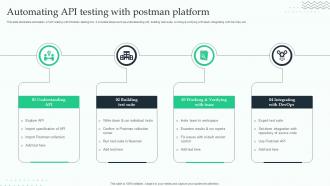
This slide illustrates automation of API testing with Postman testing tool. It includes steps such as understanding API, building test suite, working and verifying with team, integrating with DevOps, etc. Presenting our set of slides with Automating API Testing With Postman Platform. This exhibits information on four stages of the process. This is an easy to edit and innovatively designed PowerPoint template. So download immediately and highlight information on Building Test Suite, Working And Verifying, Integrating With Devops.

FAQs for Automating API Testing

So basically API testing skips all the UI stuff and goes straight to testing how systems talk to each other. You're sending requests directly to endpoints instead of clicking around on buttons. Think of it like... testing the plumbing behind the scenes? Way faster than regular testing once you figure it out. No dealing with browser weirdness or making sure things look right - just pure data and functionality. I'd start with simple GET requests first, they're pretty forgiving. Then work up to the trickier POST stuff when you're comfortable.

Dude, automated API testing is a game changer - it catches bugs way before they hit production. Your QA folks can stop doing the boring repetitive stuff (seriously, who wants to manually hit the same endpoints 50 times?) and focus on the tricky edge cases instead. Every code change triggers tests automatically, so you'll spot issues immediately. The best part? Way faster releases because you're not constantly putting out fires after deployment. I'd start with your most critical endpoints first - don't try to automate everything at once or you'll burn out. It's honestly one of those things that pays for itself pretty quickly.

Postman's where I'd start - used it for like two years straight and never looked back. UI is super clean, you can organize everything into collections, and auth stuff just works. Insomnia's decent too if you want something lighter. For Java specifically, REST Assured is solid for automated testing. Though honestly? Sometimes I just throw together curl scripts when I'm being lazy. Download Postman first, import some API docs, and mess around with it. You'll probably end up living in there once you get the hang of it.

Focus on response times first - keep 95% under 200ms if possible. Error rates should stay below 1%. Track how much of your API you're actually testing too, that coverage stuff matters more than people think. Don't chase metrics that just look pretty on dashboards though. Recovery time when things go sideways is huge, plus data accuracy in your responses. I'd stick to maybe 4-5 metrics max that actually connect to whether users are happy. Set up alerts when they start drifting. Trust me, less is more here - you'll go crazy trying to monitor everything.

Start with the happy path stuff first, then hit the edge cases and error conditions. Test your request/response data, status codes, auth flows - all that basic stuff. Boundary testing is huge though - invalid inputs, empty fields, massive payloads. Seriously, I've found more bugs doing this than anything else. Rate limiting and timeouts are annoying but you gotta test them since they'll screw you over in production. Use realistic test data but obviously don't touch real customer info. Automated tests with every deployment will save your ass when things break.

Okay so three main things to tackle: modularity, data management, and decent documentation. Don't hardcode everything - seriously, I've seen codebases where test data is just scattered everywhere and it's a nightmare. Break stuff into reusable components instead of copying the same logic over and over. Put your test data in config files or databases where it belongs. Also set up CI/CD so tests actually run automatically and catch problems before they blow up. Oh and version control your API contracts - trust me on this one. Start by looking at what you currently have and figure out which parts you can modularize first.

Oh man, API docs are everything for testing - they're literally your only guide to figuring out what the hell you're supposed to be testing. You want clear endpoint descriptions, auth requirements, request/response examples, all that stuff. Bad docs will make you want to scream into the void, trust me. Don't forget to document your own test cases and any bugs you find. Here's something I learned the hard way: keep notes on weird API quirks you discover. I can't tell you how many times I've run into the same bizarre edge case months later and completely forgotten how I dealt with it before.

Don't hardcode auth tokens in your individual tests - handle that stuff in your test setup instead. I always stick credentials in environment variables and use a helper function that authenticates once before everything runs. Cache your tokens and refresh them when they expire, trust me on this one. Tests failing because of stale auth is the worst. Create separate test users with different permission levels so you can test both the happy path (user gets access) and the cases where they should get 403/401 errors. Oh, and structure your test data so checking permission boundaries is actually manageable.

Testing across multiple API versions is honestly such a headache. You'll need separate test suites for each version, which turns into a total mess fast. Backward compatibility is where things get really annoying - old endpoints have to keep working while new stuff can't break anything. Schema changes between versions will trip you up constantly. Set up automated regression tests that hit all your supported versions at once, that's been a lifesaver for me. Also create a solid deprecation timeline so you're not stuck maintaining ancient versions forever. Trust me on that one.

Honestly, just bake it into your existing API tests. Add some basic response time checks first - like making sure endpoints don't take forever during your regular test runs. After that, grab JMeter or k6 for the heavier stuff to mimic actual user traffic. I run the light perf tests in CI but save the brutal load testing for staging (learned that one the hard way after accidentally nuking our dev environment). The trick is making it part of your normal routine instead of something you scramble to do at the end. Performance bugs are just as annoying as functional ones, so why not catch both?

Broken authentication is the big one you'll want to test first - seriously, half the APIs I've seen mess this up somehow. Injection attacks are still everywhere too, especially SQL injection. Check for data exposure in your responses and see if there's any rate limiting, because most devs forget about that completely. For testing, OWASP ZAP or Burp Suite work great for the initial scan. Then hit your auth endpoints manually with bad tokens and weird requests. Try sending a bunch of rapid-fire requests to see if anything breaks. Start automated, then get your hands dirty with the manual stuff.

Hit your critical path APIs first - authentication, payments, anything that breaks your whole app if it goes down. High-traffic endpoints come next since they'll screw over the most users. Then tackle the complex stuff with external dependencies - those APIs love to fail in weird ways, honestly. Oh, and definitely include any APIs that have bitten you before in production. I learned that one the hard way! Those troublemakers have earned their spot on your testing list through pure pain.

Honestly, there are tons of ways to handle this. WireMock and MockServer are solid choices - they let you spin up fake endpoints with whatever responses you need. Super useful when the actual API is being weird or isn't ready yet. For testing, I'd probably go with something like nock if you're using Node.js, or the responses library for Python. These intercept your HTTP calls right in the test code. Some people just use JSON files with sample data and a basic server, which works too I guess. Start with whatever fits your current setup best, then focus on covering both the success cases and when things go wrong.

Honestly, just stick them right after your build step but before you deploy anywhere. I always test against staging first - saves you from looking like an idiot when prod breaks (trust me on this one). Newman works great if you're using Postman, or just hook your existing test setup into the CI config. Cover both the happy paths and the ways things can go sideways. Speed matters here - slow tests will drive everyone nuts. Oh, and don't try to test everything at once. Start with your most critical APIs and build from there. Way less overwhelming that way.

Testing GraphQL is honestly trickier than REST. You've got one endpoint but it can spit out completely different data depending on what you ask for. REST is predictable - same URL, same response structure. With GraphQL though, you need to check that queries return exactly the fields requested, nothing extra. Schema validation becomes critical since one broken field tanks everything. Oh and definitely test query depth limits - learned this the hard way when someone tried requesting half our database in a single query. Pain in the ass DoS attack waiting to happen. I'd start with schema introspection tests and field permissions first.

Ratings and Reviews

80% of 100
Review Form
Write a review
Most Relevant Reviews
  1. 80%

    by Cleo Long

    Thrilled to see several customizable templates catering various verticals and industries. 
  2. 80%

    by O'Sullivan Evans

    Very unique, user-friendly presentation interface.

2 Item(s)

per page: