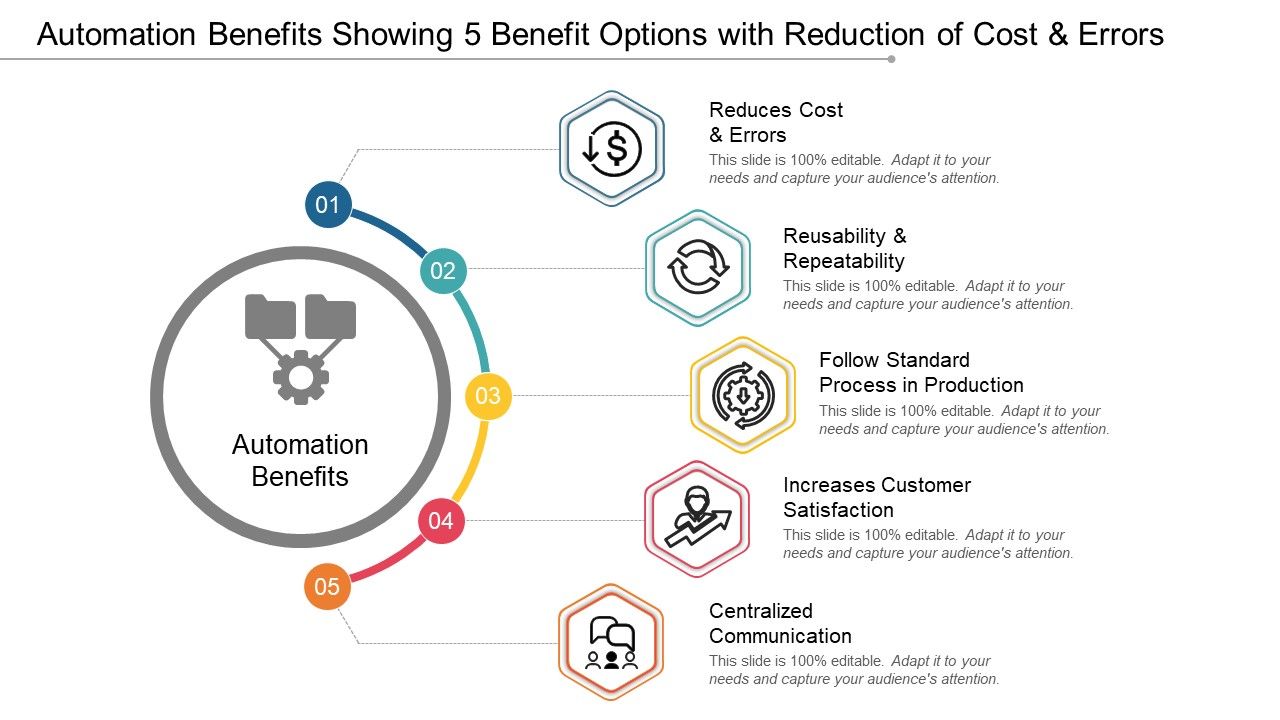
Automation benefits showing 5 benefit options with reduction of cost and errors
Try Before you Buy Download Free Sample Product
Audience
Editable
of Time
Display commitment to every engagement. Our Automation Benefits Showing 5 Benefit Options With Reduction Of Cost And Errors are dependable and consistent.
People who downloaded this PowerPoint presentation also viewed the following :
Automation benefits showing 5 benefit options with reduction of cost and errors with all 5 slides:
Give journalists a hand with our Automation Benefits Showing 5 Benefit Options With Reduction Of Cost And Errors. Assist them in acquiring information.
FAQs for Automation benefits showing 5 benefit options with reduction of
Honestly, automation is a game-changer for time and consistency. No more paying someone to do boring data entry or chase down leads with follow-up emails. Start with something simple like email marketing or invoicing - trust me on this one. Your customers get way faster responses without the typos and mess-ups that happen when you're juggling too much. Makes you look super professional even if you're running things from your kitchen table! Once you see how much time it saves (and you will), you can automate more stuff from there.
Look, automation is basically your ticket to cutting out all the slow, error-prone stuff that bogs down production. Machines don't call in sick or need coffee breaks (honestly, wish I had that superpower). They'll run the same precise operations 24/7 while catching quality issues that human eyes miss when we're tired. Plus they can automatically reorder materials when you're running low. The trick is starting with your most repetitive processes - those boring tasks that eat up tons of time. That's where you'll see the biggest impact right away.
So automation's great because it handles all the boring stuff instantly - order tracking, basic questions, scheduling appointments. Your customers don't have to sit on hold forever (which is honestly the worst). It runs 24/7 too, so people get answers at like 2am if they want. The real win though? Your actual human staff can focus on complicated problems instead of answering "where's my package" for the millionth time. I'd start with whatever questions you get asked most and automate those first - probably saves you tons of headaches.
Look, automation basically cuts costs in three big ways - less labor, fewer screw-ups, and everything runs smoother. Manufacturing's the obvious one where robots just never stop working. But healthcare? They're using it to catch medical errors before they become expensive lawsuits. Finance automates all that transaction stuff so they don't need armies of people processing payments. Retail's gotten pretty clever with inventory systems that actually predict what'll sell (though my local grocery store still somehow runs out of milk every weekend). Start with whatever boring, repetitive tasks eat up most of your time - that's where you'll see the biggest payoff.
Data entry's probably the biggest one - that and email responses. Report generation too, plus scheduling appointments. File organization, invoice stuff, social media posts... basically anything you do on repeat without thinking. Customer service bots are everywhere now (some are terrible though lol). Inventory management systems handle tons of work automatically. Look for tasks that follow the same steps every time and don't need creativity. What's eating up your day that feels totally mindless? Start there - those repetitive things are perfect for automation.
Look, first thing - write down everything you do in a day, then circle the stuff that makes you want to scream. You know, the copy-paste nonsense that takes forever. Most tools play nice with whatever you're already using (Slack, email, whatever). Here's what I'd do: pick literally ONE annoying thing this week and automate just that part. Don't go crazy trying to fix everything at once - I learned that the hard way. Run it for like a week, see if your team actually likes it or if it's just creating more work somehow. Then maybe tackle the next thing. The whole point is saving time, not making your life more complicated, right?
Honestly, automation usually works out pretty well if you don't just spring it on people. Your team will actually get more done because they're not stuck doing boring stuff like data entry all day - which let's be real, nobody wants to do anyway. They can spend time on the interesting work instead. The trick is getting them involved from the start so they don't think you're trying to replace them. When people see it as something that makes their job better rather than threatening it, they're way more on board. I'd start by asking what repetitive tasks drive them crazy.
Honestly, automation is a game changer for getting projects done faster. All those boring repetitive tasks - testing, deployments, reports - that normally take forever? They're done in minutes now. Your team stops wasting time on mindless clicking and can actually solve real problems instead. The consistency is what really gets me though. No more human screw-ups or weird delays slowing everything down. I'd start with whatever eats up most of your time each week - probably some annoying recurring task everyone hates doing. Once you automate that, boom, suddenly you've got all this extra bandwidth for the stuff that actually matters.
Honestly, automation is a lifesaver for all that boring data stuff. It'll pull your reports, clean up messy datasets, and build dashboards while you're doing literally anything else. I used to waste so much time on manual data entry - and yeah, I'd always mess something up. Now it just runs on schedule and actually catches mistakes better than I do. The best part? You get insights right away instead of waiting around for days. Oh, and start with just one report you absolutely hate doing weekly. Once you see how nice it is, you can automate more.
Honestly, the biggest headache is gonna be the upfront costs - automation isn't cheap. Your team might freak out about losing their jobs too, which I get. Integration with your current systems can be a nightmare, and when things break during busy periods? Total disaster. Training everyone takes forever and costs more than you think. Oh, and don't automate everything - sometimes you actually need real people handling stuff. I'd probably start with just one small project first, see how it goes. Way less risky than diving headfirst into some massive overhaul.
Track both hard and soft savings for the full picture. Hard stuff is easy - labor cuts, fewer errors, faster processing, equipment savings. Soft benefits are trickier but honestly way more valuable long-term. Think customer satisfaction, keeping good employees, scaling easier. Math is simple: total benefits minus costs, divide by costs, times 100 for percentage. Monthly dashboards help too - leadership loves seeing actual numbers. The soft stuff is where you'll really win, even though it's annoying to measure.
Honestly, I'd start with integration - does it play nice with what you're already using? Nothing's worse than creating more work for yourself. Scalability's huge too since you'll outgrow basic features pretty quickly. The learning curve can be brutal though, so pick something your team won't hate learning. Oh, and don't just look at sticker price - all the hidden costs like training and customization will hit you later. My advice? Run a small pilot first. Way better than finding out it sucks after you've already committed to the whole thing.
Yeah automation definitely cranks up the competition. Once your competitors start automating, they can cut prices or speed up service - then you're scrambling to catch up or you'll get crushed. It's basically like an arms race tbh. Companies that jump on it early usually win big with lower costs and faster operations. But here's what's interesting - it actually helps smaller businesses compete too since they don't need massive teams anymore. My honest take? Don't sit around waiting to see what everyone else does first. Figure out what you can automate right now and just start there.
Look into AI automation that handles complex decisions, not just basic repetitive stuff. Hyperautomation is everywhere now - it connects all your automated processes so they actually talk to each other. No-code platforms are game-changers too since regular teams can build automations without developers (my marketing friend just set one up last week). Predictive automation's pretty wild - it spots problems before they hit. Don't go crazy trying to automate everything though. Pick one process, test it out, then expand from there.
Honestly, automation's a game-changer for going greener. Your lights and heating will adjust themselves based on what you actually need instead of blasting away constantly. Way less waste too since machines don't mess up like we do - no more "whoops, made 500 extra widgets" situations. Smart monitoring spots problems early before they spiral. I'd start with whatever's sucking up the most energy in your place and throw some smart controls at it. The precision alone will save you tons of materials and power.
-
Editable templates with innovative design and color combination.
-
Much better than the original! Thanks for the quick turnaround.