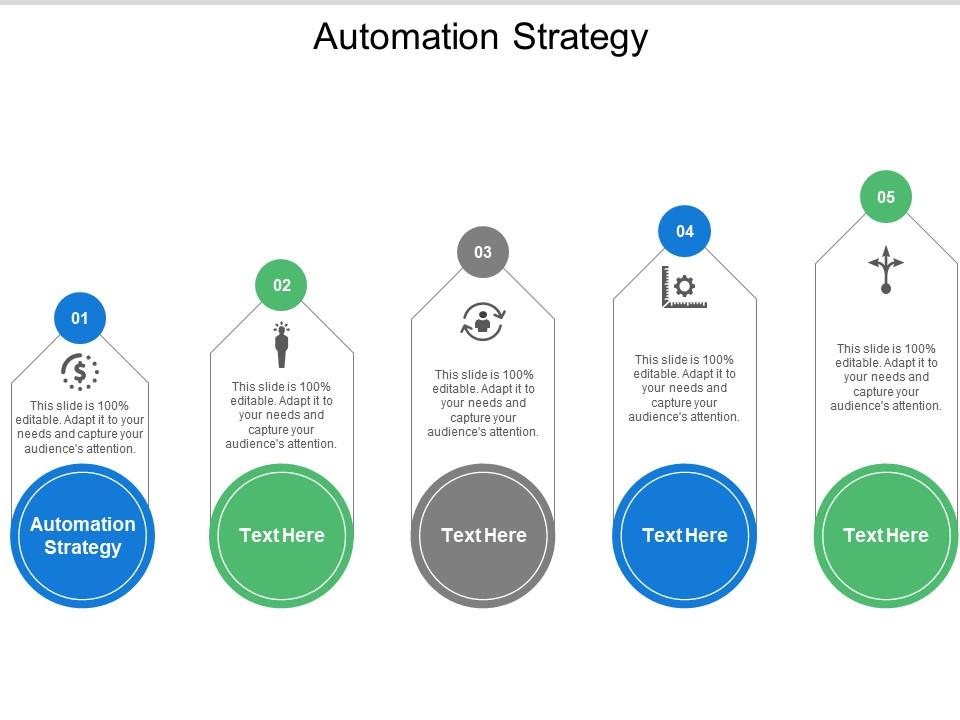
Automation strategy ppt powerpoint presentation inspiration microsoft cpb
Try Before you Buy Download Free Sample Product
Audience
Editable
of Time
Our Automation Strategy Ppt Powerpoint Presentation Inspiration Microsoft Cpb have an elegant appearance. They are all decoratively designed.
People who downloaded this PowerPoint presentation also viewed the following :
Automation strategy ppt powerpoint presentation inspiration microsoft cpb with all 5 slides:
Our Automation Strategy Ppt Powerpoint Presentation Inspiration Microsoft Cpb have an enabling format. They allow to easily chop and change.
FAQs for Automation strategy ppt powerpoint presentation
Key components of an effective automation strategy include process assessment and prioritization, technology selection, change management, performance metrics, and scalability planning. These elements work together by identifying high-impact opportunities, selecting appropriate tools, preparing teams for transformation, and ensuring measurable outcomes, with many organizations finding that strategic automation delivers significant cost reductions and competitive advantages.
Organizations can assess current processes by conducting workflow audits, analyzing repetitive tasks, measuring time consumption, identifying bottlenecks, and evaluating error-prone activities. Through process mapping and data analysis, companies in manufacturing, financial services, and healthcare streamline operations, reduce manual workloads, and enhance accuracy, ultimately delivering significant cost savings and improved operational efficiency.
Employee training serves as the cornerstone of successful automation implementation, encompassing system operation, process adaptation, change management, and strategic integration skills. Through comprehensive training programs, organizations ensure seamless transitions, minimize resistance, and maximize system utilization, with many companies finding that well-trained employees become automation advocates, ultimately enhancing productivity and competitive advantage.
Different industries approach automation strategy based on their unique operational needs, regulatory requirements, and customer expectations, with manufacturing focusing on production efficiency, healthcare emphasizing patient safety and compliance, and financial services prioritizing fraud detection and customer experience. These sector-specific approaches enable organizations to streamline processes, reduce costs, and enhance service delivery, ultimately delivering competitive advantage tailored to their industry's distinct challenges and opportunities.
Key automation success metrics include process efficiency improvements, cost reduction percentages, error rate decreases, employee productivity gains, and customer satisfaction scores. These measurements enable organizations to track ROI through faster processing times, reduced operational costs, and enhanced service quality, with many companies finding that combining financial and operational metrics provides comprehensive insights into their automation's strategic impact.
Small businesses can develop effective automation strategies by starting with high-impact, low-cost solutions like email marketing automation, basic CRM systems, and simple workflow tools that address repetitive tasks. These approaches enable resource-conscious organizations to streamline operations gradually, with many small retailers and service providers finding that strategic automation of customer communications and data entry delivers immediate efficiency gains while building foundation for future scaling.
Automation technologies shaping organizational futures include artificial intelligence, robotic process automation, machine learning, Internet of Things sensors, and cloud-based platforms. These technologies streamline operations by reducing manual tasks, enhancing data accuracy, and enabling predictive analytics, with many financial services and manufacturing companies finding that strategic automation delivers faster customer service and significant cost reductions.
Companies ensure automation aligns with business goals by conducting comprehensive strategic assessments, mapping processes to objectives, establishing clear ROI metrics, and implementing phased rollouts with continuous monitoring. Through strategic planning frameworks, organizations streamline operations, enhance customer experiences, and optimize resource allocation, while maintaining flexibility to adapt automation initiatives, ultimately delivering measurable competitive advantages and sustainable growth.
Automation strategy implementation presents both technological and organizational challenges, including employee resistance, integration complexities, high upfront costs, security vulnerabilities, and potential job displacement concerns. While these hurdles require careful planning and change management, many organizations find that strategic phased approaches, comprehensive training programs, and robust cybersecurity measures ultimately deliver enhanced operational efficiency and competitive advantage.
Automation reshapes workforce dynamics by eliminating repetitive tasks, creating new technical roles, and requiring skill development across departments. While traditional positions in manufacturing, data entry, and customer service evolve significantly, organizations increasingly find that strategic automation enhances employee productivity, enables focus on creative problem-solving, and ultimately delivers competitive advantage through optimized human-technology collaboration.
Data security plays a foundational role in automation strategy by ensuring compliance, protecting sensitive information, and maintaining operational integrity throughout automated processes. Organizations must integrate robust security protocols, encrypted data transmission, and access controls into their automation frameworks, with sectors like healthcare and financial services finding that proactive security measures ultimately enable scalable automation while minimizing risk exposure.
Businesses can create automation-embracing cultures through comprehensive change management, transparent communication about benefits, employee upskilling programs, collaborative implementation approaches, and leadership commitment to innovation. By involving teams in automation planning, providing training on new technologies, and demonstrating how automation enhances rather than replaces human capabilities, organizations ultimately foster acceptance and enthusiasm for technological advancement.
Best practices for scaling automation strategy include establishing clear governance frameworks, prioritizing high-impact processes, ensuring robust change management, maintaining standardized documentation, and creating cross-functional automation teams. These approaches streamline implementation by reducing resistance, accelerating adoption, and maintaining consistency, with many organizations finding that phased rollouts across departments ultimately deliver greater operational efficiency and measurable ROI.
Organizations balance automation with personal touch by implementing tiered service models, using AI for routine inquiries while reserving human agents for complex issues, and deploying chatbots that seamlessly escalate to live representatives when needed. This strategic combination enables faster response times, reduces operational costs, and enhances customer satisfaction, with many financial services and retail companies finding that hybrid approaches ultimately deliver both efficiency and meaningful customer relationships.
Netflix's recommendation algorithm automates content personalization, Amazon's warehouse robots streamline order fulfillment, and Tesla's manufacturing automation enhances production efficiency through predictive maintenance and quality control systems. These implementations demonstrate how strategic automation delivers competitive advantage by reducing operational costs, accelerating service delivery, and improving customer experiences, with many organizations finding that targeted automation initiatives generate measurable ROI within twelve months.
No Reviews