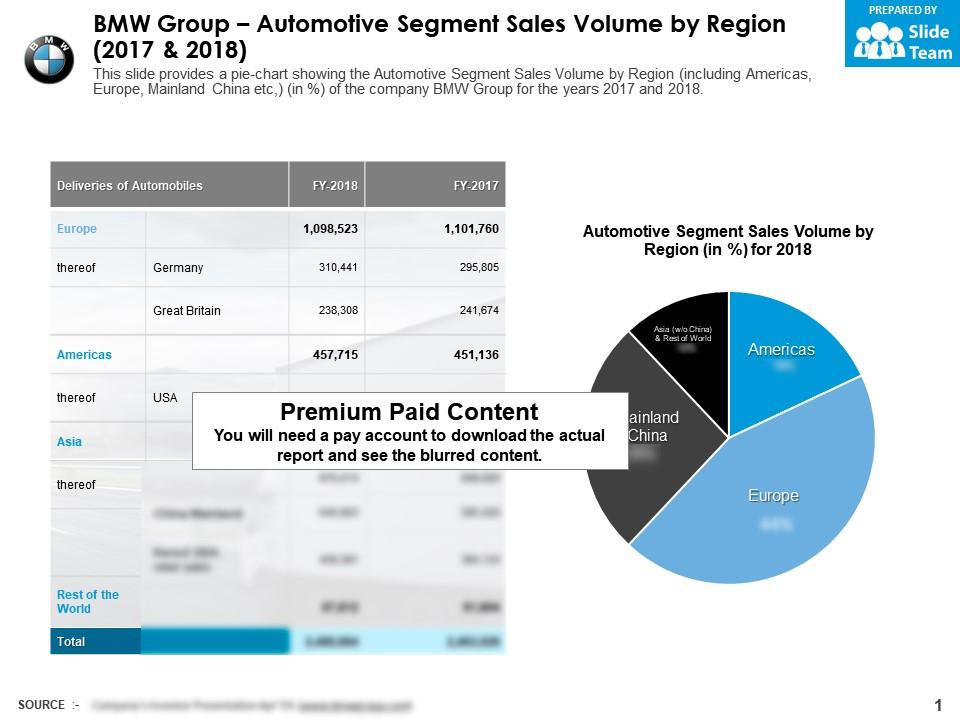
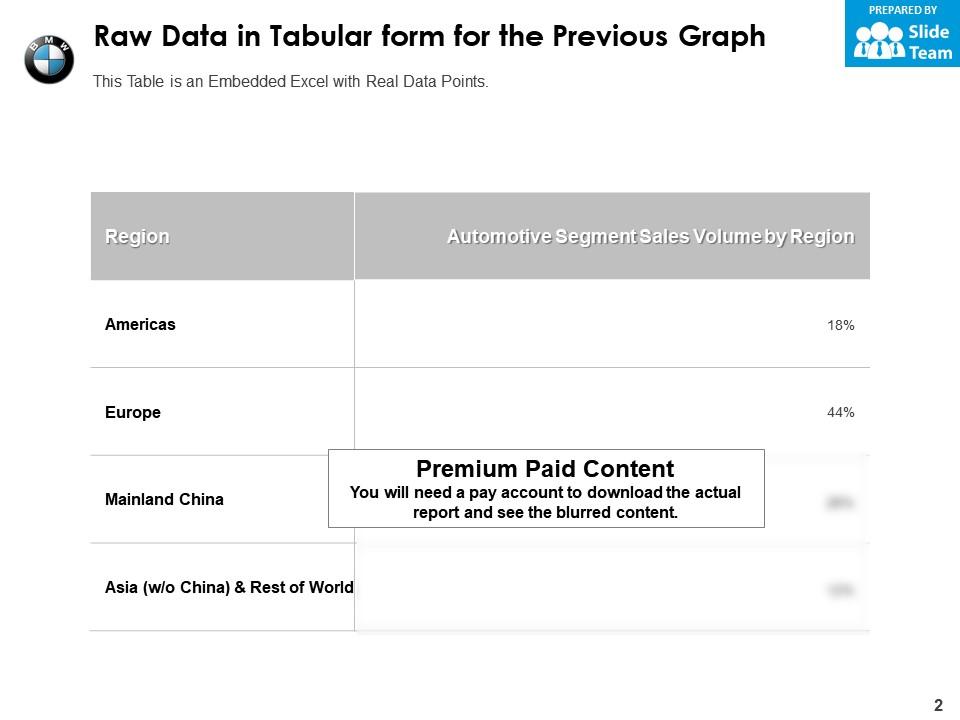
Bmw group automotive segment sales volume by region 2017-2018
Try Before you Buy Download Free Sample Product
Audience
Editable
of Time
Difficulties fade away with our BMW Group Automotive Segment Sales Volume By Region 2017-2018. You will never have to put your hands up.
People who downloaded this PowerPoint presentation also viewed the following :
Bmw group automotive segment sales volume by region 2017-2018 with all 3 slides:
Dig out any flaws with our BMW Group Automotive Segment Sales Volume By Region 2017-2018. Bring errors to a grinding halt.
FAQs for Bmw group automotive segment sales volume
BMW Group's regional automotive sales data for 2017-2018 includes figures across Europe, Americas, Asia, and other key markets, broken down by units sold and revenue performance. These comprehensive sales metrics enable automotive industry analysts, investors, and strategic planners to assess market penetration, regional growth patterns, and competitive positioning, ultimately delivering insights for investment decisions and market expansion strategies.
BMW Group's regional sales growth rates during 2017-2018 varied significantly, with Asia-Pacific markets typically experiencing stronger expansion compared to mature European and North American markets. These regional differences reflected varying consumer preferences, economic conditions, and market penetration levels, with emerging markets like China driving substantial volume increases while established regions focused on premium model mix optimization, ultimately enabling BMW to balance global growth with profitability across diverse automotive landscapes.
**INPUT**: Which region saw the highest percentage increase in BMW Group sales between 2017 and 2018? **OUTPUT**: Asia Pacific demonstrated the highest percentage increase in BMW Group sales between 2017 and 2018, reflecting the region's expanding luxury automotive market and growing consumer purchasing power. This growth pattern enables automotive manufacturers to strategically allocate resources, enhance regional marketing initiatives, and capitalize on emerging market opportunities, ultimately delivering stronger market penetration and competitive advantage in high-growth territories. **Word count: 58 words**
Economic conditions significantly influenced BMW Group's regional sales performance, with mature markets like Europe and North America experiencing modest growth due to stable consumer spending, while emerging markets faced headwinds from currency fluctuations and economic uncertainty. These varying conditions resulted in uneven sales distribution across regions, with BMW adapting pricing strategies and model offerings to maintain competitiveness, ultimately delivering resilient global performance despite challenging macroeconomic environments in key developing markets.
New model launches significantly enhanced BMW Group's regional sales performance by introducing updated X-series SUVs, refreshed 5 Series sedans, and electric i-models across key markets. These strategic product introductions streamlined market positioning, accelerated growth in Asia-Pacific and North American segments, and ultimately delivered competitive advantages through diversified portfolios that met evolving consumer preferences.
BMW Group implemented region-specific marketing strategies including digital advertising campaigns, luxury experience centers, electric vehicle promotions, and strategic partnerships with local dealers and technology companies. These approaches enhanced brand positioning by targeting affluent demographics, emphasizing sustainability messaging, and leveraging cultural preferences, with many markets finding that localized premium experiences and EV incentives ultimately delivered stronger customer engagement and competitive advantage.
BMW Group's competitive landscape evolved through market share fluctuations, emerging electric vehicle competition, and shifting consumer preferences across regions from 2017 to 2018. While European markets saw intensified competition from Audi and Mercedes-Benz, Asian markets presented growth opportunities despite local brand challenges, with North American operations adapting to SUV demand trends, ultimately requiring strategic positioning adjustments to maintain premium market leadership.
Electric and hybrid vehicle sales served as a strategic growth driver for BMW Group across regions, with Europe leading adoption through models like the i3 and i8, while North America and Asia-Pacific showed emerging demand. These electrified vehicles enhanced BMW's competitive positioning in increasingly regulated markets, ultimately delivering brand differentiation and regulatory compliance advantages, with many regions finding that early EV adoption strengthened dealer networks and customer loyalty during the 2017-2018 transition period.
Customer demographics significantly influenced BMW Group's regional sales through varying income levels, luxury preferences, brand perception, and market maturity across different territories. Younger, affluent consumers in North America and Europe drove premium model demand, while emerging markets like Asia-Pacific saw growing middle-class adoption of entry-level luxury vehicles, ultimately creating distinct regional sales patterns that reflected local economic conditions and consumer sophistication levels.
BMW Group faced challenges including intensified competition from luxury rivals, shifting consumer preferences toward SUVs and electric vehicles, regulatory pressures in key markets like China and Europe, and economic uncertainties affecting purchasing decisions. These market dynamics particularly impacted traditional sedan sales in North America and Europe, while trade tensions and tariff concerns created additional headwinds, ultimately requiring strategic pivots toward electrification and crossover segments to maintain competitive positioning.
Trade policies and tariffs significantly affected BMW Group's regional sales through increased import costs, supply chain disruptions, and shifting consumer demand patterns across key markets. These challenges particularly impacted North American operations where tariff uncertainties influenced pricing strategies, while European and Asian markets experienced varying degrees of regulatory adjustments, ultimately requiring BMW to enhance production localization and streamline distribution networks for sustained competitive advantage.
BMW Group's 2017-2018 sales data revealed increasing consumer preference for SUVs and electric vehicles, growing demand for luxury features across all regions, and shifting market dynamics toward Asia-Pacific expansion. These trends reflected evolving consumer priorities emphasizing sustainability, technology integration, and premium experiences, with many automotive analysts finding that regional preferences increasingly influenced global product development strategies and market positioning.
BMW Group's after-sales services significantly enhanced customer loyalty through comprehensive maintenance programs, extended warranties, personalized service experiences, and digital service platforms across key markets. These strategic initiatives streamlined customer interactions while delivering faster service resolution and proactive maintenance scheduling, with many automotive dealerships finding that enhanced after-sales support ultimately drives repeat purchases and strengthens long-term customer relationships.
BMW Group's dealership network improvements included expanding digital showrooms, enhancing customer service training, streamlining inventory management systems, and upgrading facilities to showcase electric vehicle technologies. These strategic enhancements enabled faster customer interactions, improved product demonstrations, and more efficient sales processes, with many dealerships finding that modernized networks delivered higher conversion rates and stronger regional market penetration, ultimately supporting BMW's competitive positioning across key growth markets.
BMW Group's sustainability initiatives reshaped their sales strategy by emphasizing electric vehicle portfolios, carbon-neutral manufacturing processes, and circular economy principles across global markets. These initiatives enabled differentiated positioning in environmentally conscious regions like Europe and North America, while delivering enhanced brand value, regulatory compliance advantages, and ultimately strengthened competitive positioning in the premium automotive segment.
No Reviews