Building a compensation plan building a compensation plan compensation plan
Try Before you Buy Download Free Sample Product
Audience
Editable
of Time
Indulge in competition with our Building A Compensation Plan Building A Compensation Plan Compensation Plan. Establish your claim of being among the best.
People who downloaded this PowerPoint presentation also viewed the following :
Content of this Powerpoint Presentation
Description:
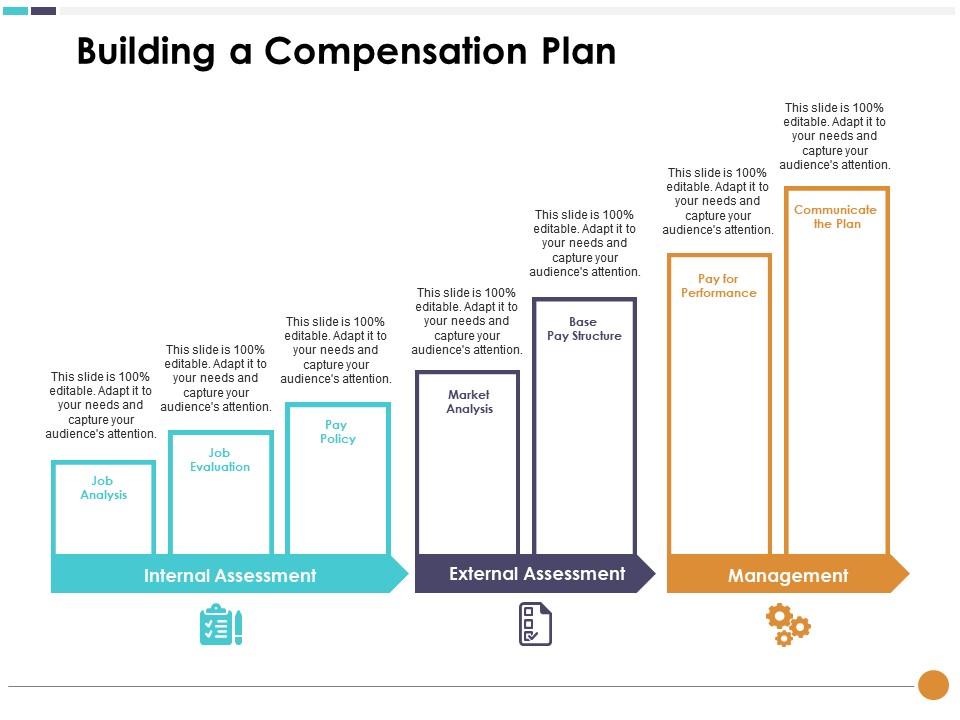
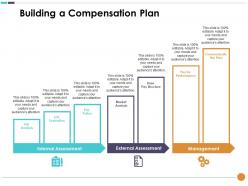
The image is of a PowerPoint slide titled "Building a Compensation Plan," which outlines the key elements and processes for creating an effective compensation strategy within an organization. The slide is segmented into four main sections, each representing a crucial step in the compensation planning process, with a color-coded scheme that enhances readability and organization.
The leftmost section, "Internal Assessment," includes "Job Analysis" and "Job Evaluation," suggesting a focus on understanding the roles within the organization and their relative worth. This step is foundational for establishing fair and equitable compensation.
The next section, "External Assessment," lists "Market Analysis" and "Pay Policy," indicating that competitive market positioning and policy considerations are essential for determining compensation structures that are both competitive and compliant with prevailing standards and regulations.
"Base Pay Structure" stands alone in the middle of the slide, bridging internal and external assessments. This implies that the base salary for employees is influenced by both internal job valuations and external market conditions.
The rightmost section, "Management," breaks down into "Pay for Performance" and "Communicate the Plan." These elements emphasize the importance of aligning compensation with performance outcomes and ensuring clear communication of compensation policies to the workforce.
Use Cases:
This PowerPoint slide is a valuable resource for any industry that relies on strategic compensation planning to attract, retain, and motivate employees.
1. Technology:
Use: Structuring competitive compensation packages for tech talent.
Presenter: HR Director
Audience: HR Team, Senior Management
2. Healthcare:
Use: Aligning compensation with healthcare providers' performance metrics.
Presenter: Chief Financial Officer
Audience: Department Heads, Administrative Staff
3. Financial Services:
Use: Detailing bonus structures for financial performance.
Presenter: Compensation Analyst
Audience: Bank Managers, Financial Advisors
4. Retail:
Use: Creating equitable pay scales for retail positions.
Presenter: HR Manager
Audience: Store Managers, Regional Directors
5. Manufacturing:
Use: Designing performance-based incentives for production workers.
Presenter: Operations Manager
Audience: HR Personnel, Line Supervisors
6. Hospitality:
Use: Implementing a tiered wage system for service staff.
Presenter: General Manager
Audience: Hotel/Restaurant Managers, Chefs
7. Education:
Use: Developing a salary scale for academic and support staff.
Presenter: School District HR Specialist
Audience: School Principals, Administrative Staff
Building a compensation plan building a compensation plan compensation plan with all 5 slides:
The path to success is rough and tough. Ease the flow with our Building A Compensation Plan Building A Compensation Plan Compensation Plan.
FAQs for Building a compensation plan building a compensation
Key elements of an effective compensation plan include base salary structures, performance-based incentives, benefits packages, equity compensation, and clear progression pathways. These components work together by aligning employee motivation with organizational goals, ensuring market competitiveness, and providing transparency in reward systems, with many companies finding that strategic compensation drives retention and enhances overall performance.
Performance metrics influence compensation structures by establishing clear measurement criteria for base salaries, variable pay, bonuses, and incentive programs that directly tie employee rewards to specific business outcomes. Through data-driven frameworks, organizations streamline performance evaluation processes, enhance pay equity transparency, and accelerate goal achievement, with many companies finding that metrics-based compensation ultimately delivers improved employee engagement and competitive talent retention.
Market research provides critical data on industry salary ranges, benefit packages, regional pay variations, competitor practices, and talent market conditions necessary for competitive positioning. Through comprehensive benchmarking studies, organizations can identify compensation gaps, understand candidate expectations, and develop strategic packages that attract top talent while maintaining cost efficiency, ultimately ensuring their compensation plans deliver competitive advantage in increasingly tight labor markets.
Companies align compensation strategies with business goals by linking pay structures to performance metrics, strategic objectives, revenue targets, and organizational priorities. Through performance-based bonuses, equity incentives, and goal-oriented raises, organizations drive employee behaviors that support growth initiatives, operational efficiency, and competitive positioning, ultimately delivering improved results and strategic alignment.
Potential pitfalls include over-emphasizing short-term sales over customer relationships, creating unhealthy internal competition, insufficient base salary security, complex calculation methods, and misaligned metrics that discourage teamwork. While commission plans drive performance, organizations increasingly find that balanced structures combining base salary with achievable targets deliver sustainable results, retain talent more effectively, and ultimately enhance both employee satisfaction and long-term revenue growth.
Employee benefits significantly enhance total compensation value by providing healthcare coverage, retirement contributions, paid time off, professional development opportunities, and work-life balance perks. These strategic additions help organizations attract top talent, reduce turnover costs, and boost employee satisfaction, with many companies finding that comprehensive benefits packages deliver competitive advantage while ultimately reducing overall recruitment and retention expenses.
Salary systems offer predictable budgeting, attract professional talent, and simplify payroll administration, while hourly wages provide cost control during slow periods, ensure compliance with overtime laws, and reward productive hours worked. Many organizations find that salaries work best for management and specialized roles requiring consistent availability, whereas hourly structures benefit operational positions with variable workloads, ultimately enabling strategic workforce optimization.
Organizations ensure transparency in compensation plans by clearly communicating salary bands, promotion criteria, performance metrics, and decision-making processes to all employees. Through regular compensation reviews, open dialogue sessions, and accessible documentation, companies build trust, reduce pay disparities, and enhance employee satisfaction, with many finding that transparent practices ultimately improve retention and workplace equity.
Pay equity strategies include conducting regular salary audits, implementing transparent pay scales, standardizing job evaluation processes, eliminating subjective compensation decisions, and establishing clear promotion criteria. These approaches streamline fairness by removing bias, enhancing accountability, and ensuring consistent application across departments, with many organizations finding that systematic equity measures ultimately deliver improved employee retention, stronger workplace culture, and reduced legal risks.
Remote compensation plans can be adjusted through geographic pay scales, flexible benefit allocations, home office stipends, performance-based metrics, and technology allowances. Many organizations are finding that strategic combinations of location-neutral salaries, enhanced digital collaboration tools, and outcome-focused incentives ultimately deliver greater talent retention and operational flexibility in increasingly distributed work environments.
Company culture significantly influences how employees perceive compensation fairness, value, and adequacy through transparency levels, communication practices, recognition systems, and overall workplace environment. Organizations with strong cultures of appreciation and open dialogue often find that employees view their total compensation more favorably, while those lacking transparency face dissatisfaction regardless of competitive pay rates.
Organizations should approach compensation by ensuring non-exempt employees receive hourly wages with overtime pay for hours exceeding 40 per week, while exempt employees earn fixed salaries meeting minimum thresholds. This strategic differentiation streamlines payroll compliance, reduces legal risks, and enhances operational efficiency, with many companies finding that clear classification ultimately delivers better cost management and employee satisfaction across diverse workforce structures.
Emerging compensation trends for gig workers include performance-based pay structures, flexible benefit packages, milestone bonuses, skill-based rate adjustments, and portable benefits across platforms. These approaches enable companies to attract top talent while providing workers greater financial stability and growth opportunities, with many platforms finding that comprehensive compensation models significantly improve worker retention and service quality.
Technology facilitates better compensation plan management through automated calculations, real-time analytics, cloud-based accessibility, and integrated payroll systems. These platforms streamline salary processing, bonus tracking, and performance-based adjustments while enabling HR teams to analyze compensation trends, ensure regulatory compliance, and deliver transparent reporting, ultimately enhancing operational efficiency and employee satisfaction.
Feedback enables organizations to identify compensation gaps, assess employee satisfaction levels, and adapt strategies to market changes and evolving workforce expectations. Through regular surveys, performance reviews, and competitive analysis, companies can refine their compensation frameworks, enhance retention rates, and maintain competitive positioning, ultimately delivering improved employee engagement and organizational performance.
-
Thanks for all your great templates they have saved me lots of time and accelerate my presentations. Great product, keep them up!
-
Attractive design and informative presentation.