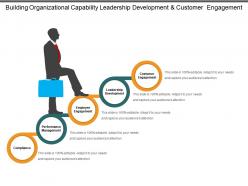
Building organizational capability leadership development and customer engagement

Rating:
90%
Building organizational capability leadership development and customer engagement
Slide 1 of 5
Favourites Favourites

Try Before you Buy Download Free Sample Product

Audience Impress Your
Audience
Editable 100%
Editable
Time Save Hours
of Time
The Biggest Sale is ending soon in
0
0
:
0
0
:
0
0
Rating:
90%
Presenting this set of slides with name - Building Organizational Capability Leadership Development And Customer Engagement. This is a one stage process. The stages in this process are Capability Building, Potential Building, Capability Development.

People who downloaded this PowerPoint presentation also viewed the following :

FAQs for Building organizational capability leadership development

Effective leaders in today's dynamic environment demonstrate adaptability, emotional intelligence, strategic vision, authentic communication, and collaborative decision-making. These qualities enable leaders to navigate uncertainty, build resilient teams, and drive innovation across diverse organizations, with many companies finding that leaders who combine empathy with decisive action ultimately deliver stronger performance and employee engagement.

Organizations can assess leadership potential through comprehensive performance reviews, 360-degree feedback assessments, behavioral interviews, leadership competency evaluations, and cross-functional project assignments. These methods enable companies to identify emerging leaders by evaluating communication skills, decision-making abilities, and team collaboration, with many organizations finding that structured assessment programs significantly enhance succession planning and ultimately deliver stronger leadership pipelines.

Emotional intelligence serves as a foundational element in leadership development, encompassing self-awareness, empathy, social skills, and emotional regulation that enable effective team management. Through enhanced EQ capabilities, leaders in healthcare, financial services, and manufacturing streamline communication, minimize workplace conflicts, and ultimately deliver stronger team performance and organizational outcomes.

Mentorship programs enhance leadership skills by providing personalized guidance, real-world insights, accelerated learning opportunities, and strategic networking connections. Through structured mentor relationships, emerging leaders develop critical decision-making abilities, emotional intelligence, and communication skills, while gaining exposure to diverse leadership styles and industry perspectives, ultimately delivering faster career progression and stronger organizational leadership pipelines.

Effective strategies for developing leadership skills in remote teams include virtual mentoring programs, cross-functional project assignments, digital leadership workshops, peer coaching circles, and simulated decision-making scenarios. These approaches enhance communication abilities, emotional intelligence, and strategic thinking through structured online interactions, with many organizations finding that remote leadership development actually accelerates skill-building by requiring more intentional and focused engagement.

Organizations create continuous leadership development cultures by implementing mentorship programs, providing regular feedback mechanisms, offering cross-functional project opportunities, and establishing clear advancement pathways. Through strategic combination of formal training with experiential learning, companies like GE and IBM enhance leadership skills at every level, while encouraging knowledge sharing and collaborative decision-making, ultimately delivering stronger organizational resilience.

Best practices for providing feedback to develop future leaders include regular one-on-one sessions, specific behavioral observations, goal-oriented discussions, 360-degree evaluations, and structured development conversations. These approaches enhance leadership readiness by building self-awareness, addressing skill gaps, and creating accountability frameworks, with many organizations finding that consistent, actionable feedback accelerates leadership pipeline development and improves succession planning outcomes.

Leaders balance authority and approachability by establishing clear expectations while maintaining open communication, demonstrating consistency in decision-making, and showing genuine interest in team members' development and concerns. This strategic combination enables enhanced trust and respect, with many organizations finding that approachable leaders who maintain professional boundaries ultimately deliver stronger team performance and employee engagement.

Leadership challenges in diverse workplaces include communication barriers, cultural misunderstandings, varying work styles, unconscious bias, and conflicting expectations across different backgrounds. These obstacles can be overcome through cultural competency training, inclusive communication practices, and structured mentorship programs, with many organizations finding that diverse leadership teams ultimately deliver enhanced innovation, broader market insights, and stronger competitive advantage.

Leadership development enhances team performance by equipping managers with essential capabilities like strategic communication, emotional intelligence, conflict resolution, and performance coaching skills. These competencies enable leaders to foster collaboration, provide clearer direction, and motivate diverse team members more effectively, with many organizations finding that well-trained leaders ultimately deliver higher productivity, reduced turnover, and improved employee engagement across departments.

Organizations can evaluate leadership program effectiveness through employee engagement scores, retention rates of high-potential talent, 360-degree feedback assessments, promotion rates from program participants, and business performance indicators. These metrics enable companies to measure both behavioral changes and tangible outcomes, with many finding that combining quantitative data with qualitative feedback delivers comprehensive insights into program ROI and organizational impact.

Generational differences significantly influence leadership styles, with Baby Boomers favoring hierarchical approaches, Gen X emphasizing independence and results, and Millennials/Gen Z prioritizing collaboration, feedback, and purpose-driven leadership. Organizations increasingly adapt development programs by combining traditional mentoring with digital learning platforms, reverse mentoring, and flexible career paths, ultimately creating more inclusive leadership pipelines that leverage diverse generational strengths.

Adaptability enables leaders to navigate changing market conditions, emerging technologies, and evolving team dynamics while maintaining organizational effectiveness and strategic direction. Leaders can nurture adaptability through continuous learning, cross-functional exposure, scenario planning exercises, and embracing diverse perspectives, with many organizations finding that adaptable leaders drive innovation, enhance team resilience, and deliver sustained competitive advantage.

Storytelling enhances leadership development by building emotional intelligence, improving communication skills, and creating memorable learning experiences through real-world scenarios and case studies. Through narrative-based training programs, emerging leaders practice articulating vision, connecting with diverse teams, and navigating complex situations, with many organizations finding that story-driven approaches accelerate skill acquisition and strategic thinking.

Technology streamlines leadership development through virtual reality simulations, AI-powered coaching platforms, microlearning apps, video conferencing tools, and analytics dashboards that track progress and skill gaps. These digital solutions enable organizations to deliver personalized training at scale, provide real-time feedback, and create immersive leadership scenarios, ultimately enhancing accessibility while reducing traditional training costs.

Ratings and Reviews

90% of 100
Review Form
Write a review
Most Relevant Reviews
  1. 100%

    by Duncan Berry

    Excellent Designs.
  2. 80%

    by Williams Morales

    Great experience, I would definitely use your services further.

2 Item(s)

per page: