Business motivation model ppt slides download
Try Before you Buy Download Free Sample Product
Audience
Editable
of Time
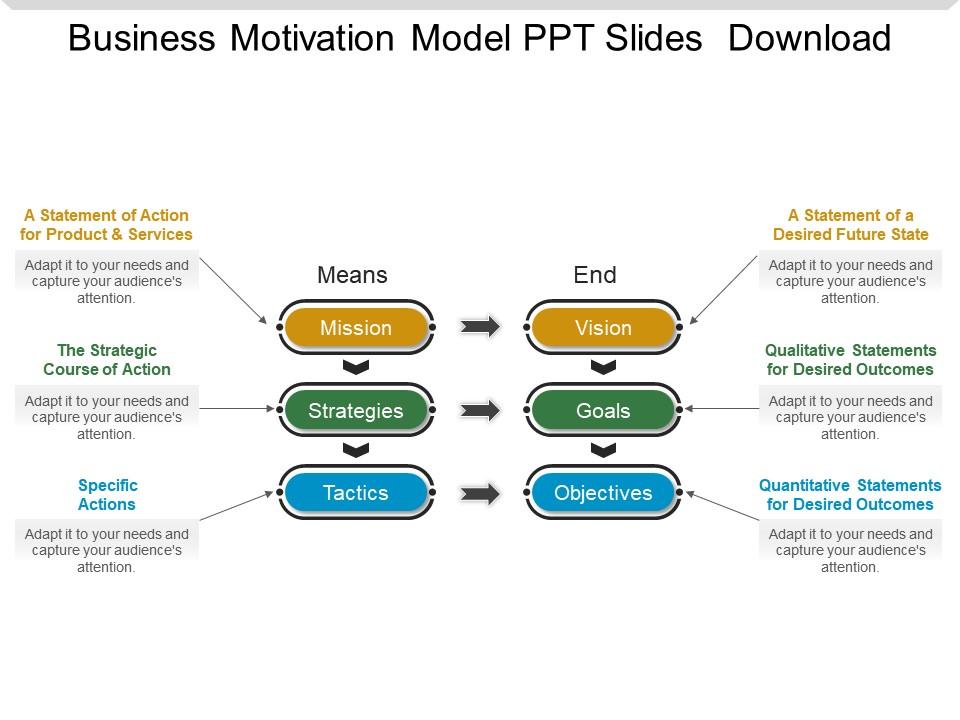
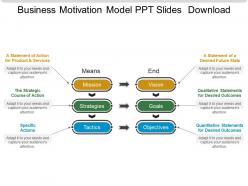
The business motivation model PowerPoint slide is suitable for all type of business presentations because it helps a user to motivate his viewers. Undoubtedly, HR is the most important part of any company. Therefore, he must take some initiative to keep the employees motivated and for that, he can help of the organizational motivation presentation template. The HR team can take help of the structured approach that displayed in the motivation model PPT slide design to inspire the employees to work hard and work smartly. A user can share the different types of strategies that can motivate the organization to accomplish its target as quickly as possible that too in the best way by using the business inspirational model presentation template. To motivate the business or organization means boosting its productivity and increase in profit and for that, a business owner needs to motivate his employees to achieve the target, mission, and vision. With the help of the business ambition template for PowerPoint, a presenter can illustrate the factors that motivate the employees, apart from that give rewards & recognition for their achievement, creative productive environment for them. Figure out how to improve functioning with our Business Motivation Model Ppt Slides Download. It helps carry out an in house analysis.
People who downloaded this PowerPoint presentation also viewed the following :
Business motivation model ppt slides download with all 5 slides:
Enhance the ecosystem with our Business Motivation Model Ppt Slides Download. Enlist yourself in the cause of conservation.
FAQs for Business motivation model
A successful Business Motivation Model includes vision statements, mission definitions, strategic goals, business objectives, and key performance indicators. These components work together by aligning organizational purpose with measurable outcomes, establishing clear accountability frameworks, and enabling systematic progress tracking, with many enterprises finding that this structured approach ultimately delivers enhanced operational efficiency and sustainable competitive advantage.
Organizations effectively align strategic goals with the Business Motivation Model by mapping vision and mission statements to desired outcomes, connecting strategic objectives to specific business tactics, and ensuring motivational elements like drivers and assessments support goal achievement. Through systematic linkage of ends, means, and influencers, companies streamline decision-making processes, enhance resource allocation, and maintain strategic focus, with many enterprises finding that this structured approach delivers greater organizational clarity and measurable progress toward competitive advantage.
A Business Motivation Model facilitates decision-making by clearly linking organizational goals to specific strategies, tactics, and performance metrics, ensuring decisions align with core business objectives. This structured approach enables leaders to evaluate options against defined success criteria, prioritize initiatives based on strategic impact, and communicate reasoning across departments, ultimately delivering faster consensus-building and more consistent organizational direction.
Stakeholder analysis identifies key parties affected by business decisions, their interests, influence levels, and potential conflicts within the Business Motivation Model framework. This analysis ensures that organizational goals, objectives, and strategies align with stakeholder expectations, while enabling companies to prioritize initiatives, manage competing demands, and build consensus around strategic direction, ultimately delivering stronger stakeholder buy-in and sustainable competitive advantage.
Startups can leverage the Business Motivation Model with simplified governance structures, rapid iteration cycles, and flexible goal-setting frameworks that accommodate pivot scenarios and resource constraints. Established enterprises require more comprehensive stakeholder mapping, formal compliance integration, and structured change management processes, with many finding that layered implementation across business units enables strategic alignment while maintaining operational continuity and competitive positioning.
Successful Business Motivation Model implementations include IBM's strategic alignment initiative, Toyota's operational excellence framework, and Microsoft's digital transformation roadmap. These organizations leveraged BMM to streamline decision-making processes, enhance stakeholder communication, and accelerate strategic execution, with many finding that structured motivation mapping delivers measurable improvements in organizational focus and competitive positioning.
External factors significantly influence the Business Motivation Model by reshaping strategic objectives, driving regulatory compliance requirements, and necessitating competitive positioning adjustments. Market trends like digital transformation and evolving customer expectations compel organizations to realign their vision and goals, while competitive pressures force strategic pivots, ultimately ensuring business models remain agile and market-responsive.
Common challenges include aligning diverse stakeholder perspectives, mapping complex interdependencies between goals and strategies, maintaining model relevance amid changing market conditions, and ensuring consistent terminology across departments. Many organizations find that while initial framework development requires significant time investment, the structured approach ultimately streamlines decision-making processes and enhances strategic clarity across all business units.
Technology supports Business Motivation Model development through strategic planning software, data analytics platforms, collaborative modeling tools, and automated tracking systems. These solutions streamline goal alignment, enhance stakeholder collaboration, and provide real-time performance monitoring, with many organizations finding that integrated platforms accelerate strategy implementation while delivering improved transparency and measurable business outcomes.
Business Motivation Model effectiveness metrics include strategy alignment scores, goal achievement rates, stakeholder engagement levels, decision-making speed improvements, and resource allocation efficiency. Organizations typically measure these through quarterly performance reviews, ROI analysis, and strategic milestone tracking, with many enterprises finding that integrated dashboards streamline monitoring while enhancing transparency and accountability across departments.
A Business Motivation Model helps identify and manage risks by systematically mapping business objectives against potential threats, regulatory requirements, and operational vulnerabilities. Through this structured approach, organizations can proactively assess risk impacts on strategic goals, implement targeted mitigation strategies, and maintain compliance frameworks, with many enterprises finding that integrated risk management ultimately delivers enhanced decision-making and competitive resilience.
Business Motivation Models integrate with existing processes through strategic alignment frameworks, performance measurement systems, decision-making protocols, and operational workflow mappings. Organizations embed these models into project management, resource allocation, and performance reviews, with many companies finding that systematic integration streamlines strategic execution, enhances accountability, and delivers measurable improvements in goal achievement across departments.
Business Motivation Model best practices include establishing clear stakeholder alignment, defining measurable objectives with specific timelines, ensuring strategic goals connect directly to operational tactics, and maintaining regular review cycles. These frameworks streamline decision-making by creating transparency between vision and execution, with many organizations finding that systematic documentation of motivations, assessments, and influences ultimately delivers enhanced strategic focus and improved resource allocation across departments.
Organizations ensure employee engagement during Business Motivation Model implementation through transparent communication about strategic objectives, comprehensive training on how individual roles connect to broader goals, and collaborative workshops that involve employees in defining tactics and processes. This participatory approach, combined with regular feedback sessions and recognition programs, helps employees understand their strategic contribution while building ownership, ultimately delivering higher adoption rates and sustained organizational alignment across all departments.
Continuous improvement within a Business Motivation Model ensures strategies remain aligned with evolving market conditions, customer needs, and organizational capabilities through regular assessment and refinement cycles. This iterative approach enables companies to adapt their vision, objectives, and tactical implementations more effectively, with many organizations finding that systematic improvement processes deliver sustained competitive advantage and enhanced operational performance.
-
Use of icon with content is very relateable, informative and appealing.
-
Understandable and informative presentation.