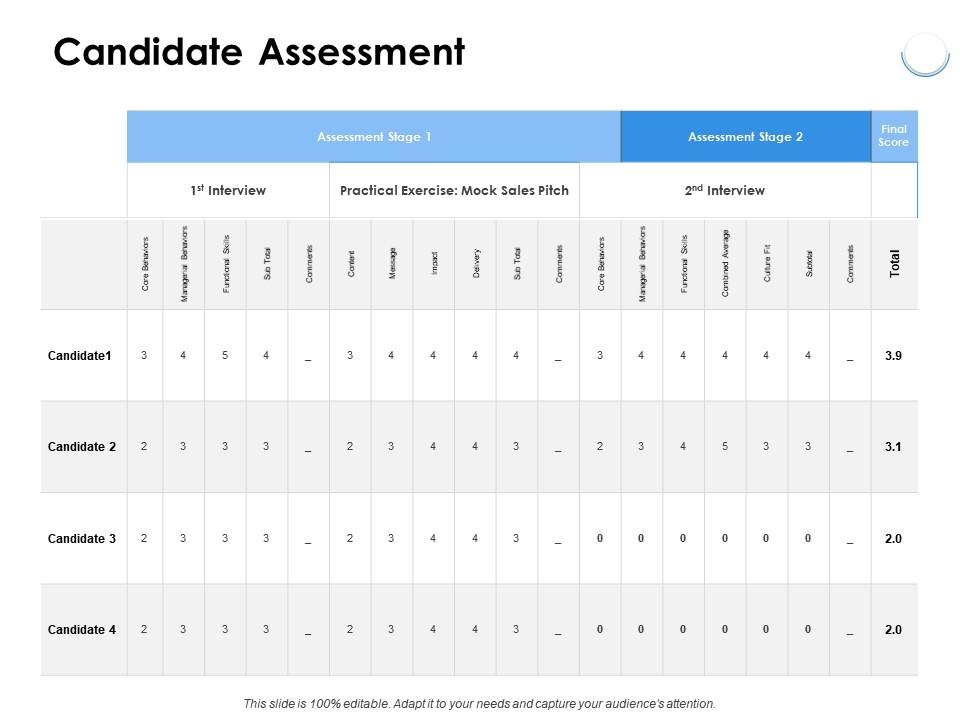
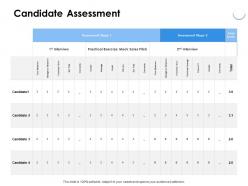
Candidate assessment candidate ppt powerpoint presentation pictures design
Try Before you Buy Download Free Sample Product
Audience
Editable
of Time
Handle irrational fears with our Candidate Assessment Candidate Ppt Powerpoint Presentation Pictures Design. Enable folks to intelligently assess their apprehensions.
People who downloaded this PowerPoint presentation also viewed the following :
Candidate assessment candidate ppt powerpoint presentation pictures design with all 5 slides:
Enable folks to intelligently assess their apprehensions with our Candidate Assessment Candidate Ppt Powerpoint Presentation Pictures Design. Help them handle irrational fears.
FAQs for Candidate assessment candidate ppt powerpoint
Key competencies include technical skills, problem-solving abilities, communication effectiveness, adaptability, and cultural alignment with organizational values. These assessments enable hiring managers to evaluate job-specific expertise, collaborative potential, and leadership capacity, with many organizations finding that comprehensive competency frameworks streamline recruitment processes while ultimately delivering better employee retention and enhanced team performance.
Behavioral interview techniques enhance candidate evaluation by focusing on past performance to predict future behavior, using structured questioning methods, scenario-based assessments, and competency mapping. These approaches enable recruiters to evaluate soft skills, cultural fit, and problem-solving abilities more effectively than traditional interviews, with many organizations finding significantly improved hiring accuracy and reduced turnover rates.
Cultural fit serves as a critical evaluation criterion that assesses how well candidates align with organizational values, work environment, and team dynamics alongside technical qualifications. This strategic combination helps companies reduce turnover, enhance collaboration, and improve overall performance, with many organizations finding that employees who align culturally demonstrate higher engagement and longer tenure.
Skills assessments can be tailored by aligning evaluation criteria with specific job competencies, incorporating role-relevant scenarios, using industry-specific tools, and including practical simulations that mirror actual work tasks. Through customized coding challenges for developers, case studies for consultants, and customer interaction scenarios for sales roles, organizations streamline hiring accuracy while reducing time-to-fill, ultimately delivering better job-candidate matches and improved retention rates.
AI-driven candidate assessment tools offer reduced bias, faster screening processes, enhanced accuracy in skill evaluation, improved candidate experience, and cost-effective scalability. These technologies streamline recruitment by analyzing resumes automatically, conducting initial video interviews, and predicting job performance through data analytics, with many organizations finding significantly shorter hiring cycles and better quality hires.
Employers can effectively assess soft skills through behavioral interviews, situational judgment tests, role-playing exercises, team-based assessments, and reference checks with specific examples. These methods enable hiring managers to evaluate communication, leadership, and problem-solving abilities in realistic scenarios, with many organizations finding that structured assessment approaches ultimately deliver better cultural fit and improved employee retention rates.
**INPUT**: What metrics should be used to measure the success of candidate assessments? **OUTPUT**: Effective candidate assessment metrics include time-to-hire, quality-of-hire scores, retention rates, hiring manager satisfaction, and cost-per-hire ratios. These measurements enable organizations to streamline recruitment processes, enhance candidate experiences, and ultimately deliver better talent acquisition outcomes, with many companies finding that comprehensive metrics reduce turnover while improving overall hiring efficiency.
Diversity and inclusion can be incorporated through structured interviews with diverse panels, bias-free assessment criteria, inclusive language in job descriptions, and standardized evaluation rubrics. Organizations streamline these approaches by implementing blind resume reviews, cultural competency assessments, and accessibility accommodations, with many companies finding that diverse hiring panels ultimately deliver more equitable candidate experiences and broader talent acquisition.
Potential biases in candidate evaluations include confirmation bias, halo effect, affinity bias, recency bias, and stereotyping based on demographics or background. These biases can significantly impact hiring decisions by favoring candidates who mirror existing team members or recent impressive interactions, while overlooking qualified diverse talent, ultimately limiting organizational growth and innovation in an increasingly competitive marketplace.
Predictive analytics enhances candidate assessment accuracy by analyzing historical hiring data, identifying performance patterns, and correlating candidate traits with job success metrics. These data-driven insights enable recruiters to make more objective decisions, reduce hiring bias, and predict long-term employee performance, with many organizations finding significantly improved retention rates and better cultural fit matches.
**INPUT**: What strategies can help in reducing candidate assessment time without sacrificing quality? **OUTPUT**: Effective strategies include structured interviews, skills-based assessments, automated screening tools, collaborative evaluation platforms, and standardized scoring rubrics. These approaches streamline recruitment by eliminating redundant steps, focusing on job-relevant competencies, and enabling faster decision-making, with many organizations finding that strategic assessment design ultimately delivers higher-quality hires while reducing time-to-fill by weeks. **Word count: 54 words**
Feedback from previous interviewers can refine assessment methods by identifying recurring blind spots, highlighting successful evaluation techniques, and revealing candidate patterns across different roles. Organizations streamline their hiring processes by analyzing interviewer insights to adjust question frameworks, eliminate bias-prone practices, and enhance scoring criteria, ultimately delivering more accurate candidate evaluations and improved hiring outcomes.
Legal considerations during candidate assessment include compliance with anti-discrimination laws, ensuring interview questions relate to job requirements, maintaining consistent evaluation criteria, protecting candidate data privacy, and documenting decisions transparently. These practices help organizations avoid bias-related lawsuits, ensure fair hiring processes, and build defensible recruitment frameworks, with many companies finding that structured legal compliance ultimately enhances both candidate experience and organizational reputation.
Role-playing scenarios assess candidates by simulating real workplace situations, evaluating communication skills, problem-solving abilities, decision-making under pressure, and interpersonal dynamics in controlled environments. These interactive assessments enable hiring managers to observe how candidates handle client interactions, team conflicts, and strategic challenges, with many organizations finding that role-playing reveals authentic behavioral competencies beyond traditional interview responses.
Best practices for creating standardized assessment rubrics include defining clear performance criteria, establishing measurable behavioral indicators, ensuring role-specific competency alignment, incorporating multiple assessment methods, and maintaining consistent scoring guidelines. These frameworks enhance evaluation accuracy by eliminating subjective bias, streamlining candidate comparisons, and enabling data-driven hiring decisions, with many organizations finding that structured rubrics significantly improve hire quality and reduce time-to-decision.
No Reviews