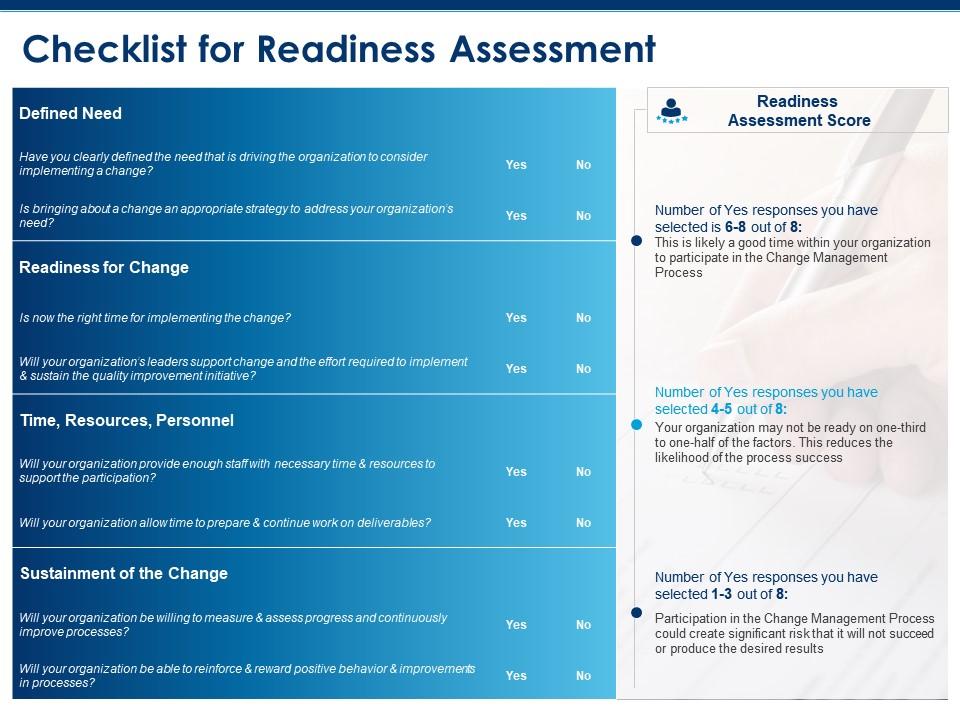
Checklist for readiness assessment resources personnel ppt powerpoint presentation inspiration
Try Before you Buy Download Free Sample Product
Audience
Editable
of Time
Our Checklist For Readiness Assessment Resources Personnel Ppt Powerpoint Presentation Inspiration ensure a bright forecast. A fresh dawn will break and bring good cheer.
People who downloaded this PowerPoint presentation also viewed the following :
Checklist for readiness assessment resources personnel ppt powerpoint presentation inspiration with all 5 slides:
Our Checklist For Readiness Assessment Resources Personnel Ppt Powerpoint Presentation Inspiration ensure a clarity of guidance. The directions to follow will appear clearly in front.
FAQs for Checklist for readiness assessment resources personnel ppt
Key components include leadership commitment, organizational culture, employee engagement levels, communication systems, and resource availability. These assessments evaluate readiness by measuring change capacity, identifying potential resistance points, and determining implementation timelines, with many organizations finding that comprehensive evaluation across these areas ultimately delivers smoother transitions and higher success rates.
Determining team readiness involves conducting comprehensive skills assessments, reviewing past project performance, identifying knowledge gaps through technical evaluations, and mapping current capabilities against project requirements. Organizations can utilize competency frameworks, peer reviews, and practical simulations to evaluate expertise, while strategic upskilling programs and targeted training ultimately bridge identified gaps, ensuring project success.
Employee readiness assessment tools include surveys and questionnaires, skills gap analyses, focus groups, one-on-one interviews, and performance evaluations. These methods enable organizations to identify training needs, address resistance concerns, and develop targeted support strategies, with many companies finding that comprehensive readiness assessments significantly reduce implementation time and enhance user adoption rates.
Stakeholder engagement significantly influences readiness assessment by identifying potential resistance points, resource availability, and organizational buy-in levels across departments. Through structured interviews, surveys, and workshops, organizations can gauge leadership commitment, employee preparedness, and cultural alignment, with many finding that early stakeholder involvement ultimately accelerates implementation and minimizes project risks.
Common barriers to readiness include inadequate resource allocation, insufficient stakeholder buy-in, outdated technology infrastructure, skills gaps, and unclear project scope. These obstacles can be identified through comprehensive audits, stakeholder interviews, and gap analyses, with many organizations finding that early identification enables strategic planning, targeted training initiatives, and improved resource distribution, ultimately delivering smoother implementations and enhanced competitive positioning.
Team morale measurement involves employee satisfaction surveys, engagement metrics, turnover rates, productivity assessments, and communication frequency analysis. These indicators directly correlate with operational readiness, as organizations with higher morale consistently demonstrate faster project delivery, better collaboration, and enhanced problem-solving capabilities, ultimately delivering improved performance and competitive advantage.
Communication serves as the foundation for successful readiness assessments, ensuring stakeholders understand expectations, timelines, and responsibilities while facilitating coordination across departments and teams. Effective communication strategies enable organizations to streamline preparation processes, minimize confusion during evaluations, and ultimately deliver comprehensive responses that demonstrate operational readiness, with many institutions finding that clear communication protocols significantly enhance assessment outcomes.
Cultural factors significantly influence organizational readiness through employee attitudes, change tolerance, collaboration patterns, and leadership support structures. Organizations with adaptive cultures, open communication, and strong change management experience typically demonstrate higher readiness scores, while rigid hierarchies or resistance to innovation can create implementation barriers, ultimately affecting project success rates and stakeholder buy-in across departments.
**INPUT**: What is the ideal timeline for conducting a readiness assessment before a major change? **OUTPUT**: The ideal timeline for conducting a readiness assessment is typically 3-6 months before implementation, depending on organizational complexity and change scope. This timeframe enables comprehensive stakeholder analysis, infrastructure evaluation, and skills gap identification, while providing sufficient opportunity to address deficiencies, build change capacity, and develop mitigation strategies that ultimately enhance implementation success rates. [Word count: 54 words]
Past project outcomes inform current readiness assessments by providing historical performance data, identifying recurring challenges, and revealing organizational strengths and weaknesses. These insights enable teams to benchmark capabilities, anticipate potential risks, and calibrate resource requirements more accurately, with many organizations finding that leveraging previous project analytics significantly enhances their strategic planning precision and ultimately delivers more realistic timelines and improved success rates.
**INPUT**: What metrics should be tracked to evaluate readiness over time? **OUTPUT**: Key readiness metrics include completion rates of training programs, system performance benchmarks, stakeholder engagement scores, risk mitigation progress, and resource allocation efficiency. These indicators enable organizations to monitor preparedness across departments, identify potential bottlenecks before they impact operations, and ensure strategic initiatives remain on track, with many companies finding that consistent metric tracking ultimately delivers greater project success rates and competitive advantage. [Word count: 60]
Resource availability significantly impacts readiness assessments by determining implementation capacity, timeline feasibility, and scalability potential across organizations. When evaluating budget constraints, staffing levels, and technological infrastructure, companies can identify critical gaps early, enabling strategic resource allocation and phased deployment approaches, ultimately delivering more realistic project timelines and sustainable competitive advantages.
Best practices for involving leadership in readiness assessment include securing executive sponsorship, establishing clear governance structures, defining accountability frameworks, conducting regular progress reviews, and ensuring transparent communication channels. Through strategic engagement, leaders provide essential resources, remove organizational barriers, and champion change initiatives, while their visible commitment accelerates adoption and delivers sustainable transformation outcomes.
Feedback loops can be established through regular milestone reviews, stakeholder surveys, performance dashboards, and real-time monitoring systems that track progress against readiness criteria. These mechanisms enable project teams to identify gaps early, adjust strategies dynamically, and maintain alignment with objectives, ultimately delivering more successful outcomes and ensuring continuous improvement throughout the project lifecycle.
Technology readiness assessment should evaluate infrastructure capacity, system integration capabilities, data quality and accessibility, cybersecurity frameworks, and staff technical competencies. Organizations must also consider scalability potential, vendor support structures, and compliance requirements, with many enterprises finding that thorough readiness evaluation significantly reduces implementation risks while accelerating successful technology adoption.
No Reviews