Commission Scheme For Accounting Executive Compensation Mix
Try Before you Buy Download Free Sample Product
Audience
Editable
of Time
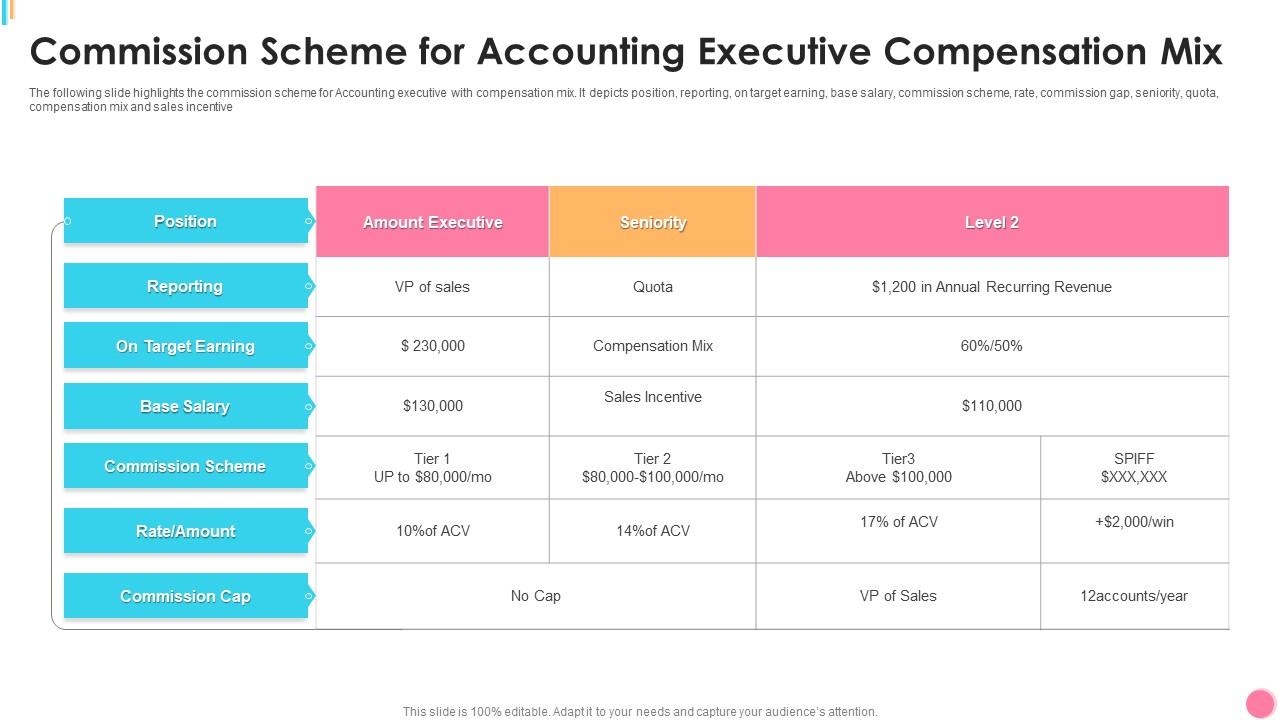
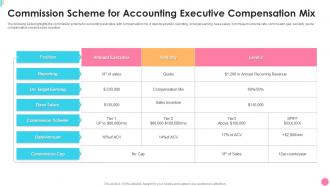
The following slide highlights the commission scheme for Accounting executive with compensation mix. It depicts position, reporting, on target earning, base salary, commission scheme, rate, commission gap, seniority, quota, compensation mix and sales incentive
People who downloaded this PowerPoint presentation also viewed the following :
Commission Scheme For Accounting Executive Compensation Mix with all 6 slides:
Use our Commission Scheme For Accounting Executive Compensation Mix to effectively help you save your valuable time. They are readymade to fit into any presentation structure.
FAQs for Commission Scheme For Accounting
A commission scheme is a performance-based compensation structure where salespeople earn percentages or fixed amounts based on sales achievements, quotas, and targets. It functions by incentivizing revenue generation through tiered rates, territory assignments, and milestone bonuses, with many organizations finding that strategic commission structures drive higher performance, improve retention, and ultimately deliver measurable revenue growth while aligning individual success with company objectives.
Commission schemes motivate sales teams by directly linking compensation to performance, creating financial incentives that reward achievement and drive competitive behavior among team members. This pay-for-performance structure enables organizations to align individual goals with company objectives, ultimately delivering increased revenue generation and improved sales productivity, with many companies finding that variable compensation significantly enhances team motivation and target attainment.
Effective commission schemes include clear performance metrics, competitive rate structures, transparent calculation methods, realistic target setting, and regular review processes. These components work together by aligning sales behaviors with business objectives, motivating high performance through fair compensation, and providing predictability for both management and sales teams, ultimately delivering improved revenue outcomes and enhanced employee satisfaction.
Tailoring commission schemes involves aligning compensation structures with specific role responsibilities, sales cycles, and performance metrics for each position. Account managers might receive higher base salaries with relationship-based bonuses, while hunters earn aggressive commission rates on new acquisitions, and support roles receive team-based incentives, ultimately creating targeted motivation that drives both individual performance and organizational revenue growth.
Tiered commission structures offer escalating rewards that motivate higher performance levels, improved employee retention, and enhanced revenue growth, while flat rates provide simplicity, predictable costs, and easier administration. While flat commissions work well for consistent sales environments, tiered systems drive competitive advantage by incentivizing top performers to exceed targets, ultimately delivering stronger business outcomes and scalable growth across organizations.
Commission schemes significantly impact team dynamics by creating competitive environments that can either foster healthy rivalry or hinder collaboration, depending on structure and implementation. While individual-based commissions may encourage personal performance, team-based or hybrid models promote knowledge sharing, collective problem-solving, and peer support, with many sales organizations finding that balanced approaches ultimately deliver stronger overall results and sustained team cohesion.
Commission scheme effectiveness metrics include sales revenue growth, profit margins, customer acquisition rates, retention percentages, and sales cycle duration. These measurements enable organizations to evaluate performance comprehensively, with many companies finding that tracking both individual and team metrics, alongside customer satisfaction scores, ultimately delivers improved sales outcomes and strategic alignment across departments.
Commission schemes should be evaluated quarterly to capture market shifts, competitive dynamics, and performance trends, with annual comprehensive reviews for strategic adjustments. This balanced approach enables organizations to respond to changing customer behaviors, economic conditions, and industry benchmarks while maintaining sales team stability, ultimately delivering consistent motivation and competitive positioning in increasingly dynamic markets.
**INPUT**: What legal and ethical considerations should be taken into account when designing a commission scheme? **OUTPUT**: Commission scheme design requires compliance with labor laws, anti-discrimination regulations, tax requirements, fair compensation standards, and transparency in calculation methods. These frameworks protect both organizations and employees by ensuring equitable payment structures, clear performance metrics, and documented processes, with many companies finding that ethical commission practices ultimately enhance employee retention and organizational reputation. [Word count: 54 words]
Commission schemes vary significantly across industries, with retail typically using percentage-based models on individual sales, B2B employing tiered structures with higher rates for complex deals, and SaaS focusing on recurring revenue with multi-year incentives. These industry-specific approaches reflect different sales cycles, customer relationships, and revenue models, ultimately delivering optimized performance while aligning compensation with strategic business objectives.
Transparency significantly enhances employee satisfaction by building trust, reducing uncertainty about earnings calculations, and enabling better financial planning and goal-setting strategies. When organizations clearly communicate commission structures, payment timelines, and performance metrics, employees experience greater motivation and engagement, with many sales teams finding that transparent processes ultimately deliver improved retention rates and stronger performance outcomes.
Businesses can leverage data analytics to refine commission schemes by tracking performance metrics, analyzing sales patterns, identifying top-performing incentive structures, and monitoring market trends. Through predictive analytics and real-time dashboards, companies streamline compensation decisions, enhance sales team motivation, and optimize revenue outcomes, with many organizations finding that data-driven commission adjustments ultimately deliver improved performance and competitive advantage.
Common implementation challenges include resistance to change from sales teams, complex calculation errors, unclear communication of new structures, and inadequate system integration. These obstacles can be overcome by involving sales representatives in the design process, conducting thorough testing phases, providing comprehensive training sessions, and ensuring transparent communication throughout the transition, with many organizations finding that phased rollouts minimize disruption while building confidence.
Businesses can ensure commission scheme alignment by establishing clear performance metrics tied to strategic objectives, incorporating value-based behaviors into compensation structures, and regularly reviewing schemes against organizational outcomes. Through balanced scorecards that reward both financial results and cultural adherence, companies streamline goal achievement while maintaining ethical standards, with many organizations finding that aligned incentives ultimately enhance both employee satisfaction and long-term business performance.
Common pitfalls include overly complex structures, misaligned incentives, inadequate communication, insufficient performance tracking, and lack of regular reviews. These design flaws often lead to decreased motivation, internal competition, and reduced team collaboration, with many organizations finding that simplifying structures while ensuring transparent metrics and balanced individual-team incentives ultimately delivers better sales outcomes and sustained performance.
-
A library of engaging, customizable and content-ready templates.Â
-
Eye-catching PPT designs, outstanding team, and best customer service. I’m a super satisfied customer here!