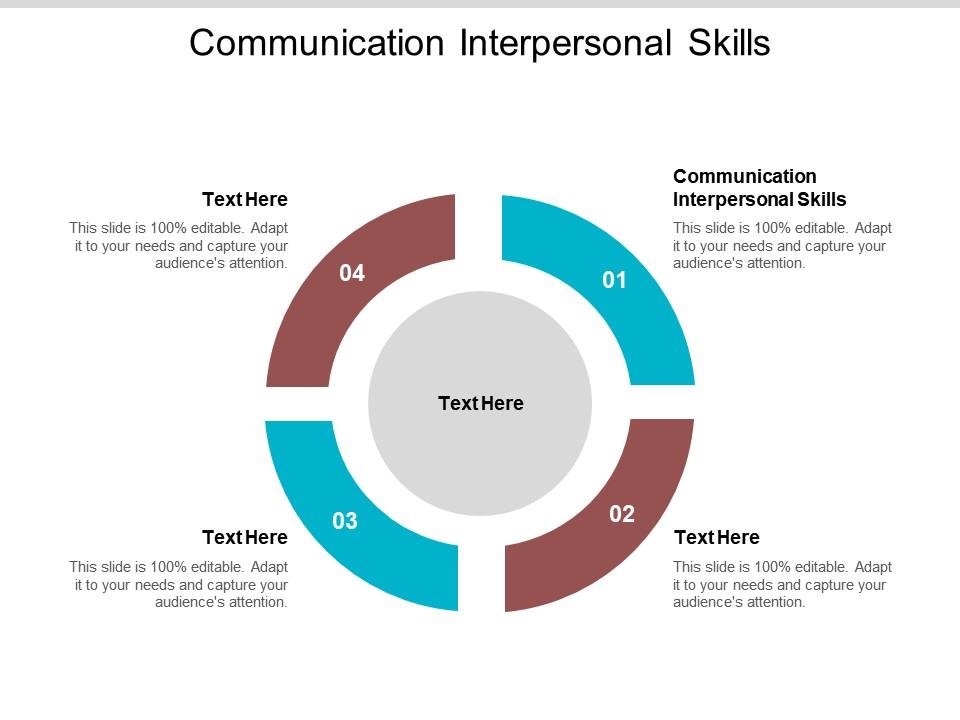
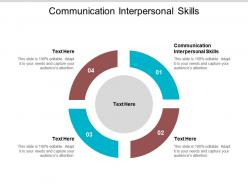
Communication interpersonal skills ppt powerpoint presentation infographic template inspiration cpb
Try Before you Buy Download Free Sample Product
Audience
Editable
of Time
Our Communication Interpersonal Skills Ppt Powerpoint Presentation Infographic Template Inspiration Cpb help you build up your data bank. They keep generating fresh discoveries.
People who downloaded this PowerPoint presentation also viewed the following :
Communication interpersonal skills ppt powerpoint presentation infographic template inspiration cpb with all 5 slides:
Display a level head with our Communication Interpersonal Skills Ppt Powerpoint Presentation Infographic Template Inspiration Cpb. Come up with balanced assessments.
FAQs for Communication interpersonal skills ppt powerpoint presentation infographic
Key components of effective interpersonal communication skills include active listening, clear verbal expression, nonverbal awareness, empathy, and emotional intelligence. These skills enhance workplace collaboration by building trust, reducing misunderstandings, and fostering stronger team dynamics, with many organizations finding that employees with strong interpersonal abilities deliver better client relationships and drive operational efficiency.
Active listening enhances interpersonal communication by building trust, reducing misunderstandings, and fostering deeper workplace relationships through focused attention, empathetic responses, and clarifying questions. These skills enable professionals to capture critical project details, resolve conflicts more effectively, and strengthen team collaboration, with many organizations finding that employees with strong active listening deliver superior customer service and drive better business outcomes.
Body language comprises 55% of interpersonal communication through facial expressions, posture, gestures, eye contact, and spatial positioning, significantly influencing message reception and relationship building. Optimizing body language involves maintaining open postures, appropriate eye contact, and mirroring techniques, with many professionals finding that strategic nonverbal alignment enhances trust, credibility, and communication effectiveness across diverse business interactions.
Cultural differences significantly impact interpersonal communication through varying nonverbal cues, directness levels, hierarchical expectations, and relationship-building approaches. These variations present both challenges and opportunities, with many organizations finding that culturally aware teams enhance collaboration, reduce misunderstandings, and deliver superior customer experiences, ultimately enabling competitive advantage in increasingly global business environments.
Effective conflict resolution strategies include active listening, empathy development, clear boundary setting, collaborative problem-solving, and emotional regulation techniques. These approaches streamline workplace disputes by fostering mutual understanding, reducing escalation patterns, and creating structured dialogue frameworks, with many organizations finding that enhanced interpersonal communication ultimately delivers stronger team cohesion and improved operational efficiency.
Empathy develops through active listening, perspective-taking, emotional awareness, and genuine curiosity about others' experiences and viewpoints. In professional settings like healthcare consultations, team meetings, and customer service interactions, expressing empathy involves reflective responses, validating emotions, and asking thoughtful questions, ultimately building stronger relationships and enhancing collaborative outcomes.
Leaders can foster better interpersonal communication through active listening training, regular team-building exercises, open-door policies, structured feedback sessions, and cross-functional collaboration opportunities. These approaches enhance workplace dynamics by encouraging transparent dialogue, building trust, and minimizing misunderstandings, with many organizations finding that improved communication ultimately delivers higher productivity, stronger team cohesion, and better employee engagement across departments.
Emotional intelligence significantly enhances interpersonal communication by enabling individuals to recognize, understand, and manage both their own emotions and those of others during interactions. This self-awareness and empathy streamlines conflict resolution, builds stronger workplace relationships, and delivers more persuasive presentations, with many organizations finding that emotionally intelligent employees ultimately create better customer experiences and team collaboration.
Common barriers to effective interpersonal communication include emotional reactions, cultural differences, poor listening habits, assumptions and biases, and physical distractions. These obstacles can be overcome by practicing active listening, developing cultural awareness, managing emotions through pause-and-reflect techniques, and creating distraction-free environments, with many organizations finding that structured communication training ultimately enhances team collaboration and workplace productivity.
Constructive feedback enhances interpersonal communication by focusing on specific behaviors, using "I" statements, timing delivery appropriately, and emphasizing improvement opportunities rather than personal shortcomings. This approach creates psychological safety, encourages open dialogue, and strengthens professional relationships, with many organizations finding that structured feedback processes ultimately improve team collaboration, reduce workplace conflicts, and enhance overall productivity.
Non-verbal cues account for approximately 55% of interpersonal communication, including body language, facial expressions, tone of voice, eye contact, and personal space management. These signals enable professionals to gauge engagement levels, detect resistance or agreement, and build stronger rapport in meetings, negotiations, and team interactions, ultimately enhancing workplace relationships and communication effectiveness.
Interpersonal communication skills influence relationship-building by fostering trust, clarity, and mutual understanding through active listening, empathy, and effective expression of ideas. In professional contexts, these skills enable stronger team collaboration, enhanced client relationships, and improved leadership effectiveness, while personal relationships benefit from deeper emotional connections, reduced conflicts, and more meaningful interactions, ultimately delivering sustained relationship satisfaction and success.
Practical exercises to enhance interpersonal communication skills include active listening practice, role-playing scenarios, feedback sessions, empathy-building activities, and conflict resolution simulations. These approaches strengthen workplace collaboration by developing emotional intelligence, improving team dynamics, and enhancing client relationships, with many organizations finding that structured communication training ultimately delivers better project outcomes and increased employee engagement.
Technology impacts interpersonal communication through enhanced connectivity, real-time collaboration tools, and broader networking opportunities, while also creating challenges like reduced face-to-face interaction and digital communication barriers. Organizations increasingly find that strategic technology integration enables remote team collaboration and global client relationships, yet requires deliberate investment in maintaining personal connection skills, ultimately delivering competitive advantage when balanced effectively.
Adapting communication styles to different audiences enhances collaboration, reduces misunderstandings, and builds stronger workplace relationships across cultural, generational, and professional backgrounds. This strategic approach enables organizations to leverage diverse perspectives more effectively, improve team productivity, and create inclusive environments where employees feel valued, ultimately delivering better business outcomes and competitive advantage.
No Reviews