

Communication plan goals and kpis powerpoint show




Try Before you Buy Download Free Sample Product
 Impress Your
 Audience
 100%
100% Editable
 Save Hours
 of Time


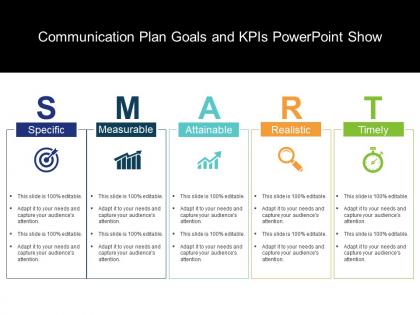
Are you worried about ways to present KPI to your team as its time consuming and a tedious process? If yes, then don’t worry, use our one of the most innovative communication plan goals and KPI’s PowerPoint show design template to do it without any hassle. PPT design is perfect to visualize communication plan to evaluate the performance of an organization against its strategic objectives. This design template for key performance indicators helps to reduce the complexity associated with performance tracking. You can track department wise or individual’s operational performance against predetermined business goals by using this PPT design. It can also be useful for selecting key performance indicators and metrics for your business. You can analyze the advantages and disadvantages of KPI and strategic communication planning accordingly. Visualize the concept of SMART business goals with this design. Now, don’t delay, download this communication plan goals and KPI’s PowerPoint and use in your future presentations. Experience goodwill with our Communication Plan Goals And Kpis Powerpoint Show. Everyone will express friendship.
People who downloaded this PowerPoint presentation also viewed the following :
Content of this Powerpoint Presentation
Description:
The image depicts a PowerPoint slide titled "Communication Plan Goals and KPIs PowerPoint Show," presenting the SMART criteria (Specific, Measurable, Attainable, Realistic, Timely) laid out across five columns. Each column features a letter from the acronym SMART along with a corresponding icon to visually represent the criterion targets for Specific, a bar graph for Measurable, a mountain for Attainable, a magnifying glass for Realistic, and a stopwatch for Timely.
Use Cases:
These slides can be applied across various industries for setting and reviewing strategic objectives within communication plans or any other goal-oriented projects.
1. Marketing:
Use: To establish and discuss marketing campaign objectives.
Presenter: Marketing Manager.
Audience: Marketing Team.
2. Sales:
Use: To set clear and quantifiable sales targets.
Presenter: Sales Director.
Audience: Sales Representatives.
3. Human Resources:
Use: For outlining recruitment and retention strategies.
Presenter: HR Coordinator.
Audience: HR Staff and Management.
4. Information Technology:
Use: To define project guidelines for IT systems implementation.
Presenter: IT Project Manager.
Audience: IT Team and Stakeholders.
5. Education:
Use: To set and track educational objectives and outcomes.
Presenter: Academic Dean.
Audience: Faculty Members.
6. Healthcare:
Use: For setting patient care standards and performance metrics.
Presenter: Healthcare Administrator.
Audience: Medical Staff and Department Heads.
7. Non-Profit Organizations:
Use: To guide the development of initiatives and measure impact.
Presenter: Program Director.
Audience: Volunteers and Board Members.
Communication plan goals and kpis powerpoint show with all 5 slides:
Control instability with our Communication Plan Goals And Kpis Powerpoint Show. Handle frequent changes in a calm fashion.
FAQs for Communication plan goals and
So basically you want to inform people, get them to act, and keep them engaged - pretty simple stuff. Think of it like having a GPS for all your messaging so you don't go off track. Map each communication goal back to what your business actually needs (more sales, better brand recognition, whatever). Honestly, I've seen too many companies skip this step and wonder why their campaigns flop. Start with the end goal and work backwards. What does winning look like for your company? Then figure out what communication moves will get you there. Set some KPIs you can actually measure - makes everything way clearer.
Honestly, you gotta figure out what success looks like before you even start. Pick specific numbers you can actually measure - website visits, email opens, how many people show up to events, that kind of stuff. But here's the thing: don't just chase pretty numbers that mean nothing. Like, if you want better employee engagement, track who's actually participating in feedback sessions instead of just counting email clicks. I always start backwards - what would winning actually look like? Then I find the metrics that'll prove it happened. Way easier than guessing later.
For communication KPIs, I'd focus on engagement stuff first - open rates, clicks, social shares. Then look at comprehension through surveys and feedback scores. Behavioral changes are gold though, since they prove people actually did something with your message. Reach matters too, and sentiment analysis is useful but honestly kind of a pain to measure right. Oh, and don't go crazy tracking every metric possible. Pick maybe 3-4 that actually connect to what you're trying to achieve. Start with engagement and comprehension, then add the behavioral stuff once you've got some baseline data to work with.
So audience segmentation basically flips your whole strategy upside down. Different groups want totally different things, you know? Like if you're talking to both executives and regular employees - execs care about quarterly reports and strategic stuff, while frontline workers need safety updates and training info. Your goals change from boring "increase awareness" to specific targets like "get 40% of executives engaging with strategic updates" or "75% attendance at safety meetings." The metrics follow whatever matters to each group. It's honestly like learning different languages for different people. Map out what success looks like for each segment first, then build your KPIs around that.
Honestly, feedback is like your BS detector for whether your communication strategy is actually doing anything. The data shows you if people care about your messages or if they're just ignoring you completely. When your numbers suck or people tell you straight up that something's confusing, time to switch gears. I've definitely gotten caught up tracking stuff that looked impressive but meant nothing - whoops. You want those feedback loops happening regularly so you're not stuck wondering why nothing worked for like six months. Monthly check-ins are clutch for staying on track.
Honestly, the data side of comms is a game-changer once you get into it. You can track engagement, reach, and conversions across everything in real-time instead of just guessing what's working. I'd start with Google Analytics - connect it to your social and email stuff. The dashboards will show you which messages actually hit and which ones... don't. It's wild seeing the numbers sometimes. Just don't get sucked into tracking everything though. Pick maybe 3-4 metrics that actually matter to what you're trying to do, not the vanity stuff that looks impressive but doesn't mean much.
Ugh, the worst thing people do is obsess over follower counts instead of tracking what actually moves the needle for business. Pick maybe 3-5 metrics tops - I've watched entire teams lose their minds trying to measure literally everything. Also don't compare yourself to that one insanely successful campaign from last year because you'll just feel terrible lol. Your KPIs need to match what you're actually trying to accomplish, not just whatever's easiest to track. Honestly? Start with "what would make this a win" then figure out how to measure that.
Set up monthly check-ins right from the start - quarterly if it's a longer project. Watch your metrics like a hawk and be ready to change course when the numbers aren't adding up. Stakeholders love switching priorities at random (ugh), so keep those feedback channels wide open. Dashboards are your friend here - set alerts for when things start tanking. Honestly? Don't fall in love with your original plan if it's not working anymore. The bigger picture matters more. Oh, and schedule that review meeting for next week so you can figure out what backup options you need built in.
Track sentiment from surveys and see how people actually feel about your messaging. Customer satisfaction scores are good. So is social media sentiment - that stuff tells you if your message is landing or falling flat. Honestly, media tone analysis helps too, but some reporters will nitpick no matter what you do. The real win is setting up pulse surveys to see if people actually "get it" and want to take action. Don't just count reach and impressions - those numbers don't tell you if anyone cares. Focus on whether your messaging drives the behavior changes you're after.
Look, stakeholder engagement totally changes your communication goals because everyone wants different stuff. Get them involved early and you'll figure out what they actually care about - not what you assume they do. Some people want constant updates, others just need the highlights when they're swamped with meetings. This shapes whether you're trying to raise awareness, change behaviors, or just share info. The trick is connecting what stakeholders need to real, measurable results. Otherwise you're just going through the motions instead of making an actual impact (which honestly happens way too often).
Social media metrics totally feed into your communication KPIs, just gotta know which ones matter. Engagement rates and reach show if you're hitting awareness goals. Click-throughs and conversions tell you if people are actually taking action. I used to get way too hung up on follower counts - honestly such a waste of time. The good stuff is sentiment analysis and brand mentions for reputation tracking. Oh, and don't forget how social drives traffic to your other channels. Just map your social numbers to actual communication goals instead of tracking random metrics because they're there.
Honestly, start by figuring out where your people actually hang out and how they like getting info. Complex stuff? Email or docs work better. Quick updates are perfect for Slack or Teams though. I used to obsess over all the engagement metrics, but response rates tell you everything - are people actually doing what you asked? That's what matters. Timeline's huge too since some channels are way more work to maintain. My advice? Pick 2-3 max and test what gets results. You can always add more later once you see what clicks.
Check your communication KPIs monthly at least - though honestly, every 2-3 weeks works better if things are moving fast. Crisis mode? Product launch? Then you'll want to review more often since your metrics need to adapt to what's actually going down. I always set calendar reminders because this stuff gets forgotten when you're swamped. Monthly gives you enough data to spot real trends without obsessing over every tiny blip. Just don't chase every fluctuation or you'll drive yourself crazy.
Tell the story behind your numbers instead of just dumping data on people. Honestly, executives get glazed eyes when you show them spreadsheets - dashboards are so much cleaner. Start with what the metrics actually mean for business, then show the proof. Your boss wants the big picture stuff while your team needs all the nitty-gritty details, so adjust accordingly. Don't forget to explain WHY the numbers moved - was it seasonal? New campaign? Always wrap up with what you're gonna do next, otherwise people just sit there wondering "okay... so what now?"
Look at your engagement data from the past 6 months - that's your starting point. Trust scores tanking in pulse surveys? Make "boost leadership transparency by 15%" your target. Nobody showing up to town halls? Figure out better timing and promotion to get butts in seats. Honestly, the metrics do the heavy lifting here by showing you exactly where things are broken instead of making you guess what people actually want. Pick your biggest problem areas first and build specific goals around those. Way more effective than throwing solutions at random issues and hoping something sticks.
-
Graphics are very appealing to eyes.
-
Innovative and attractive designs.