

Community engagement powerpoint presentation slides




Try Before you Buy Download Free Sample Product
 Impress Your
 Audience
 100%
100% Editable
 Save Hours
 of Time


Employ these Community Engagement PowerPoint Presentation Slides to increase the loyalty of your clients towards your organization. Take advantage of these community relationship PPT templates to showcase steps for engaging communities like informing, consulting, involving, collaborating and empowering. Take the assistance of these community interaction PowerPoint visuals to portray various advantages of engagement such as employee interaction, advocating social changes, etc. Expound the engagement process which includes setting the stage, gathering facts, brainstorming, implementing and evaluating facts with this community relationship PPT slideshow. Reveal the outcomes of social engagement including seeking aspirations of communities, incorporating aspirations into decision-making processes. Unveil the methods of community engagement like the relational model, the continuum of participation, etc. using these community interaction PowerPoint deck. Illustrate the architecture of virtual community engagement like cost, size of CoP, support, and activities using these social engagement PowerPoint layouts. Download these social relationships PPT infographics and ensure coordination between your origination and society.
People who downloaded this PowerPoint presentation also viewed the following :
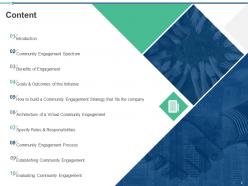
Content of this Powerpoint Presentation
Community engagement is the gathering of people to address concerns, solve problems, and encourage positive change. Simply put, it means listening to the community’s needs and then working together to create plans that will improve things for everyone.
With this in mind, we have designed a community engagement PowerPoint presentation. Use these Community Engagement PowerPoint Presentation Slides to demonstrate ways to involve, inform, consult, collaborate, and empower the communities. By working together, you can address the community challenges and create a better future. This collaboration will then help reinforce trust and understanding between the participants.
Our community engagement PowerPoint Presentation will help foster positive change by harnessing the collective energy of its members. With this PPT presentation, you can address social issues and build a stronger community.
In essence, these community participation slides serve as a guide to a robust process. Look below to check out the most amazing slides of this PowerPoint Presentation.
Template 1: Community Engagement Spectrum

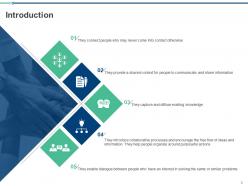
This PPT Slide represents different levels of community involvement in projects and decision-making. The framework highlights the importance of tailoring engagement strategies to specific situations. Instead of a one-size-fits-all approach, you can choose from methods that range from simply informing the public to fully empowering them. This presentation slide will help illustrate these stages: informing, consulting, involving, collaborating, and empowering. Understanding the community engagement spectrum and its various levels ensures the chosen strategy aligns with the initiative's goals and fosters inclusive decision-making, empowered groups, and collaborative action.
Template 2: Benefits of Engagement
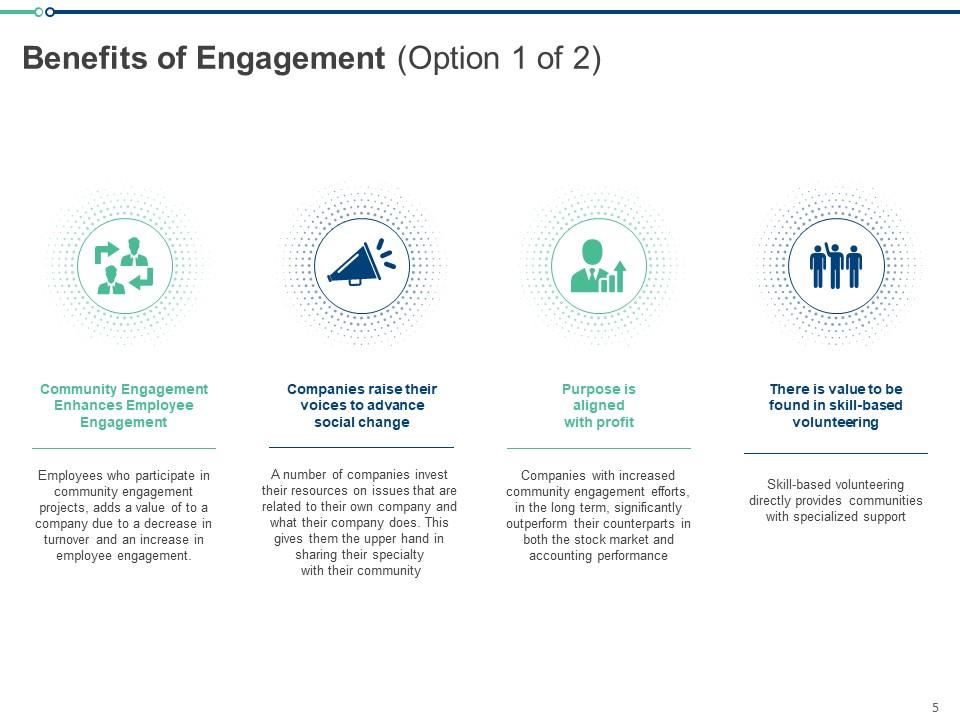
This PPT Slide shows how engagement between the communities can be beneficial. It begins by highlighting the positive outcomes of fostering community engagement. With this PPT Design, you can grab your audience's attention and convince them to invest their time and resources into community management efforts. You can improve decision-making, increase trust and transparency, enhance problem-solving capability, and empower and build capacity.
Template 3: Benefits of Engagement

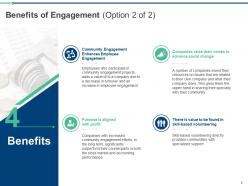
This PPT Layout is an add-on to the previous discussion. In this presentation design, you can list the four significant benefits of engagement that can be discussed in detail. There is a design variation compared to the previous PPT Slide. Thus, you can choose between the two readymade PPT Layouts to discuss benefits with your stakeholders.
Learn more about social media community engagement PPT. Click here to learn more.
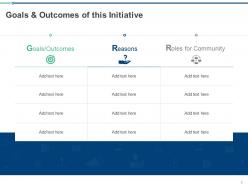
Template 4: Goals and Outcomes of the Initiative
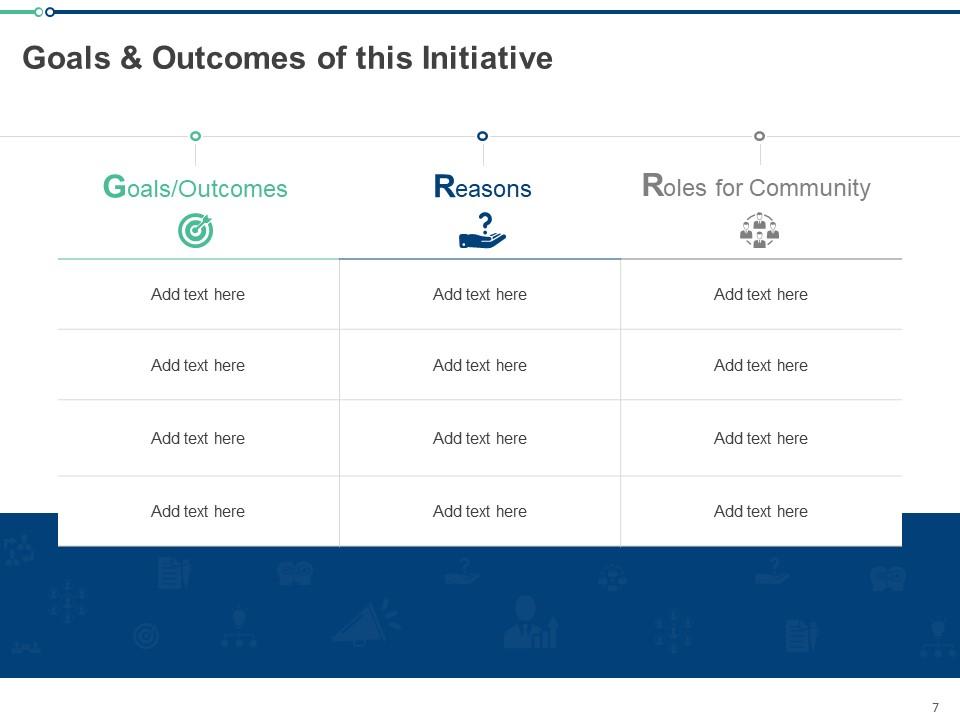
This presentation design sets the stage by clearly outlining the specific goals and desired outcomes of the initiatives taken for community engagement. Organizations can assess the success of their community engagement programs with this PPT Slide. They can adjust to fulfill their needs and ambitions if the results need to be better. This PPT Layout will make your mind clear about the goals you want to achieve and carry out brief information about the outcomes of all the initiatives that need to be fulfilled. Using this PPT Design guides the way towards your goals and helps you focus entirely on achieving them for better and more significant growth.
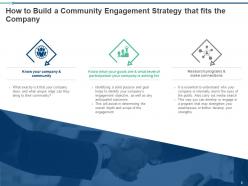
Template 5: How to Build a Community Engagement Strategy That Fits the Company

A customized community involvement plan must be developed to guarantee alignment with the organization's beliefs, goals, and resources. This PPT Preset will help you create a section to add information about your community and company to learn more about them. Also, you will get a section where you can add about the goals and participation of the company. In the third section, you can add about the research programs and connections. It is the most critical part of community engagement as it helps in understanding your company's position and setting future goals.
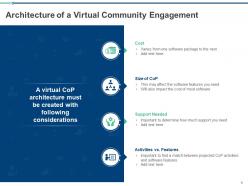
Template 6: Architecture of Virtual Community Engagement
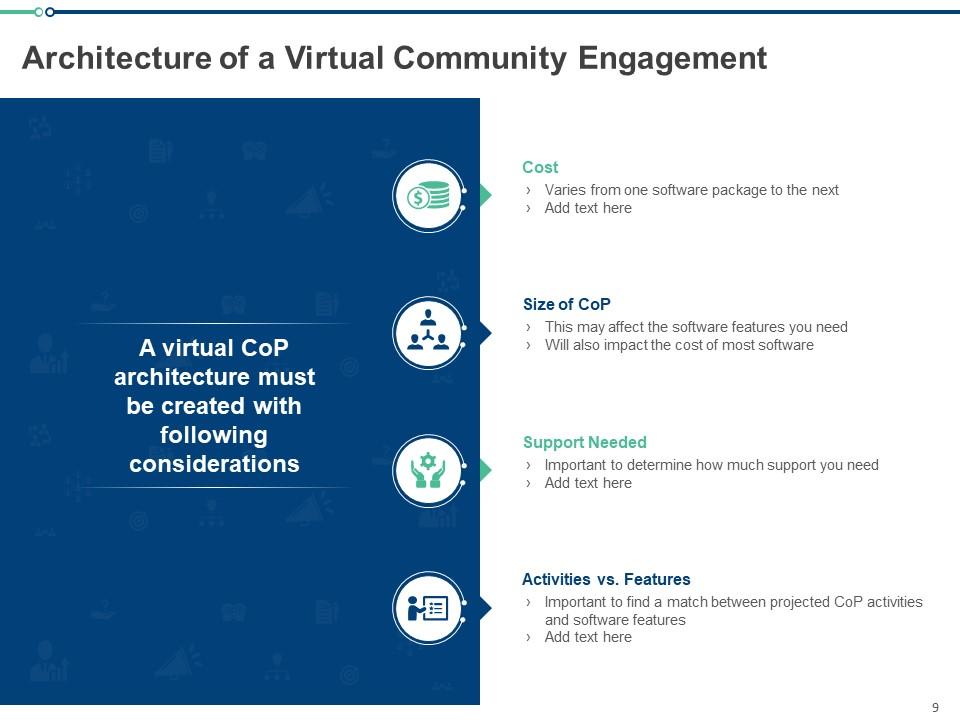
The architecture of Virtual Community Engagement creates a structure that enables meaningful communication, teamwork, and involvement in an online community. In this PPT Slide, you can add the cost, size of the CoP, whether any support is needed, and activities, along with their features. All in all, this presentation slide depicts a complete cycle that explains the structure of virtual community engagement.
Template 7: Specify Roles & Responsibilities
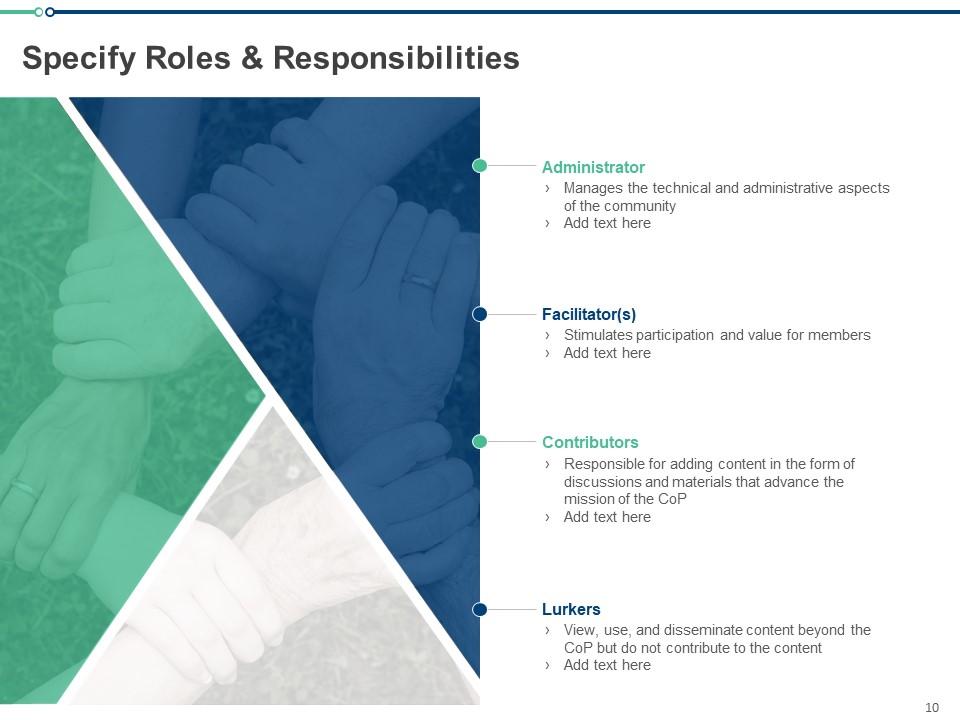
In a community, it is necessary to understand the specific roles and responsibilities of the members. It makes the process smooth and moderated. Each role and responsibility is designated to the administrator, facilitator, contributors, and lurkers. Every stage has a different job to do, which helps create a positive and valuable experience for members. To make it concise, you can mention every role with the designated person in this PPT Slide.
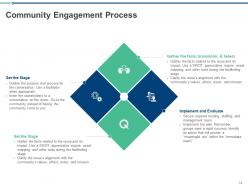
Template 8: Community Engagement Process
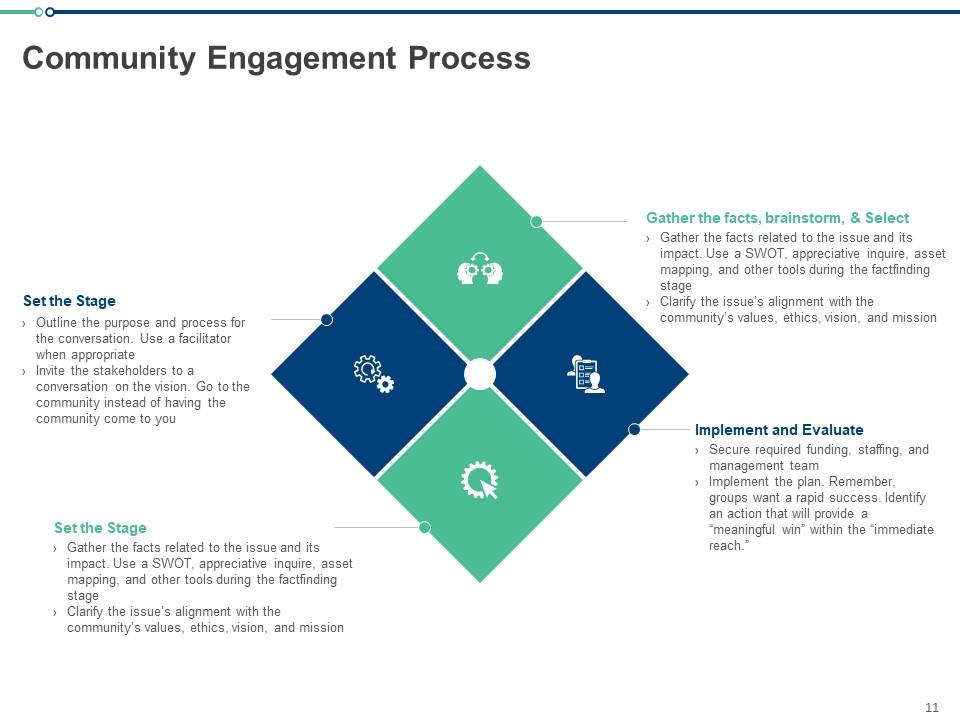
The community engagement process PPT Slide outlines the clear and sequential steps involved in engaging the community. By summarizing the process, you can demonstrate transparency to the community. You can see the steps involved and understand how your input will be gathered and considered. In this PPT Layout, you can find four sections to add to your required process. The steps included in this presentation slide of the community engagement process are - setting up the perfect stage, understanding stakeholder needs, proper analysis and synthesis, implementation, and final evaluation. This PPT Design will help organizations empower communities to address problems, make decisions, and effect good change by fostering meaningful involvement and developing trust.
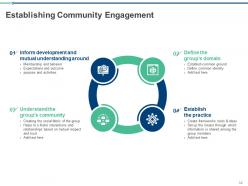
Template 9: Establishing Community Engagement
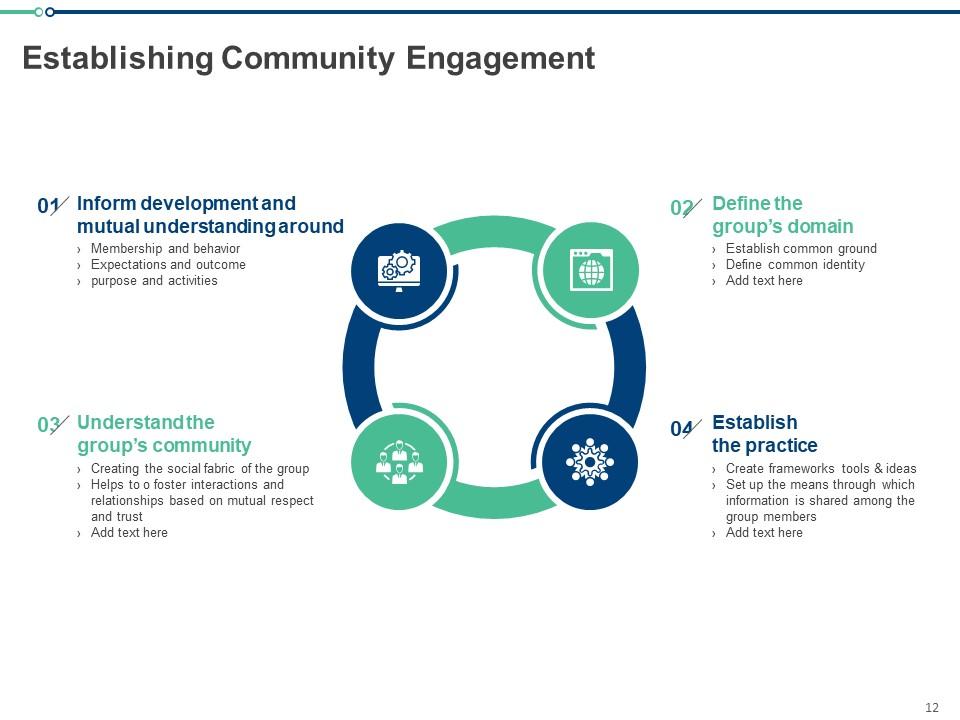
Like the previous PPT Layout, this also explains a similar four-way process. With this PPT Theme, you can quickly inform the development and mutual understanding around membership, behavior, expectations, and outcomes. Also, you can define the group's domain, understand the group's community, and thus establish the final practice. It allows you to create tools and ideas and helps set up the means to share information among the group members.
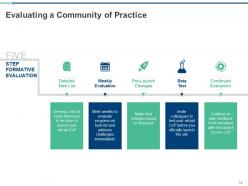
Template 10: Evaluating a Community of Practice
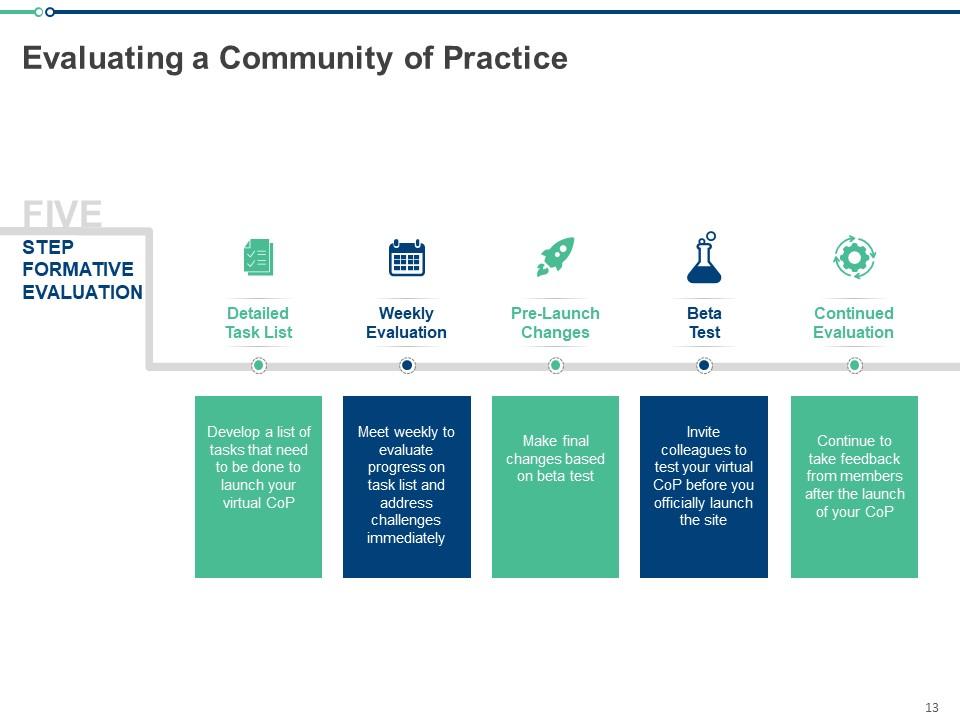
When evaluating a community of practice in community engagement, the focus is on assessing how effectively the practice facilitates collaboration. This PowerPoint Theme will help you evaluate a community of practice. It consists of 5 essential steps to be followed in a specific order. You can easily make a detailed task list, have weekly evaluations, efficiently focus on the pre-launch changes, work on beta testing, and thus focus on the continued assessment for better results.
Conclusion
Community engagement is more than just a procedure. It is a dedication to cooperation and inclusivity. We can use our community engagement PowerPoint presentation to address all your stakeholders. This PowerPoint presentation has equipped you with the tools and knowledge to embark on a successful community engagement journey. Remember, community engagement is an ongoing process, not a one-time event. By fostering open communication, collaboration, and inclusivity, you can tap into your community's collective wisdom and energy to achieve positive change.
Community engagement powerpoint presentation slides with all 24 slides:
Our Community Engagement Powerpoint Presentation Slides ensure excellent facilities. They have an array of attributes.





FAQs for Community engagement
Honestly, it's mostly about trust-building and turning random people into actual supporters. You'll get feedback you'd never hear otherwise - people are surprisingly honest about what you're screwing up. Community engagement also saves your butt during crises since you already have those relationships built up. The advocacy part is huge too. When you do it right, these folks become your biggest cheerleaders without you even asking. They'll defend your work before you know there's an attack coming. My advice? Listen way more than you talk next time you're with your community. Sounds obvious but most orgs still blow this.
Track the obvious stuff first - participation rates, volunteer hours, money raised, social media numbers. But don't sleep on the personal stories and feedback from people you're actually helping. Survey them about real impact. Did your literacy thing boost reading scores? Are people getting jobs after your training programs? I learned this the hard way - set clear goals before you start, not months later when you're scrambling to prove it worked. Also measure from day one. The qualitative stuff honestly matters as much as the spreadsheet data.
Honestly, tech just makes it way easier to reach people who can't make those boring town halls. Social media and apps help you connect with busy parents, younger folks, people who can't get around easily - you know, the ones who actually skip regular meetings. Quick online surveys work great for gathering opinions fast. Plus livestreaming lets people join from home (sometimes you get better turnout that way, weirdly). Don't ditch in-person stuff completely though - mix both approaches. Figure out where your neighbors are already hanging out online and just show up there.
Figure out exactly who you're trying to reach first - their problems, where they spend time online, what they actually care about. Don't wait for them to find you. Jump into their Facebook groups and Reddit threads, but lurk for a bit to get the vibe before posting anything. Nobody likes the person who immediately starts pitching stuff. Ask your current supporters what other communities they're in - that's honestly been super helpful for me. Show up regularly with something useful to offer. The whole "only reaching out when you need something" approach? Yeah, that never works.
Honestly, just be consistent first - coffee chats, events, whatever works for your schedule. But here's the thing: listen way more than you talk. People can smell fake from a mile away. When you ask for feedback, actually use it (or explain why you can't). Oh, and don't make everything about you - help community members connect with each other too. That's where the real magic happens. Start with your most active people and go deeper there. Response time matters more than you'd think. Follow through on what you promise. Pretty basic stuff but most people mess it up.
Look, you gotta actually listen to what communities want instead of just guessing. Survey people, hit up local nonprofits, go to those boring town meetings - whatever it takes to figure out their real problems. Then match your CSR stuff to those needs. Job training, cleaning up parks, helping small businesses - you know, things that matter to them. Don't just throw money at random charity events and call it a day. That's honestly pretty lazy. Build actual relationships first. Keep talking to people throughout your programs too. And measure success by asking the community if you're helping, not just tallying up your spending. It's way more work but actually makes a difference.
Oh man, Patagonia's "Don't Buy This Jacket" thing was genius - totally backwards but it worked. Community gardens are surprisingly effective too, way more than you'd think. Ben & Jerry's activism stuff always feels real, not like some marketing BS. Honestly, the best campaigns just feel natural to whoever's doing them. Local cleanup days might sound boring but people actually show up. Start with what your community gives a damn about first, then figure out the campaign part. That order matters way more than having some flashy concept.
Look, community feedback is honestly like having a cheat sheet for what actually works. You get real intel on what people love, what bugs them, and why they stick around or bail. Instead of playing guessing games, you can design stuff they genuinely want. Here's the thing though - people get way more invested when they see you actually use their ideas. It's like they're helping build the whole thing with you. But here's what matters most: you gotta close that loop. Tell them how their feedback changed things, otherwise it's just empty surveys that annoy everyone.
Honestly, most companies just dive headfirst into posting random stuff without actually knowing their community. Like, you'll see them hosting events that completely flop because they never bothered learning what people want. Building genuine relationships is slow as hell too - way slower than bosses expect. I've seen execs get frustrated when engagement doesn't happen overnight, which is pretty unrealistic. The tricky part is staying authentic while repping a brand. Communities can spot fake corporate vibes instantly. My advice? Lurk for a few months first. Just listen and participate naturally before trying to take charge of conversations.
You gotta be super clear about what you want and why they should care. Ditch the corporate speak - nobody has time for that garbage. Go where people actually hang out: town halls, Facebook groups, local papers. Too many organizations just fire off boring press releases then act shocked when nobody responds. Show them your timeline and budget stuff upfront. Here's the thing - frame everything around what's in it for the community, not your org. Oh, and start simple. Make a one-page explainer that you'd actually want to read yourself. Think "what would I tell my neighbor over the fence" level of normal conversation.
Dude, cultural competence can totally make or break your whole project. I've watched so many teams crash and burn because they just assumed everyone communicates the same way - spoiler alert, they don't. You gotta learn about their values, how they prefer to meet, even timing matters way more than you'd think. Different communities have completely different styles. My advice? Do some research first, but honestly the best thing is just asking local leaders straight up what actually works in their area. They'll tell you if your fancy presentation format is gonna flop before you embarrass yourself.
Honestly, grassroots groups are where it's at for real community work. They've already built trust with locals and actually know what people need - way better than us guessing from our desks anyway. When you partner with them, you're tapping into networks that would take you years to build. They're also amazing at getting people to actually show up and do stuff. My advice? Find groups already doing good work in your area and figure out how to support what they're doing. Don't try reinventing the wheel. These folks can connect you with people you'd never reach otherwise, and honestly, they're usually more passionate about the cause than anyone you could hire.
Do your homework first - check out what they're actually working on lately before you hit them up. Nobody wants to feel like a walking ATM, so lead with what you can offer them, not what you need. Start small instead of going straight for your dream project. Maybe show up to a city council meeting or two? Sounds boring but it shows you actually care about local stuff. Oh and this is huge - if you say you'll do something, DO IT. These people remember everything, especially who flakes out on them versus who comes through.
So here's the thing - community engagement actually brings different voices into your decision-making, which is huge. Instead of just posting job ads and hoping, you're building real relationships with diverse groups. Host events, partner with organizations that matter to you. Honestly, it beats the whole "we value diversity" lip service most companies do. You get fresh perspectives on products, culture, all that stuff your current team might miss. Oh, and start by figuring out which communities actually align with what you stand for - then see how you can help them first before asking for anything.
Honestly, just go where they're already hanging out - gaming tournaments, social media challenges, those random pop-up events. Let them make TikToks about stuff they actually care about in the community. The biggest thing though? Ask what THEY want to work on instead of guessing. I've seen peer mentoring work really well too, like having older teens run things and get their friends involved. Oh and definitely start with just one small pilot program. Let them help design it from the start - they'll have way better ideas than you think.
No Reviews